
Gm frens, welcome to this week’s crypto news round-up!
Wallets move 100 BTC after 16 years, XRP Ledger lending system nears approval, and Finnish homes use Bitcoin mining for heat. Tether pitches a gold token as an ETF rival, Meta reportedly tests a prediction app, and whales may halt Ethereum’s slide. Finally, Zypto puts your crypto on Apple Pay.
Let’s get into it.
Dormant wallets move 100 BTC after 16 years
On November 13, two Bitcoin addresses that had sat dormant for more than 16 years moved about 100 BTC. The crypto assets were worth approximately $6.89 million, according to on-chain data.
The first address sent nearly 50 BTC to one address and 0.01 BTC to another at 4:08 a.m. UTC. Just over two minutes later, the second address sent nearly 49 BTC to one address and 1 BTC to another. Both sets of coins came from block rewards mined in September 2010. Whale Alert first reported the moves, estimating that each 50 BTC reward was worth about $3 when received in 2010.
By 4:48 a.m. UTC, about 20 BTC from the first transfer and 39 BTC from the second had been consolidated at a new address starting “bc1qj5.” Some 30 BTC sits at another new address starting “bc1qqs,” 10 BTC at “bc1qds,” and 1 BTC at “bc1qce” at the time of writing.
The reason for the transfers, the identity of the wallets’ owners, and whether the two original outputs had the same owner remain unknown. With Bitcoin currently trading for over $68,000, the value of the Bitcoin the addresses transferred has risen more than 1.15 million times since 2010.
Mempool.space labels both 50 BTC inputs as pay-to-public-key, or P2PK. The four addresses that received the coins on Friday all start with bc1q, a prefix used by newer native SegWit (P2WPKH) addresses. Older Bitcoin addresses include pay-to-public-key-hash (P2PKH) addresses starting with 1 and pay-to-script-hash (P2SH) addresses starting with 3. The latest Taproot (P2TR) address format starts with bc1p.
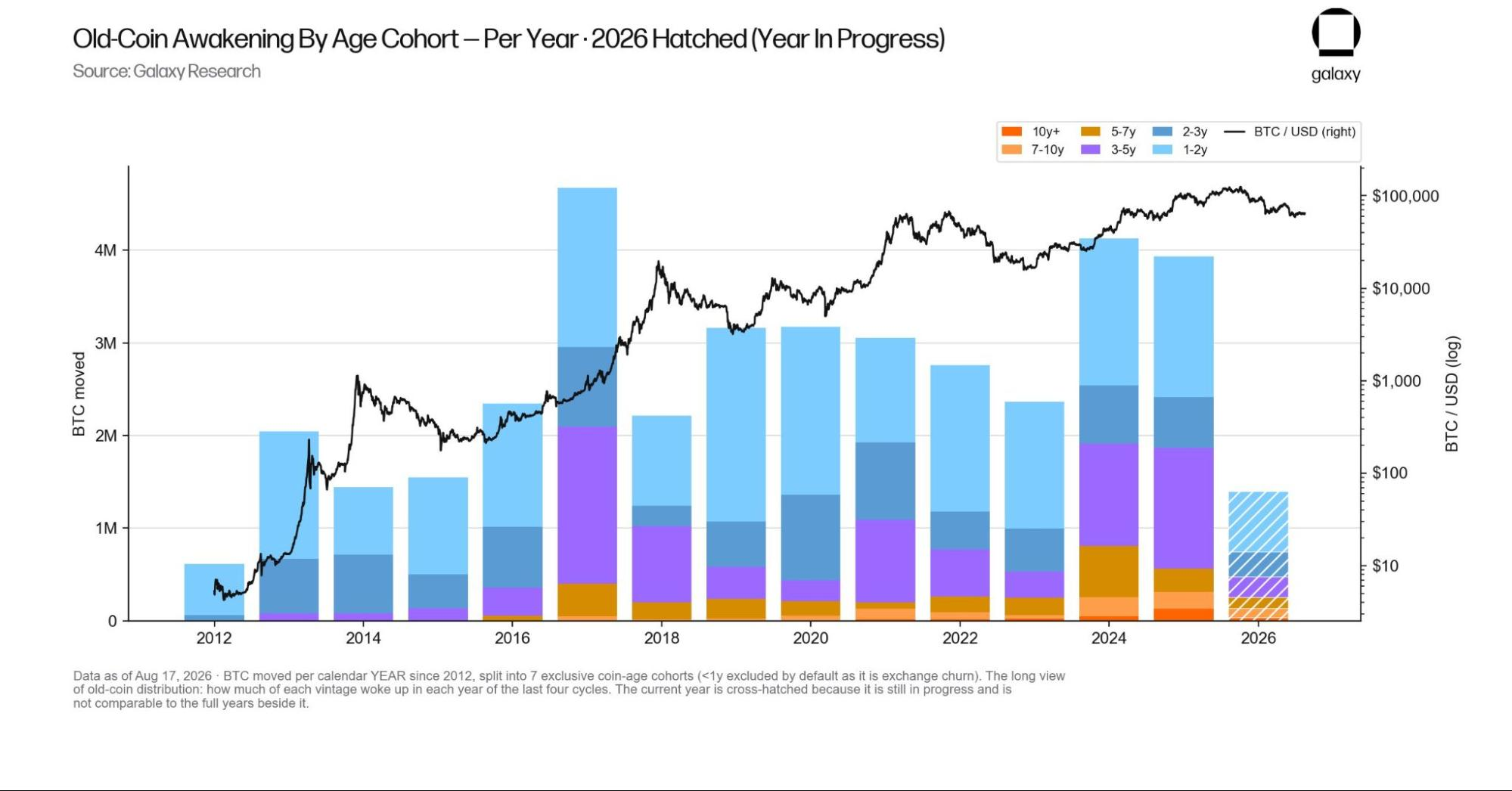
The transfers are part of a broader trend of ancient Bitcoin wallets waking up in 2026. According to Galaxy Research data, Bitcoin that had remained untouched for at least a decade was moving at a pace rarely seen in previous years. In one 10-day stretch alone, six wallets dating back to 2011, 2012, and 2014 transferred a combined 553.59 BTC, worth over $40 million at the time.
XRP Ledger lending system nears approval
The XRP Ledger’s proposed lending system is gaining validator support. For context, the Lending Protocol is an XRP Ledger DeFi primitive that enables on-chain, fixed-term uncollateralized loans using pooled funds from a Single Asset Vault.
An amendment goes live only after more than 80% of trusted validators support it for 14 days in a row. With 35 trusted validators, that means at least 29 votes. If support falls below 80% during those 14 days, the countdown stops and starts over once the threshold is reached again.
As per the amendment voting record on XRPL, three lending-related amendments are being voted on. SingleAssetVault has garnered 23 votes, LendingProtocol has 22 votes, while LendingProtocolV1_1 has 22 votes. They still need 6, 7, and 7 votes, respectively. None of the three has reached the 80% mark, so the 14-day countdown hasn’t started for any of them.
RippleX opened voting on LendingProtocolV1_1 in September. It adds closed-ended vaults, which run in three stages: subscription, investment, and redemption. It also changes how lending income is recorded, so vaults can count interest as income as soon as a borrower pays it.
On November 4, developers proposed further code changes. They include storing loan data directly in ledger entries and an optional sequence check when creating loans. These changes don’t affect the amendments now being voted on. Institutions are already lining up, while Clearpool has said it plans to build credit services on the system.
While validators deliberate, the network remains busy. On November 11, the XRP Ledger processed 3.9 million transactions.
Finland heats homes with Bitcoin mining
During the extremely cold winter months in Northern Europe, heating efficiency is a major topic of discussion. Harsh conditions have pushed heating specialists to develop modern, creative ways to replace traditional oil heating with cutting-edge technology.
That’s where the crypto industry comes into play. Finnish homes have already adopted liquid-cooled mining-machine heaters via SunBit’s Bitcoin Boiler. Mining revenue helps offset heating costs. On the other hand, that kind of solution is highly dependent on network mining difficulty and factors like general market conditions.
After the next halving in 2028, which cuts mining rewards in half, the system may need BTC above $131,000 to break even. With installation costs exceeding $20,000, SunBit’s Bitcoin Boiler aims to relieve high heating costs for residents of Finland. The machine is supposed to be profitable as long as Bitcoin’s price stays above $70,000, slightly above its current price.
For instance, in a historical house in Tampere, Finland’s third-largest city, mining rigs replaced wood burning, maintaining a 1,500-liter water tank between 50℃ and 60℃. SunBit’s liquid-cooled Bitcoin miner uses the Antminer S21 XP Hydro, delivering up to 495 TH/s. The device consumes 5.3 kilowatts of power and draws about 46,400 kWh annually.
The Bitcoin Boiler device stores this heat in water, reaching temperatures up to 60℃, which is then circulated throughout the house via radiators and underfloor heating pipes. It costs roughly $5,200 a year to run. SunBit founder Elmeri Suomi said the heating function itself is unaffected by market conditions; only the payback period changes.
Bitcoin-based heating systems have been tested in several countries like France and Canada, but Finland’s adoption has grown much further. The Bitcoin Boiler service fee is optional and includes 24/7 remote monitoring with automatic heating strategy optimization aligned with Finland’s floating electricity prices. This runs in a companion app with grid peak-shaving options for advanced enthusiasts.
Tether pitches gold token as ETF rival
Tether CEO Paolo Ardoino said Tether Gold (XAUT) is on track to compete in the gold-ETF market. He made the claim in an official announcement a day after Anchorage Digital added custody, trading, and collateral support for the token. The real test is how easily XAUT converts to cash at the size and price a holder needs.
Tether also said KPMG U.S. gave a clean audit opinion on the 2025 financial statements of XAUT’s issuer, TG Commodities S.A. de C.V. The audit covers only that entity and that year. It doesn’t cover Tether’s current reserves or today’s trading terms.
Eligible Anchorage clients can sell XAUT through its desk or borrow USD or USDT against it, with loans funded by other clients. Borrowing keeps the gold exposure but creates debt. Anchorage hasn’t named a settlement currency for sales or a timeline for fiat withdrawals. Access is mainly for institutions, and custodied tokens carry no Anchorage guarantee and no FDIC or SIPC protection.
U.S. persons generally can’t buy or redeem XAUT directly with the issuer. The exception is “eligible contract participants,” whom Tether Gold may accept at its discretion. Even then, buyers must be verified issuer customers, and Anchorage access alone doesn’t guarantee issuer approval.
Approved customers still have no guaranteed cash buyback. Redemption is in whole gold bars delivered in Switzerland. Tether Gold can instead try to sell the gold to a dealer, but cash (minus fees) arrives only if a buyer is found.
Gold ETFs work similarly. iShares Gold Trust (IAU) shares trade on NYSE Arca through brokers, so sale proceeds come from market buyers, not the trust. Its prospectus limits direct creation and redemption to authorized participants, who exchange gold for shares.
ETF holders can also borrow without selling. For example, Fidelity accepts ETFs held for at least 30 days as margin collateral, subject to approval. However, this doesn’t confirm that IAU specifically qualifies, or set a borrowing limit.
Meta reportedly tests prediction app ‘Takes’
Technology giant Meta is moving ahead with its planned prediction market app. Employees are reportedly testing it, betting on events with a points currency called “cred” instead of real money.
According to a Wall Street Journal report, Meta employees have started testing the app, which is still in development. Internal testing is a step Meta often takes before a public launch. In the app, called Takes, employees use cred to wager on events and questions. Correct predictions earn points, and wrong ones lose points.
Details of the app first emerged earlier this year. As previously reported in June, it was originally called Arena when development began. The current name, Takes, could still change before release.
The app could put Meta in competition with leading prediction market platforms such as Polymarket and Kalshi. However, it’s not yet clear whether Meta will allow real-money bets, as those platforms do, or stick with points-based cred.
A launch would come as prediction markets face growing pushback from U.S. state regulators. Regulators argue these platforms are illegal betting sites, with up to 11 states taking enforcement action against the industry.
Can whales halt Ethereum’s slide?
The past few weeks have been brutal for crypto, and Ethereum (ETH) has been hit hard, falling to its lowest price since July. Some analysts expect further losses, but recent whale buying and other signals suggest a rebound could be close.
Earlier this week, ETH, the largest altcoin, briefly dropped to about $1,700 before recovering to around $1,800. The main driver is the wider market downturn, fuelled by inflation concerns and turmoil around Nvidia. But a few factors have weighed on ETH in particular.
The Ethereum Foundation (EF) sold 7,500 ETH (roughly $14.5 million) in just four days. Then EF sold off another 2,500 ETH (about $4.7 million). The spot ETH ETFs recorded their seventh straight week of outflows, with almost $400 million withdrawn in the past seven days alone. But there’s good news too!
Analyst Ted Pillows noted that ETH held its $1,700 support level as whale buying picked up. He warned, however, that ETH isn’t out of the woods until it reclaims the $2,000 mark with “strong spot demand.”
Lookonchain reported that wallets linked to Erik Voorhees have bought about $14.5 million worth of ETH. Over the past five days, the wallets bought a total of $139.74M worth of ETH and now sit on more than $10 million in unrealized losses.
Whale buying during a period of extreme fear is often read as a bullish sign, because large investors tend to buy when they think prices are heavily discounted. Their moves can also encourage smaller investors to follow, bringing fresh money into the market.
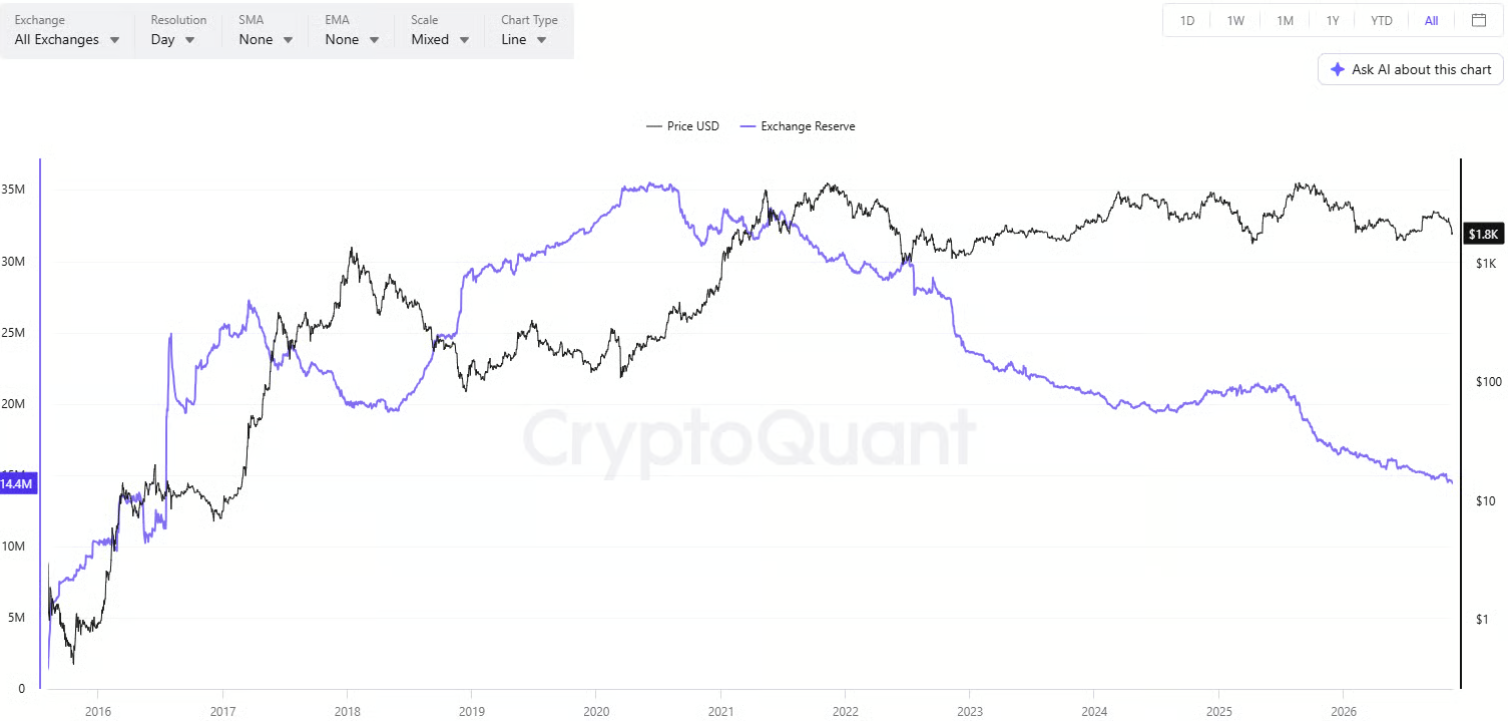
Another positive sign is the falling amount of ETH held on exchanges. According to CryptoQuant, exchange reserves have dropped to a ten-year low of about 14.4 million ETH. This suggests investors are moving coins off centralized platforms into self-custody, which reduces immediate selling pressure.
Zypto puts your crypto on Apple Pay
Zypto supports Apple Pay and Google Pay through its Premium Visa card range, allowing users to turn crypto holdings into a USD balance for everyday purchases without carrying a separate physical card.
Users can order and fund the virtual card through Zypto App, then add it to a mobile wallet for contactless payments at compatible Visa-accepting terminals. It also supports online purchases, connecting crypto-funded balances to existing card payment infrastructure.
Unlike cards that convert cryptocurrency at the point of purchase, Zypto converts funds when users load their cards. Subsequent purchases draw from that prepaid balance rather than triggering another crypto conversion at checkout, giving users control over when they convert their holdings into spending money.
Users must complete identity verification before receiving a card, and availability varies by country and region. Both physical and virtual Premium Visa cards carry no monthly fee, although transaction, crypto off-ramp, network, and applicable foreign-exchange fees still apply.
Zypto’s broader ecosystem includes more than one million cross-chain swap routes, bill payments, mobile top-ups, and gift cards. Bringing these services into one interface lets users manage crypto, move between supported assets, and fund everyday spending without navigating several separate applications.
Find out more here.
Closing remark
Two Bitcoin wallets dormant for more than 16 years moved roughly 100 BTC worth $6.89 million, with their ownership and reasons for transferring the funds still unknown. XRP Ledger’s proposed lending system is drawing validator support, but its three related amendments remain six or seven votes short of triggering the required 14-day approval countdown.
Finnish households are using heat from Bitcoin mining to warm their homes, with mining revenue helping offset heating costs despite high installation expenses and uncertain returns. Tether is positioning its gold-backed XAUT token as a rival to gold ETFs, citing a clean issuer audit and expanded institutional services.
Meta employees are reportedly testing Takes, a prediction app that uses virtual points for wagers, with no confirmation of a public launch or real-money betting. Ethereum whale buying and declining exchange reserves offer tentative signs of relief after ETH’s sharp fall, but persistent ETF outflows and Ethereum Foundation sales continue to cloud the recovery outlook.
Zypto’s Premium Visa cards let eligible users convert crypto into prepaid balances for Apple Pay and Google Pay purchases, with conversion happening when the card is loaded rather than at checkout.
FAQs
How much did the dormant Bitcoin wallets move?
The two Bitcoin addresses moved about 100 BTC after more than 16 years of dormancy.
How many XRPL lending amendments are being voted on?
There are three: SingleAssetVault, LendingProtocol and LendingProtocolV1_1.
Which Bitcoin mining system is used for heating in Finland?
It’s called SunBit’s Bitcoin Boiler.
What did Tether pitch as an ETF rival?
Tether CEO Paolo Ardoino said Tether Gold (XAUT) could compete in the gold-ETF market.
What is Meta reportedly testing?
Meta is reportedly testing its prediction market app called "Takes."
Prices, fees, features and availability mentioned in this article were correct at the time of publishing and may have changed since.
Related topics