
Gm frens, welcome to the penultimate news roundup for July!
Whale wins $3.3m on World Cup final bet, Jimothy the Raccoon token surges 186.66%, as Kalshi adds 3 million users during the World Cup. Ripple launches certified veteran employer grants, while Tether invests $20 million in Argentine neobank, and a long-term bullish setup could take Ethereum to $22K. Finally, Zypto launches the ‘Spend by Country’ feature.
Let’s dive in.
Whale wins $3.3m on World Cup final bet
Spain’s 1-0 extra-time win over Argentina in the 2026 FIFA World Cup final split prediction market traders into sharp winners and losers. One anonymous whale banked $1.35 million, while global superstar Drake lost a $1.5 million crypto bet.
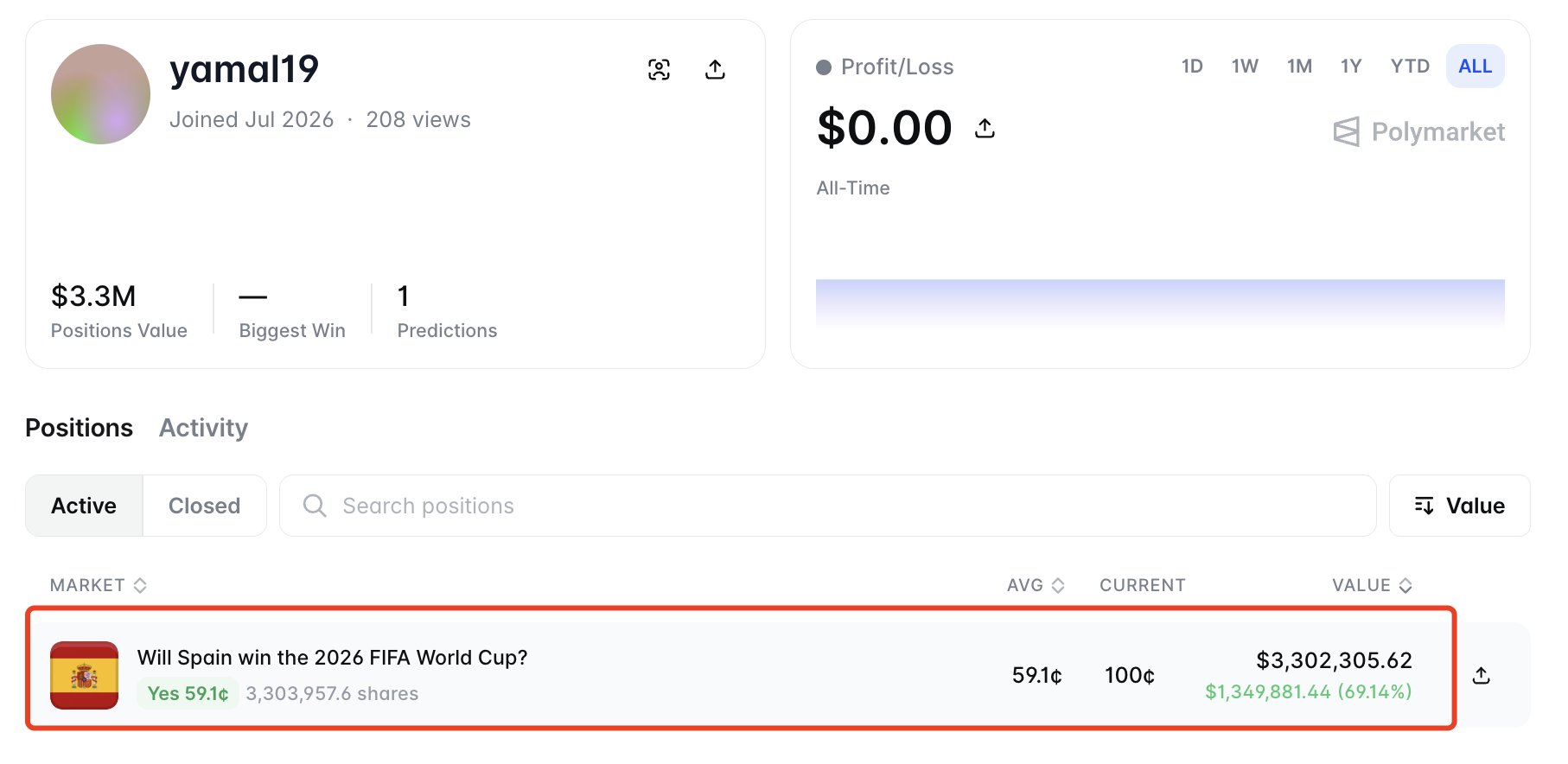
Blockchain analytics account Lookonchain reported that a trader using the handle “yamal19” created a fresh Polymarket wallet. The account then bought about 3.3 million “Yes” shares in Spain to win the World Cup. The shares cost an average of 59.1 cents, totaling roughly $1.95 million. Spain’s victory settled the position at $3.3 million, a profit of $1,349,881, or 69.14%.
Meanwhile, Drake wagered $1.5 million in Tether (USDT) on Argentina to beat Spain in regulation time. A win would have paid him over $5 million. The wager needed Argentina to win inside 90 minutes, which they didn’t. Drake carries a reputation for backing losing sides, called the “Drake Curse,” but the Canadian rapper was not the only person to lose big backing Argentina.
A trader using the handle “gud.hl” bet $1.23 million on the team at 10% odds, chasing a $12.35 million payout. The gamble carried extra weight. According to Bubblemaps, the trader had earned more than $1 million on $TRUMP, then rolled the entire sum into Argentina. Spain’s win wiped out the whole trade.
Prediction markets became a major venue for World Cup wagering across the tournament. Polymarket recorded $4.33 billion in trading volume, while Kalshi logged $1.89 billion over the same period.
Both platforms saw winning and losing positions throughout the rounds. The final capped a tournament that pulled in billions into crypto-based prediction markets, leaving open how much of that activity carries into the months ahead.
Jimothy the Raccoon token surges 186.66%
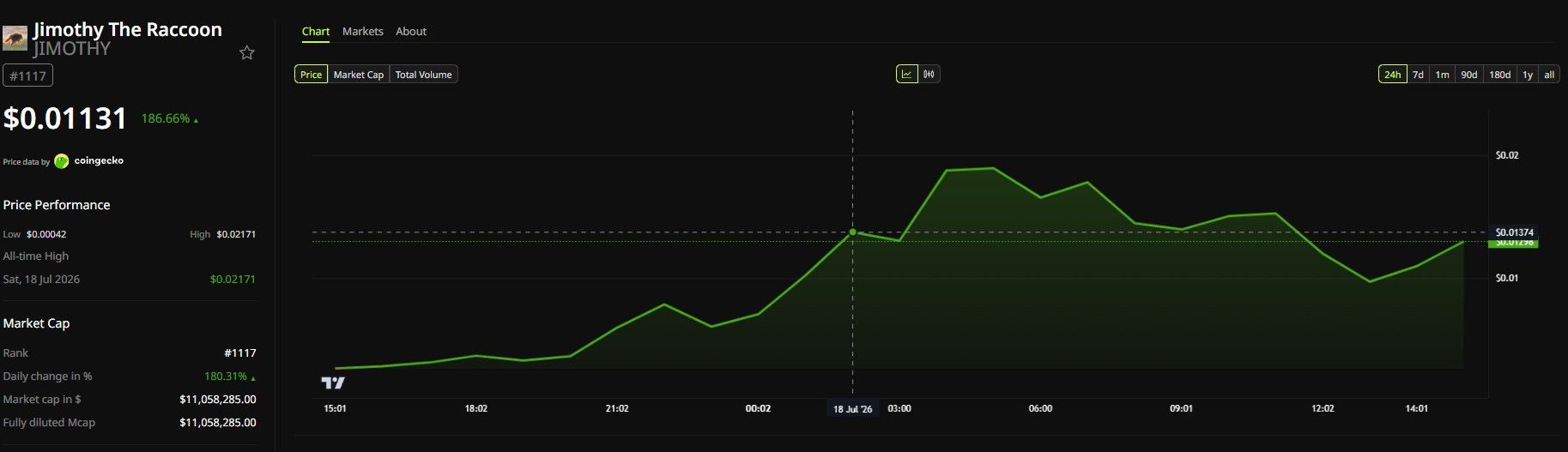
Jimothy the Raccoon (JIMOTHY), a Solana meme coin named after a viral Seattle raccoon, jumped 186.66% in 24 hours over the weekend. Anonymous developers recently launched the token, as clips of the animal’s odd shape had already spread across social media.
Seattle resident Kiana Hall filmed the raccoon near her Ballard neighborhood. They suspected it likely had short spine syndrome, a rare congenital condition that shortens the spine and limits mobility. Hall subsequently named it “Jimothy.”
Anonymous creators listed JIMOTHY on Pump.fun. The platform’s trending page then exposed the token to a wide pool of Solana traders within hours. A dedicated subreddit and a wave of fan merchandise followed. Tattoo artists even offered discounts for raccoon-inspired inks.
The launch also arrived during a broader Pump.fun trading rebound. The platform’s share of profitable traders has climbed for four straight months. Meanwhile, Solana network activity has jumped even as the SOL token itself struggles. Meme coin launches keep pulling in fresh volume.
It reached an all-time high of $0.0217 and ranks 1,117th by market capitalization. While that is tiny next to Solana’s blue-chip names, its supply is close to one billion. However, tokens built on viral animal moments rarely hold their gains once the news cycle fades.
The pattern already played out this year in a World Cup meme coin rally tied to footballer Erling Haaland. A similar narrative-driven token rally followed Pentagon UFO files, and both cooled within weeks.
Kalshi adds 3 million users during the FIFA World Cup
Kalshi has added three million new users during the 2026 FIFA World Cup, the prediction market platform announced. Trading volumes across the platform also surged alongside the tournament.
More than $1.2 billion was traded on Kalshi’s contract predicting the World Cup winner, a record for a single market on the platform. That market closed Sunday, when Spain beat Argentina in the final, 1-0.
Kalshi leaned on soccer’s global reach to fuel the surge. Undoubtedly, the sport’s presence in nearly every country gives it an addressable market few other events can match. The platform partnered with ADI Predictstreet, FIFA’s official prediction market sponsor.
Meanwhile, it also worked with OpenAI to surface its odds inside ChatGPT searches. There were also campaigns featuring soccer stars Luka Modric and Jose Mourinho, plus a partnership with the Argentina national team. Kalshi CEO Tarek Mansour said the strategy prioritizes speed and relevance over volume alone.
Despite the popularity and boom from the World Cup, prediction markets carry regulatory risk. Sports event contracts remain caught in a dispute between the federal government and several states, which argue the contracts function as sports betting. That fight has already produced a CFTC lawsuit against Kentucky for suing major prediction market platforms.
Other bettors have felt the swings too. One Polymarket trader lost $11.6 million on World Cup wagers in early July. Kalshi now faces a familiar test. Volume drops on days without matches, a pattern that has repeated after past major events. Now, fresh catalysts, not a slowdown, are expected to keep prediction market volume climbing once the World Cup ends.
Ripple launches certified veteran employer grants
Nonprofit Hire Heroes USA named the 25 recipients of a Ripple-funded grant program for veteran and military spouse-owned businesses, distributing $250,000. Ripple handled the cost through a donation in RLUSD, the stablecoin it issues.
Hire Heroes disclosed the 25 awardees last week, after a selection process that ran through the spring. Each business receives $10,000, a combined total of $250,000. The figure is small by corporate standards, though relevant for firms with limited access to credit.
To qualify, companies had to be at least 51% owned by a US military veteran or military spouse and operate domestically. They must also plan to hire from the military community within 12 to 18 months, a condition the nonprofit says it will track over time. Recipients also gain access to employer resources and the organization’s pool of military-connected candidates.
The grants belong to Ripple’s philanthropic arm rather than its payments business. The company previously committed $25 million, mostly in RLUSD, to education nonprofits. Independent data on the employment impact of these donations is not yet available.
The launch coincides with a sharp escalation in the Middle East. The United States reimposed its blockade of Iranian ports in response to Iran’s attacks on commercial ships in the Strait of Hormuz. Thus, the conflict keeps veterans and military families at the center of public attention.
Both stories keep developing on separate tracks. Hire Heroes USA plans to track the hiring commitments of the awarded businesses over the coming months, while Washington and Tehran face an increasingly uncertain path back to negotiations. Any future overlap between the two hangs in the balance.
Tether invests $20 million in Argentine neobank
Leading stablecoin issuer Tether invested $20 million in Argentine neobank Ualá, taking an equity stake in a financial platform with more than 11 million customers across Argentina, Mexico and Colombia.
The investment was part of Ualá’s $197 million funding round announced in March, led by Allianz X at a $3.2 billion post-money valuation. Tether was initially mentioned in Ualá’s announcement, and only later on unveiled the $20 million investment figure. Given the headline valuation, the investment should represent a rough 0.6% stake in the neobank’s post-money equity, though the terms may differ.
Ualá offers accounts, cards, lending and investments to more than 11 million customers across Argentina, Mexico and Colombia. The company’s CEO Pierpaolo Barbieri has reportedly said regulations in Argentina and Mexico prevent near-term USDT integration and that Tether joined the round solely as a financial investor.
Tether has made several bets in Argentina and across South America. It led a $14 million round for payments wallet Belo in April and controls 70% of agricultural and energy producer Adecoagro, which operates across Argentina, Brazil and Uruguay.
Earlier this month, it invested $20 million in Brazilian crypto company Mercado Bitcoin.
Tether funds its investments with excess capital generated by income earned from the reserves backing the USDT stablecoin, which now has $184 billion in circulation. It posted a $1.04 billion profit in the first quarter.
Long-term bullish setup could take Ethereum to $22K
Ethereum could be entering the final stage of a long-term bullish pattern that eventually sees it go as high as $22,000, according to new analysis shared by pseudonymous crypto commentator Noname.
While the projection is highly speculative, it has added to a growing debate over whether ETH’s June lows marked the start of a broader recovery. According to a chart market watcher shared on X, since 2021, Ethereum has been building an ‘expanding diagonal.’
It consists of five waves, with each successive wave becoming larger than the last one. They pointed out that the first four waves were already complete, with the fourth finding support between $1,072 and $1,385.
“That’s the floor this entire structure was building toward,” Noname explained. They added that expanding diagonals often end with a fifth wave that breaks above the previous cycle high. They also compared ETH’s structure to a historical Dow Jones Industrial Average (DJIA) fractal and said that both charts have a similar formation and could produce a similar breakout. Based on that interpretation, the projected target is anywhere from $12,000 to $22,000.
They also described ETH as “one of the most underpriced assets on the market” currently, suggesting that many people had given up on it, which could create an opportunity for long-term investors.
Another analyst, Crypto Patel, reached a similar conclusion using a different framework. In his version, he said that Ethereum has been following a Wyckoff accumulation pattern that could eventually lift the asset toward $10,000 by 2027 or 2028, provided the recent swing low around $1,500 remains intact.
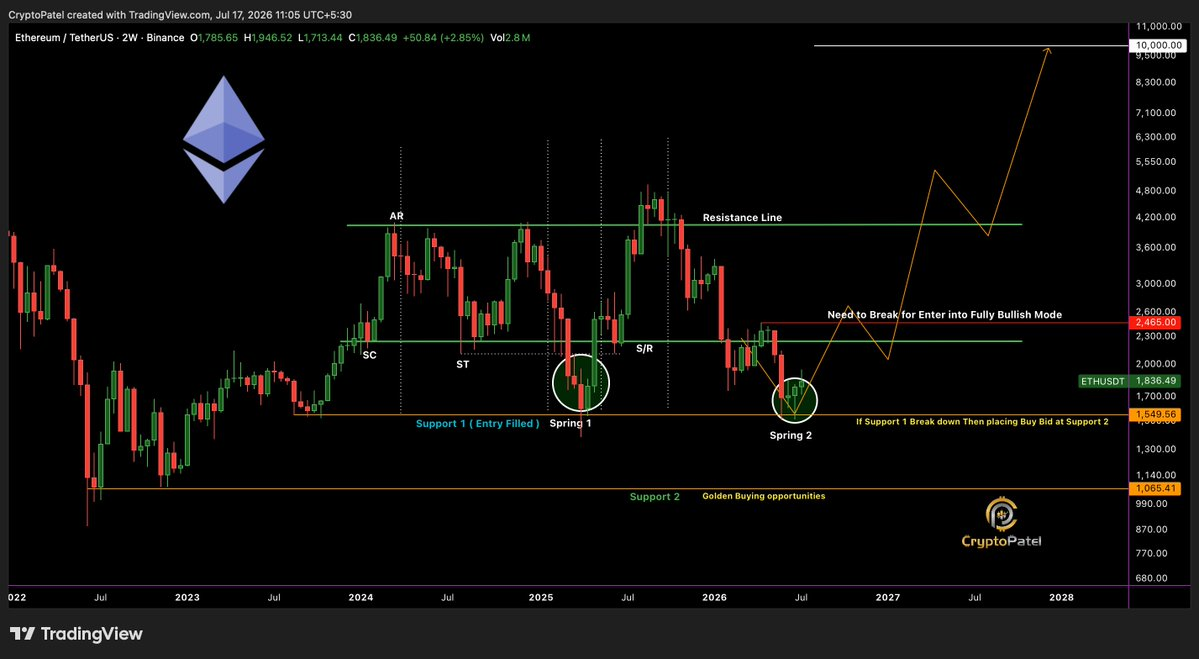
The trader also identified resistance between $2,400 and $2,600 and called it the first major hurdle the world’s second-largest cryptocurrency will have to overcome before any larger price advance can begin.
CryptoQuant contributor CW8900 also struck an optimistic note, sharing data showing that Ethereum wallets holding more than 100,000 ETH have gone back to green following the latest rebound.
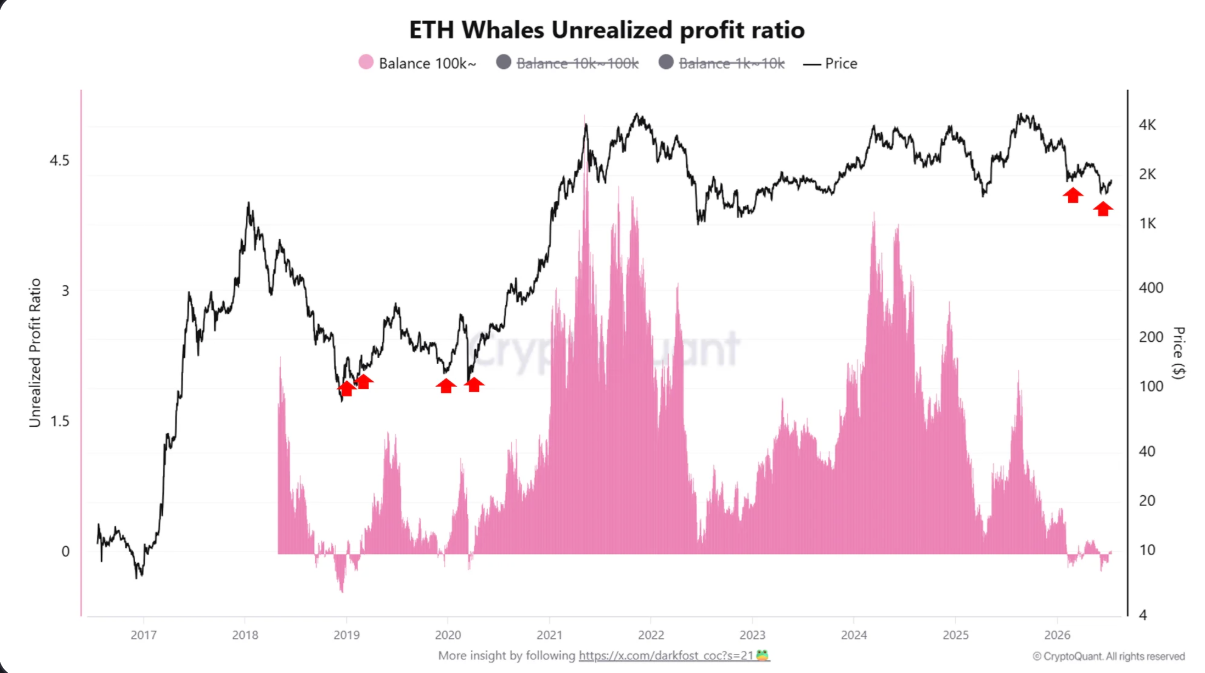
According to them, whales have only fallen into loss during major market bottoms, and their return to profit on many occasions has coincided with either a sustained rally or a meaningful short-term recovery.
Zypto launches the ‘Spend by Country’ feature
Zypto has introduced a Spend by Country directory that helps users quickly see what they can do with their crypto wherever they live or travel. Instead of digging through separate product pages or regional FAQs, users select their country to view all available Zypto services in one place.
At the core of the experience are Zypto’s crypto Visa cards, available in physical and virtual formats. Users load these prepaid cards with their favorite cryptocurrencies, which convert to local currency at load, then spend wherever Visa is accepted, both online and at point-of-sale terminals.
Beyond cards, Zypto’s country pages highlight additional ways to route crypto into everyday spending rails, including bill payments, phone top-ups, gift cards, and cash-out options where supported.
Spend by Country sits on top of Zypto’s broader ecosystem, which combines a DeFi wallet app, payment gateway, and card infrastructure. The Zypto App supports self-custodial storage and swapping for over 24,000 assets across more than 20 blockchains. At the same time, Zypto Pay acts as a crypto payment gateway for merchants who want to accept digital assets and settle in local currency.
By organizing its global services around local availability, Zypto is removing a persistent source of friction for everyday crypto users: figuring out what is actually possible in their jurisdiction.
Instead of generic claims about global coverage, the Spend by Country view surfaces concrete options per market, making it easier for users to decide whether to lean on cards, bills, gift cards, or gateway integrations depending on where they live.
Closing remark
The 2026 FIFA World Cup became a major driver for crypto prediction markets. The final delivered a fresh round of winners and losers, with the $3.3m whale winner arguably the biggest of them all.
While Jimothy’s rapid rise is a heartwarming tale, it reflects a familiar pattern of short-lived, narrative-driven token rallies. Kalshi adding three million users and seeing record trading volumes shows how soccer’s global appeal and high-profile partnerships can be leveraged.
Ripple, via Hire Heroes USA, aims to support hiring within the military community despite limited data on long-term employment impact. Tether’s investment in Argentine neobank Ualá continues its broader Latin American expansion strategy.
Analysts suggest Ethereum may be forming a long-term bullish pattern that could push prices as high as $22,000, though the outlook remains speculative and dependent on sustained market momentum.
As more wallet providers compete on real-world usability, Zypto’s country-level mapping underscores a strategic focus on turning crypto from a speculative asset into a practical spending and payments tool.
FAQs
How much did the whale win?
An anonymous whale won $3.3 million after betting correctly on the World Cup final result.
Who made the Seattle raccoon go viral?
A Seattle resident, Kiana Hall, filmed, named, and uploaded a video of the raccoon online.
How many new users did Kalshi gain during the World Cup?
Kalshi added three million new users during the 2026 FIFA World Cup.
What did Ripple do?
Ripple funded a grant program for veteran and military spouse-owned businesses.
Where did Tether invest?
Tether invested $20 million in Argentine neobank Ualá.
Related topics