
Gm frens, welcome to this week’s crypto news roundup!
Circle expands to other markets, Bored Ape trading cards launch on Solana, and Tx launches USTX stablecoin. Ethereum’s co-founder unveils ‘Paranoid Mode,’ while the GTA 6 trailer sparks a Solana meme coin rally, and XRPL volume surges. Finally, Zypto enables payments from external crypto wallets and exchanges.
Let’s get to it.
Circle expands to 40 emerging markets
Circle wants USDC in a lot more wallets around the world. The stablecoin issuer is preparing to enter roughly 40 emerging and developing countries, CEO Jeremy Allaire told Reuters on the sidelines of the IMF and World Bank meetings in Bangkok.
Allaire pointed to rising organic demand for stablecoins across Southeast Asia, Latin America, Africa, and the Middle East from people and businesses looking to tap into an internet-based economy. He said the technology is moving “from the early adopter phase of blockchain technology into the mainstream scaling phase.”
Circle, the world’s largest regulated stablecoin issuer, has the resources to support the push, including its $400 million acquisition of Tazapay. Its stablecoin USDC holds about 25% of the market, compared with roughly 60% for Tether’s USDT. USDC’s circulation rose 19% year over year to $73.3 billion in the second quarter.
The company is also leaning on regulatory tailwinds. Circle secured a federal banking charter in July, sending its stock higher, and has pursued a New York trust charter. The GENIUS Act, the U.S. stablecoin law, is slated to take effect in January. Allaire said the law would give the world “legal digital dollars,” calling it “a watershed moment.”
Banks are building their own stablecoins, which Allaire framed as healthy competition. He also credited tiny machine-to-machine payments by AI agents with boosting USDC usage. BlackRock, Visa and Standard Chartered have adopted Circle’s Arc network. Circle has been pushing to make USDC the currency of AI agents, while acknowledging AI’s security risks.
Bored Ape trading cards launch on Solana
Yuga Labs has launched Mudwater, a trading card game on Solana with physical and digital Bored Ape cards. However, the Bored Ape Yacht Club (BAYC) NFT collection itself lives on Ethereum.
Existing holders get first access. Each Bored Ape unlocks 10 packs, and each Mutant Ape Yacht Club (MAYC) NFT unlocks 2. The total supply stops at 10,000 boxes. To start, Yuga airdropped a Totem to every BAYC and MAYC token holder.
The Totem uses ERC-6551, an Ethereum standard that gives an NFT its own wallet. Holders need it to claim packs. Each pack holds 10 cards, and 24 packs fill a box, for 240,000 packs or 2.4 million cards.
Bored Apes alone can claim 100,000 of those packs. In other words, owners of just 10,000 NFTs can lay claim to about 42% of the packs before open trading sets prices. The team says eight Bored Ape cards sit at the top as serialized cracked-ice 1/1s, and BAYC calls them the set’s grails. The Solana Foundation adds that Mudwater spans 120 BAYC art pieces, with foils and both physical and digital versions.
BAYC urged holders to cross-check every claim link with official channels. Yuga knows the risk well, having led a white-hat rescue operation after a protocol exploit endangered Bored Apes. Ultimately, Bored Ape cards test whether a blue-chip Ethereum brand can find fresh demand on a rival chain. If the set sells, other NFT projects may follow liquidity across networks rather than stay loyal to one.
Tx launches USTX stablecoin for tokenized asset trading
Real-world asset (RWA) platform tx has launched USTX, a dollar stablecoin for its wallet and planned marketplace for tokenized stocks. The move aims to create a native settlement asset on the network while using external infrastructure for issuance, reserves, minting, and redemption.
Users will need USDC to mint USTX, which they can also redeem for USDC, and the platform accepts deposits from eight blockchains, including Ethereum and Solana.
Fintech platform Brale issues USTX, manages its reserves, and facilitates minting and redemption. According to tx, each token is backed by $1 in assets, including cash, bank deposits, government money market funds, and short-term U.S. Treasury bills.
For tx, a native stablecoin gives users a common dollar balance for buying tokenized assets, settling trades, and posting collateral across the network. Eligible USTX users may also receive rewards through tx wallet programs, extending the token’s role beyond simple transaction settlement.
Nonetheless, the GENIUS Act law bars stablecoin issuers from paying holders interest or yield solely for holding, using, or retaining a payment stablecoin. The launch follows a broader pattern. In it, blockchain networks and trading platforms launched branded dollar stablecoins through third-party providers that handle issuance and reserve management.
Ethereum’s co-founder unveils ‘Paranoid Mode’ AI privacy
An AI assistant that helps manage investments could expose your holdings, trading plans, and financial questions to the company running the model. Ethereum co-founder Vitalik Buterin has built a way to make that trail harder to follow.
On October 16, Buterin unveiled a “Paranoid Mode” for his AI agent, designed to obscure who uses it, where requests originate, and how they are paid for. The code is public, but the combined setup remains experimental.
As AI agents gain access to wallets and financial tools, their conversations could reveal sensitive financial information. A trading assistant might disclose which tokens it monitors or details about a user’s portfolio. Even anonymous users may be identified through payment records, internet addresses, or repeated details in prompts.
Buterin addresses those risks in four steps:
- Tor routes each conversation separately to hide the user’s IP address.
- Fake requests disguise real traffic.
- A small AI model on the user’s computer rewrites prompts to reduce identifying details.
- zkAPI uses cryptographic proofs to show that requests are paid for without identifying the payer.
The payment system already runs on Ethereum mainnet and accepts deposits in assets such as ETH and USDC. Buterin also confines his agent to a software sandbox to limit its access to his computer.
Buterin says the system is “getting quite usable,” although each new conversation starts more slowly. Complete anonymity remains elusive. Providers still see rewritten prompts, which could contain recognizable information. He acknowledged another weakness: an AI provider cooperating with Tor’s first relay could study traffic timing and potentially identify real requests. He favors a more specialized privacy network, despite higher data costs.
For investors, the longer-term question is whether private AI payments become cheap and fast enough for trading tools and other financial services. Buterin says lower zkAPI transaction fees are coming. His prototype suggests a potential use for Ethereum infrastructure, but offers no evidence of widespread adoption or an immediate benefit to ETH’s price.
GTA 6 trailer sparks Solana coin surge
Two seconds of the Grand Theft Auto (GTA) 6 trailer was all it took for a Solana meme coin to fly, making some traders pretty rich. Dacity Coin (DACITY) was plastered on the side of a plane in the GTA 6 launch trailer released on October 15, with a man setting off a neon-pink flare on the wing.
The plane shows a fictional in-game brand, and the real Solana token copied its name. This made it skyrocket 2,900%, from a $104,000 market capitalization to $3.18 million, in the hour after the trailer’s release. Interestingly, the token was created four days earlier, after notorious hacker ‘Cyberleek’ leaked GTA 6. It revealed that Dacity Coin was set to be in the game, but only a comparatively small group of traders noticed.
Upon its October 11 launch on Solana launchpad Pump.fun, Dacity Coin hit a peak market cap of $1.14 million before falling to $144,700 over the following day and trading sideways until Thursday’s sharp rise.
As a result, traders had plenty of time to buy into the meme coin before it skyrocketed. According to DEX Screener, 24 traders profited more than $10,000 on the token, with the top trader turning $1,912 into $44,000. Dacity now sits at a $1.5 million market cap, dropping around 53% from its $3.18 million peak.
In the launch trailer, the plane reads “DacityCoin AudaCity,” and in previously leaked footage, the game’s protagonist Lucia is seen skydiving in an AudaCity parachute. When the parachute opens, per the leaked screenshots, it features the slogan “Quit your job. Sell your house.”
This follows years of rumors about cryptocurrencies appearing in GTA 6. Several theories have circulated, including play-to-earn features, NFT-owned properties, and even an entire blockchain for the game. However, all of them were unsubstantiated; Dacity Coin is the first solid sign that cryptocurrency will be in the upcoming game.
XRPL volume surges as analysts eye $2 to $9 target
The rollercoaster ride that swept crypto markets over the past several weeks led to a substantial price decline, perhaps due to rising U.S. inflation or growing economic and macro uncertainty.
For XRPL bulls, one bright spot is activity on the XRP Ledger. Citing data from Santiment, analyst Ali Martinez shared a chart showing a tremendous surge in network transaction volume, reaching almost $50 billion, a significant rise from previous levels.
According to Martinez, this massive uptick in on-chain activity around such a key support level suggests that “$1.25 could mark the bottom.” If that’s the case, the analyst predicted XRP could resume its August/September rally and target $2.
Meanwhile, Vincent Van Code was significantly more bullish on XRP (and other assets). He believes the events over the past week or so were a broader crypto shakeout designed to remove weak hands.
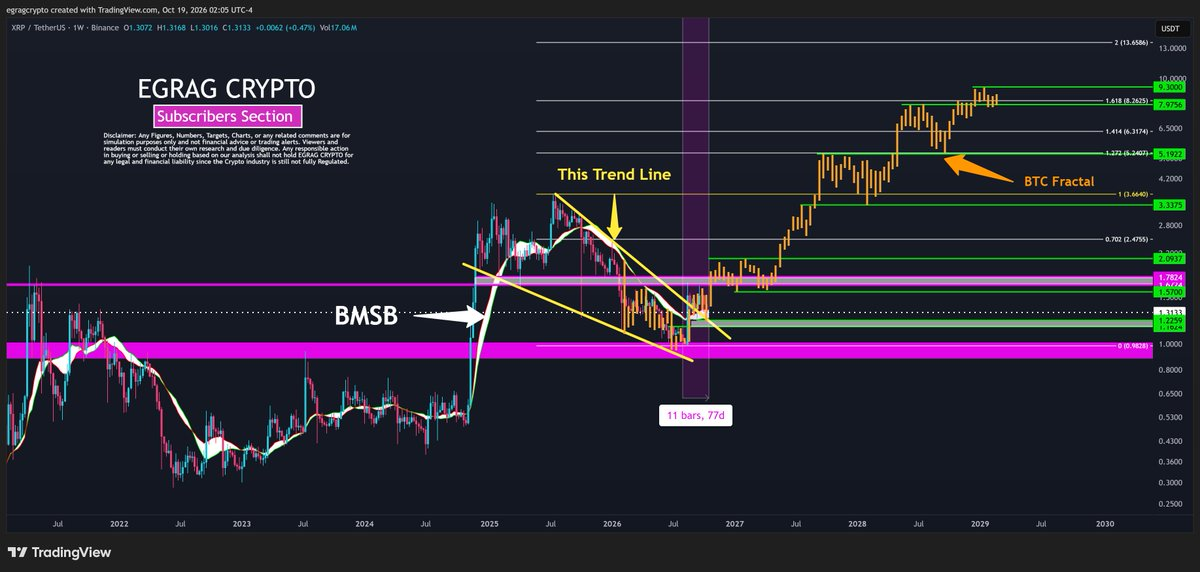
Furthermore, staying true to his long-standing bullish nature on XRP, EGRAG CRYPTO provided another scenario under which the token could skyrocket to well above its 2025 all-time high of $3.65. In a weekend post, he outlined a cycle top of $7 to $9 for the cross-border token.
Another piece of good news is that Ripple has finally gotten a dedicated X account for the crypto asset. The account launched after a hugely successful week for Ripple, during which it announced major partnerships with Standard Chartered, Evernorth Holdings, and Cross River Bank.
Zypto enables payments from external crypto wallets and exchanges
Zypto’s External Payments feature allows users to pay for products and services in its crypto app directly from an external wallet or exchange. This removes the need to transfer funds into a Zypto wallet before checkout.
The feature gives users access to Zypto’s payment ecosystem while allowing them to keep their crypto in their preferred wallet or exchange until they are ready to complete a purchase. Supported funding sources include hardware wallets, other mobile wallets, and exchanges that allow external crypto transfers.
External Payments connects those holdings to services including crypto card funding, bill payments, and mobile top-ups. Rather than requiring users to consolidate their assets in the app, Zypto lets them fund purchases directly from where they already hold their crypto.
For crypto card users, the feature supports loading from either a Zypto wallet or an external source. Zypto’s physical card documentation states that Zypto converts supported cryptocurrencies to US dollars when users load the card, making the resulting balance available for spending.
By separating access to its services from where a user’s funds are held, Zypto positions its app as a payments hub rather than a wallet-only platform. External Payments brings externally held crypto into the purchasing process without requiring an intermediate transfer to a Zypto wallet.
Find out more here.
Closing remark
Circle plans to bring USDC to roughly 40 emerging markets as demand for digital dollars grows across Southeast Asia, Latin America, Africa and the Middle East. Yuga Labs has launched Mudwater, a physical and digital Bored Ape trading card game on Solana.
Tx has launched USTX, a dollar-backed stablecoin issued by Brale, to support payments, trade settlement and collateral across its tokenized asset ecosystem. Vitalik Buterin has unveiled an experimental “Paranoid Mode” to make AI interactions harder to trace.
A Dacity Coin (DACITY) appearance in the GTA 6 trailer sent a same-named Solana meme coin soaring 2,900% before it lost more than half its peak market value. Reported XRP Ledger transaction volume approaching $50 billion has fueled bullish analyst forecasts ranging from a $2 recovery to a speculative $7 to $9 cycle peak.
Zypto’s External Payments feature lets users fund crypto cards, pay bills, and buy mobile top-ups directly from compatible external wallets or exchanges without first moving funds into a Zypto wallet.
FAQs
What is Circle planning with USDC?
Circle is preparing to bring its USDC stablecoin to roughly 40 emerging and developing countries across Southeast Asia, Latin America, Africa, and the Middle East, citing rising organic demand for digital dollars.
What are the Bored Ape trading cards on Solana?
Yuga Labs launched Mudwater, a trading card game on Solana featuring physical and digital Bored Ape cards, even though the BAYC NFT collection itself lives on Ethereum. Existing BAYC and MAYC holders get first access to the packs.
What is USTX?
USTX is a dollar stablecoin launched by RWA platform tx and issued by Brale. Users mint it with USDC to buy tokenized assets, settle trades, and post collateral across the network, with each token backed by $1 in cash and short-term U.S. Treasuries.
What is Vitalik Buterin's “Paranoid Mode”?
It is an experimental privacy setup for an AI agent that hides who uses it, where requests come from, and how they are paid for, using Tor, decoy traffic, on-device prompt rewriting, and zero-knowledge payment proofs.
How does Zypto's External Payments feature work?
External Payments lets you pay for services in Zypto App directly from an external wallet or exchange, so you can fund crypto card loads, bill payments, and mobile top-ups without first moving your crypto into a Zypto wallet.
Prices, fees, features and availability mentioned in this article were correct at the time of publishing and may have changed since.
Related topics