Gm frens, welcome to the third news roundup for July!
Hyundai completes a stablecoin remittance test on Avalanche, as Haaland’s memecoin goes viral on Solana. Polymarket applies for a U.S. margin trading license, SpaceX sends $88 in Bitcoin between internal wallets, and Ethereum whales add $20.6M in ETH. Plus, Solana’s record FUD could be a bullish setup, and Zypto launches Share Studio.
Let’s dive in.
Hyundai implements Avalanche stablecoin-based remittance system
Hyundai, the world’s third-largest carmaker by vehicle sales, completed its first proof-of-concept (PoC) testing of a stablecoin-based, cross-border, internal remittance system on the Avalanche blockchain. The PoC processed a real remittance between Hyundai Motor Company’s U.S. and Mexican entities using USDT.
The international transfer comes as stablecoins gain traction beyond crypto trading. Large companies are increasingly testing the technology to move money between subsidiaries, settle cross-border payments, and reduce the cost and time associated with traditional banking rails.
For the maker of the Kia compact and Ioniq electric cars, the first phase involved transferring $20,000 from Hyundai Motor America to Hyundai Motor Mexico. Dollars were converted into Tether’s USDT stablecoin before being converted back into dollars. The companies plan to expand the project to additional cross-border payment corridors and currencies.
Project leader Hyundai Card, the manufacturer’s credit card unit, said the process took an average of seven minutes, compared with the three to four hours typically required through traditional banking networks.
A second pilot involving Hyundai’s European subsidiaries is scheduled to begin later this month. It will test local currency transfers and value the cost of foreign exchange conversions in partnership with Circle Internet (CRCL), the issuer of the USDC stablecoin, and Visa. It will also involve real-world stablecoin remittances in local currencies other than the U.S. dollar.
Haaland’s Viking-themed memecoin goes viral
Erling Haaland’s name is fueling a wave of speculative Solana meme coins. A Viking-themed Google Easter egg linked to Norway’s World Cup quarterfinal against England sent the phenomenon viral this past week.
Anonymous developers seized the moment and launched short-lived meme coins such as $HAALAND and $VIKINGROW on Solana to capture retail curiosity. These tokens carry no utility or team affiliation. An Erling Haaland-branded token also drew fresh attention from traders alongside the surge in searches.
The Google Easter egg appeared as Norway prepared to face England in last week’s Friday quarterfinal. The animation showed a Nordic helmet graphic when users searched Haaland’s name directly, drawing global search traffic toward the striker within hours.

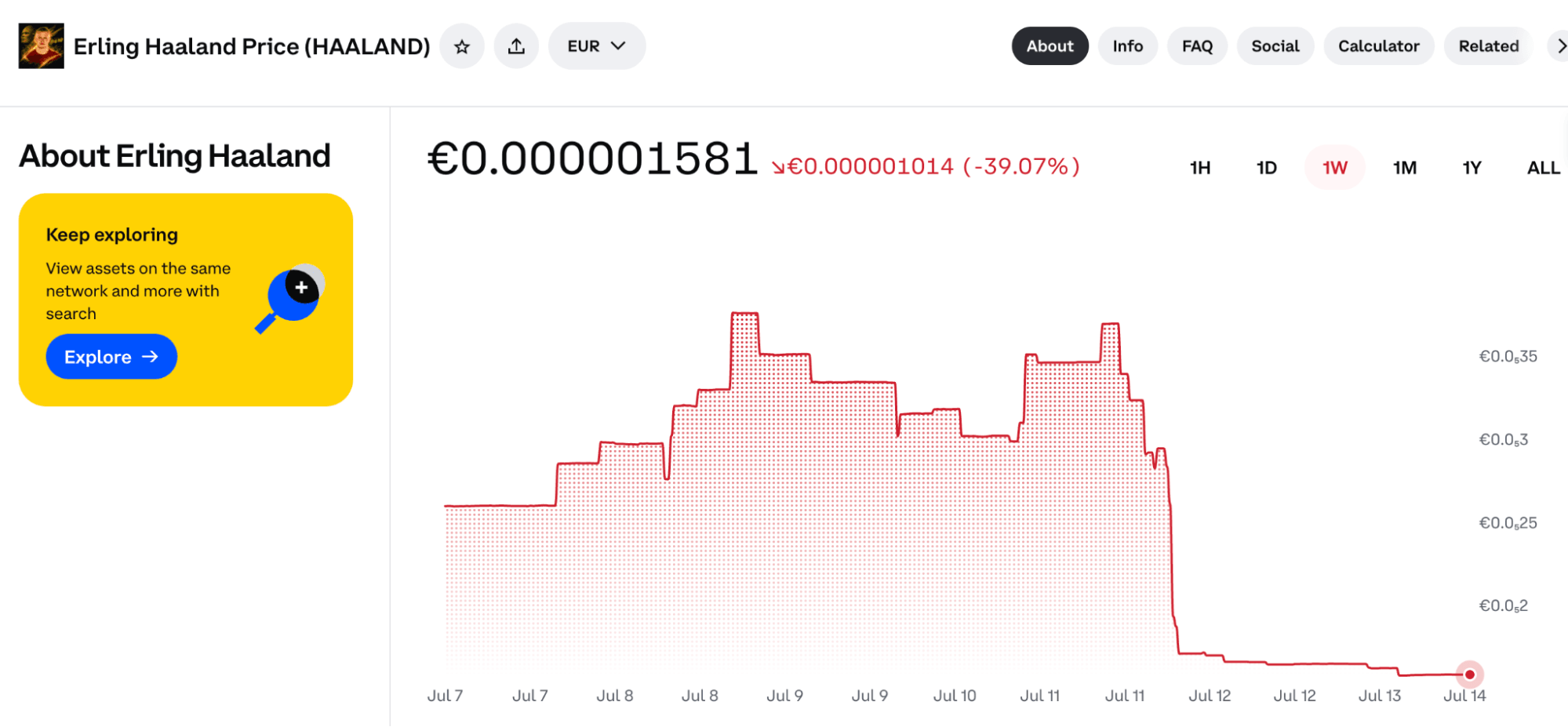
Retail traders have piled into these instruments despite thin liquidity. Few carry any verified link to Haaland himself. At the time of writing, data shows the Erling Haaland meme coin trading near $0.0000016 on Solana, with a market cap of around $1.57K.
The meme coin dropped by 39.07% over the week, reflecting the volatility common among speculative launches. Some analysts view the token less as an investment and more as a short-term cultural bet. Meanwhile, other traders continue to chase World Cup tokens regardless of risk. Established fan tokens during knockouts have shown comparatively steadier price action.
Polymarket seeks to offer margin trading to U.S. users
Polymarket has applied for a U.S. license to offer margin trading. The prediction market is seeking a futures commission merchant license, which, if approved, would enable users to open positions by posting only a portion of the required capital.
According to Bloomberg, Polymarket filed through its affiliate, Coming Home GBA LLC, to register as a Futures Commission Merchant (FCM). The application was submitted on July 3, as per the National Futures Association.
Margin trading lets traders borrow to increase their position size without paying the full amount upfront. Institutional traders use it to improve capital efficiency, but it requires a broker that can hold funds and manage margin. An FCM license would give Polymarket that role, enabling it to handle customer funds and margin in the same way as established futures intermediaries.
That structure enables leveraged trading and provides institutions with the familiar brokerage and custody rails they expect. Even so, Polymarket still needs approval from the Commodity Futures Trading Commission (CFTC) for rulebook changes before it can list margined contracts.
Notably, rival Kalshi secured an FCM license earlier this year through its affiliate, Kinetic Markets LLC. The next move sits with the CFTC, whose decision will determine whether Polymarket can close the gap in the coming months.
SpaceX executes test transfer of $88 in Bitcoin
SpaceX moved Bitcoin on-chain for the first time in six months. The company sent an $88 test transaction between two of its tagged wallets, as reported by Arkham Intelligence.
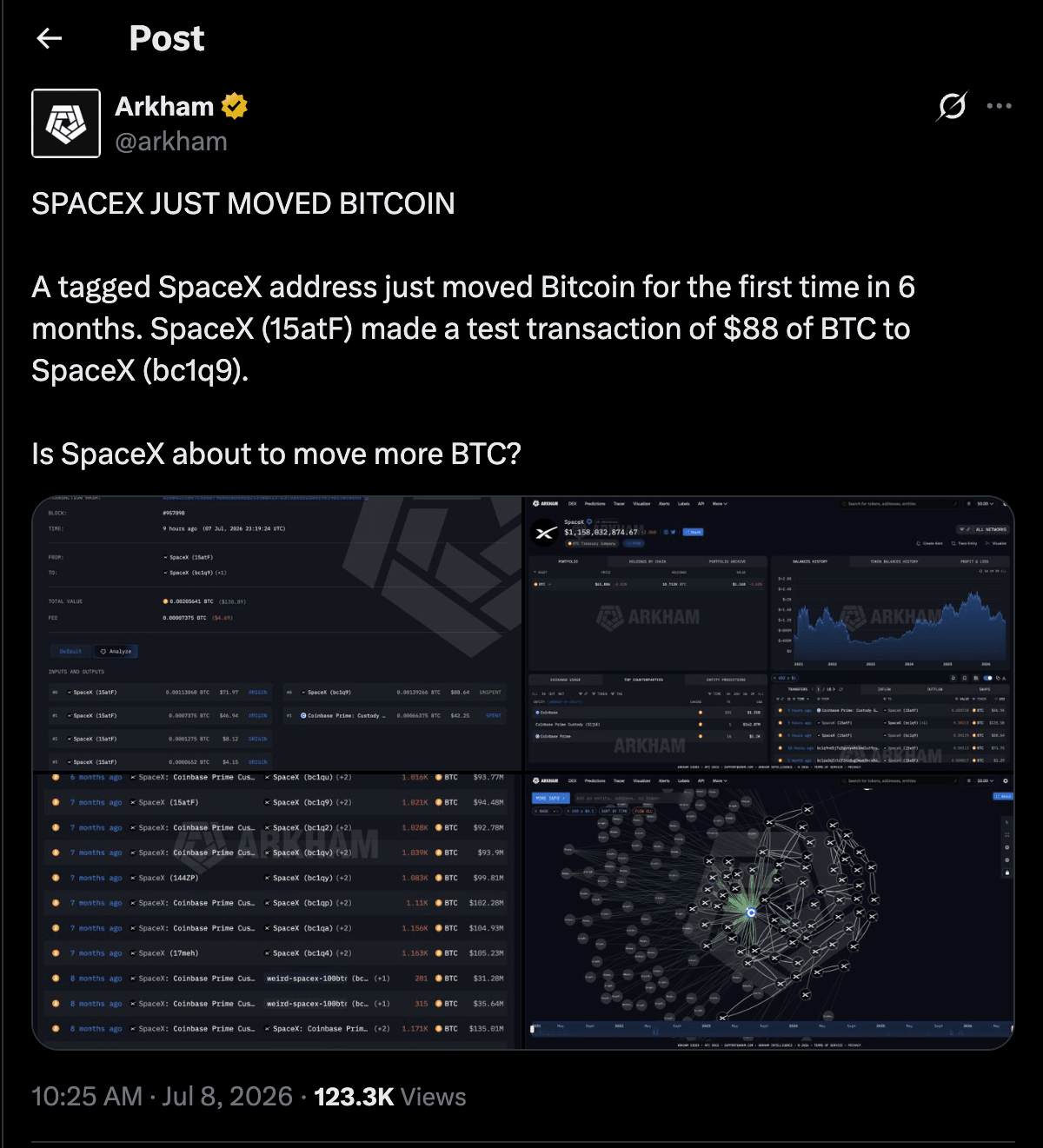
The tiny transfer revived a familiar question about whether SpaceX is about to move more BTC. SpaceX holds 18,712 BTC, and Elon Musk’s companies rarely touch their coins without drawing market attention. The funds traveled from a legacy “15atF” address to a newer “bc1q9” address.
Tiny test sends are a standard custody step that verifies a new address before larger sums follow. SpaceX has followed this playbook before. In October 2025, Arkham Research recorded 2,495 BTC, worth $257 million, being sent to two new wallets after months of quiet.
Traders also remember that SpaceX has sold before. Arkham’s records show it offloaded two large chunks of its stack during the 2022 crypto winter. Tesla, by contrast, has left its 11,509 BTC untouched since 2024.
Still, nothing currently points to selling. BitcoinTreasuries shows 18,712 BTC, unchanged since the May 21 S-1 filing that preceded SpaceX’s June 12 IPO. That filing also revealed that on-chain trackers had never traced 10,427 BTC of the treasury, meaning Arkham’s tagged addresses cover less than half of SpaceX’s total holdings.
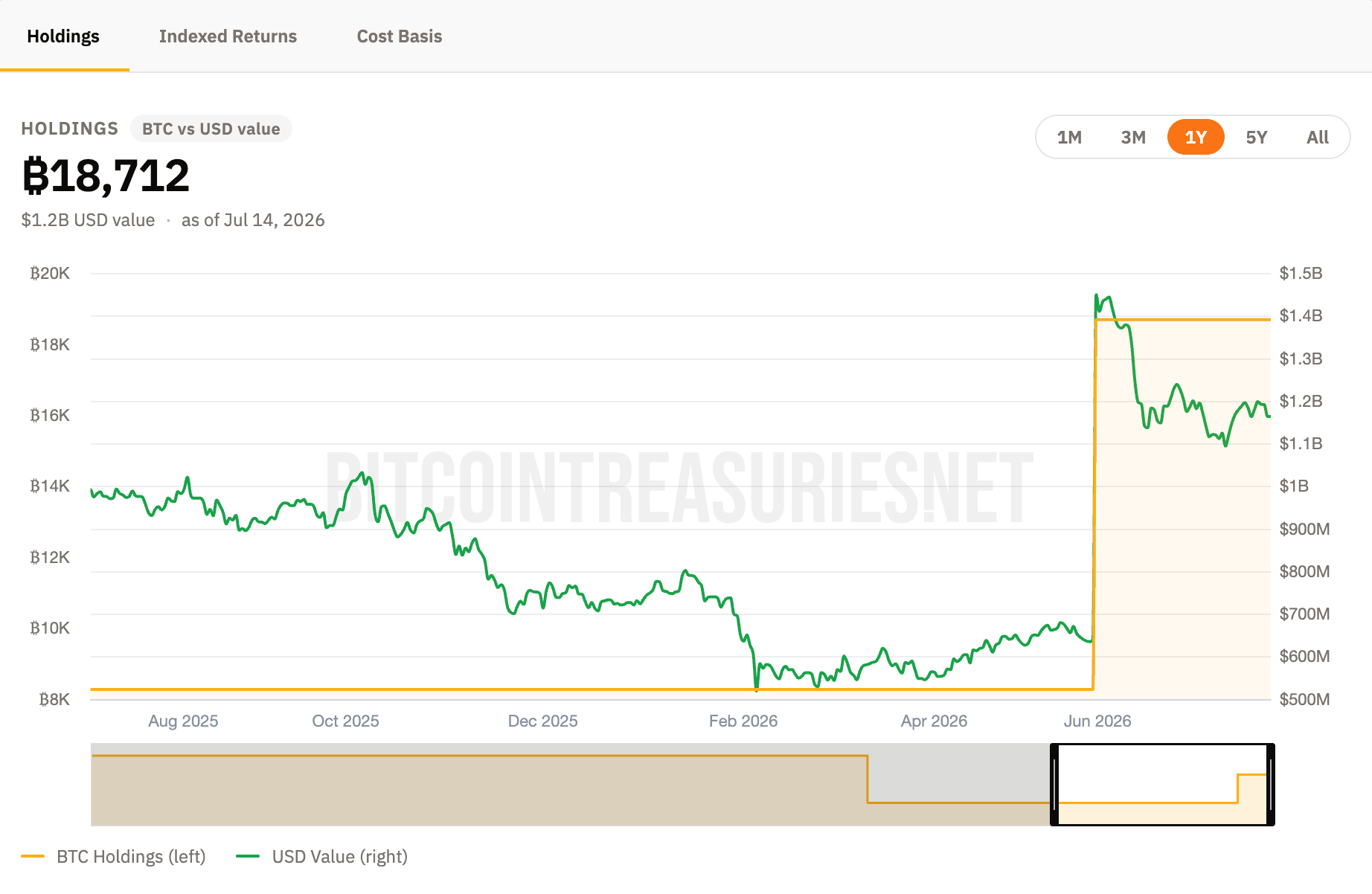
If precedent holds, the $88 send points to custody housekeeping rather than an exit. Follow-up transfers from the new address in the coming days would reveal whether a larger reshuffle is underway.
Ethereum whales add $20.6M in ETH
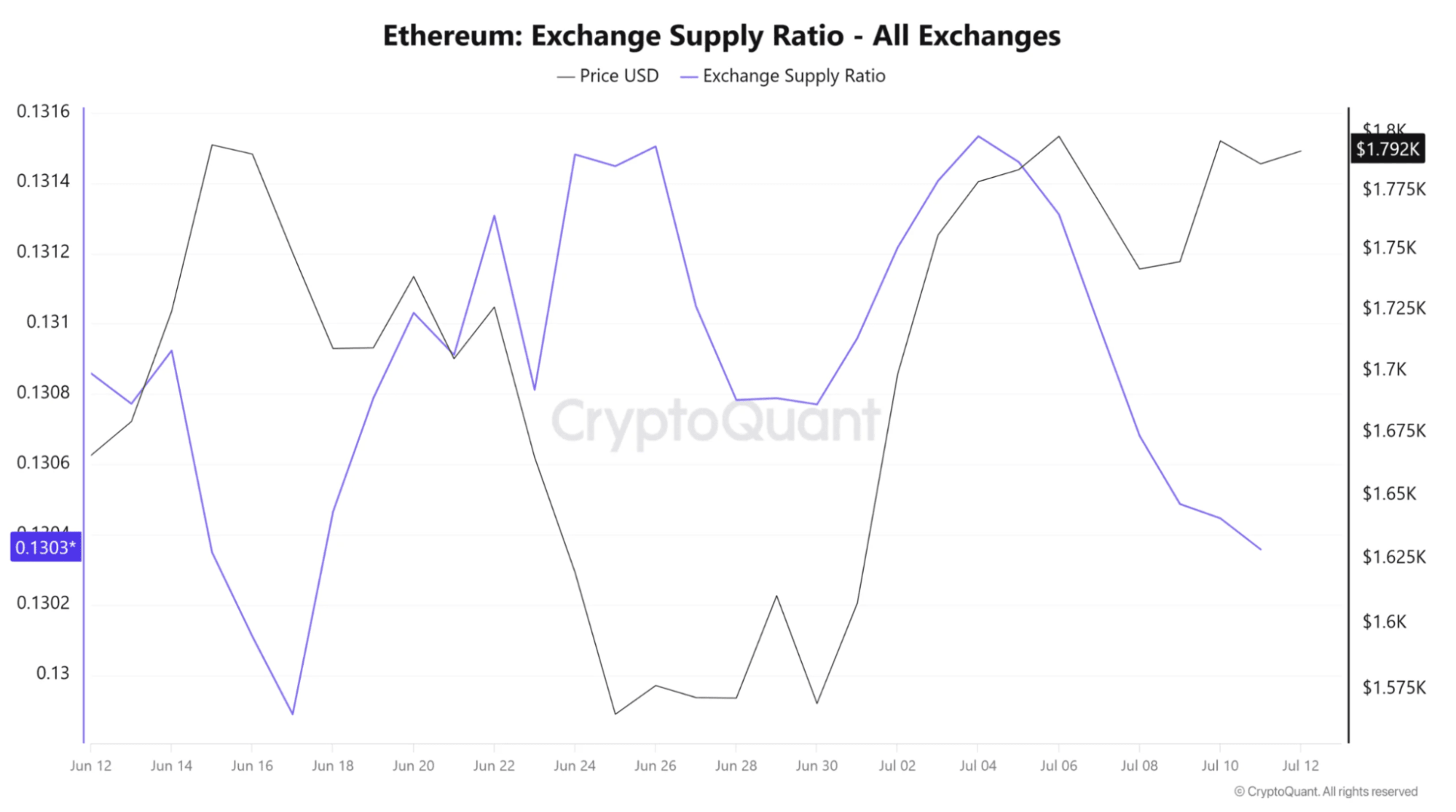
At the time of writing, Ethereum (ETH) has reclaimed the $1,800 level and held it for three straight days, trading around $1,857.84 after rising 7%. As the price steadies, high-net-worth investors have seized the opportunity to increase their positions.
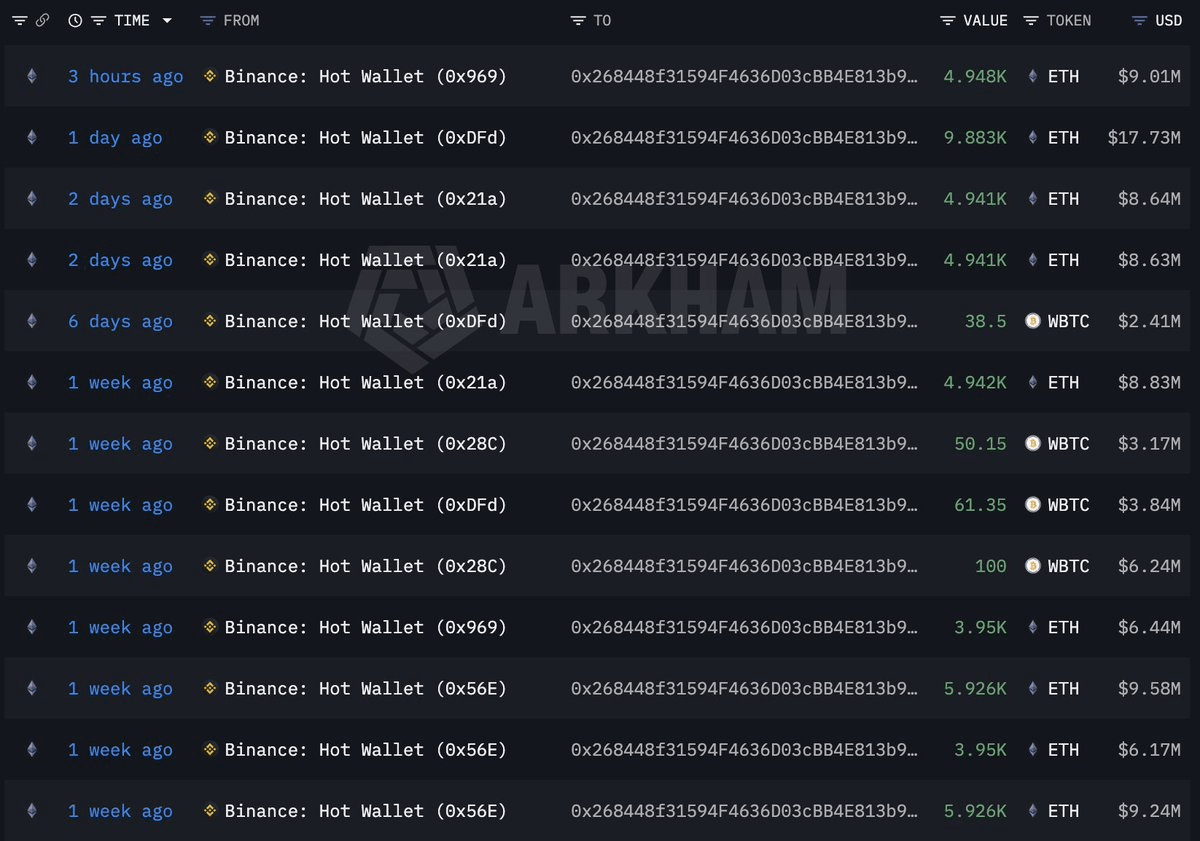
According to Lookonchain, one whale withdrew 4.95K ETH worth $9.01 million, bringing their total holdings to 49,407 ETH, valued at $84.3 million. Additionally, Onchain Lens reported two wallets, likely linked to the same entity, purchasing 6,358 ETH worth $11.59 million. In total, these whales purchased 11,306 ETH worth $20.59 million.
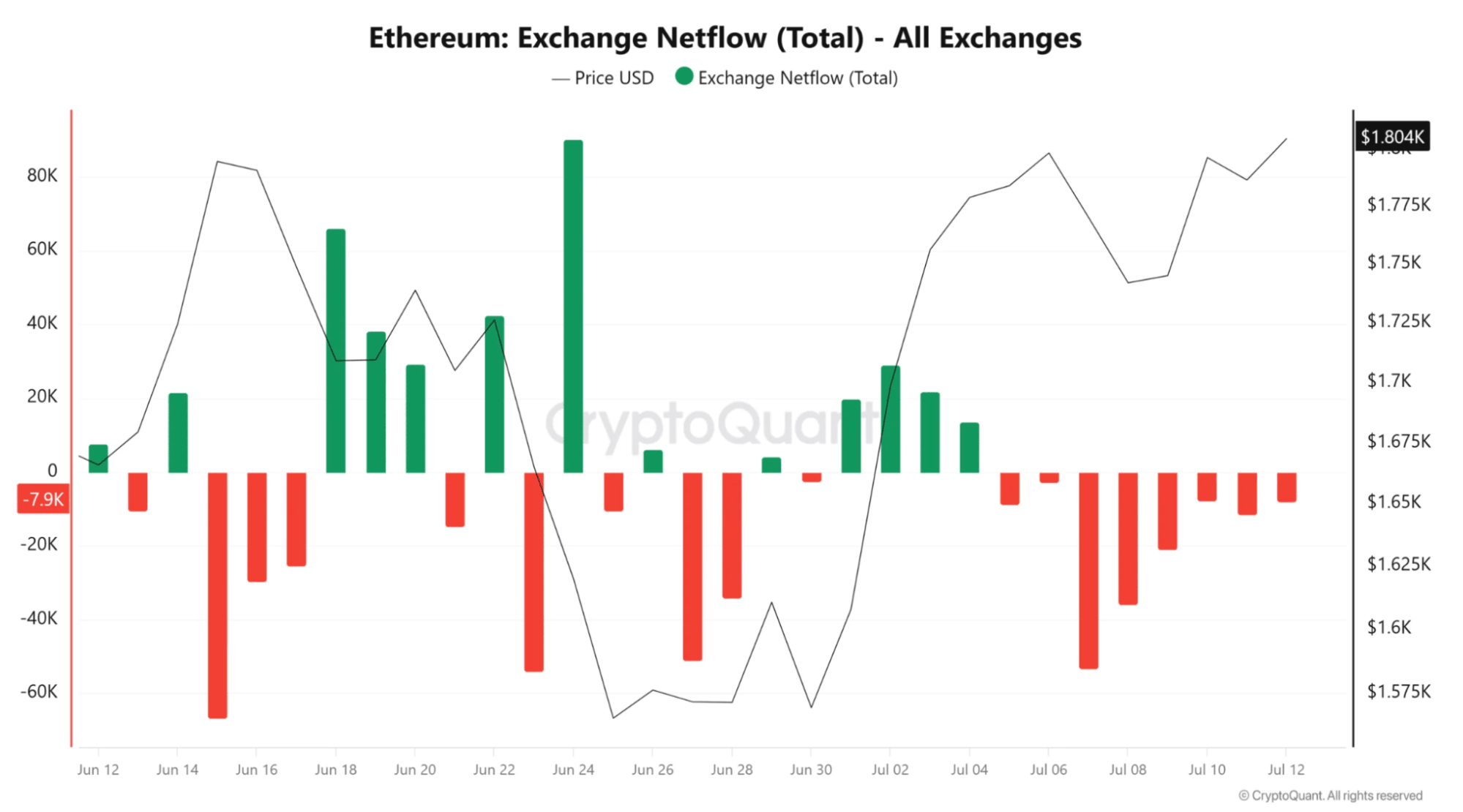
Sustained whale accumulation alongside a price recovery signals strong confidence in the market. A look at CryptoQuant’s Exchange Netflow data supports this view: net flow has remained negative for eight consecutive days, marking the longest negative streak year-to-date. A sustained period of negative net flow suggests that buyers have gained control and displaced sellers.
Due to continued exchange outflows, scarcity has increased while the supply available for immediate sale has declined. The altcoin’s Exchange Supply Ratio (ESR) declined to a three-week low of 0.13 at the time of writing. A drop in ESR indicates that fewer Ethereum tokens are entering exchanges than leaving them, and historically such a setup has preceded greater price appreciation.
Why Solana record FUD could be a bullish setup
Solana’s recovery appears to have lost momentum recently. Trading near $77, it is facing one of its most negative sentiment readings of 2026. SOL’s trading volume has dropped to its lowest point this year, while negative commentary surrounding the asset has surged to its highest daily level, according to Santiment.
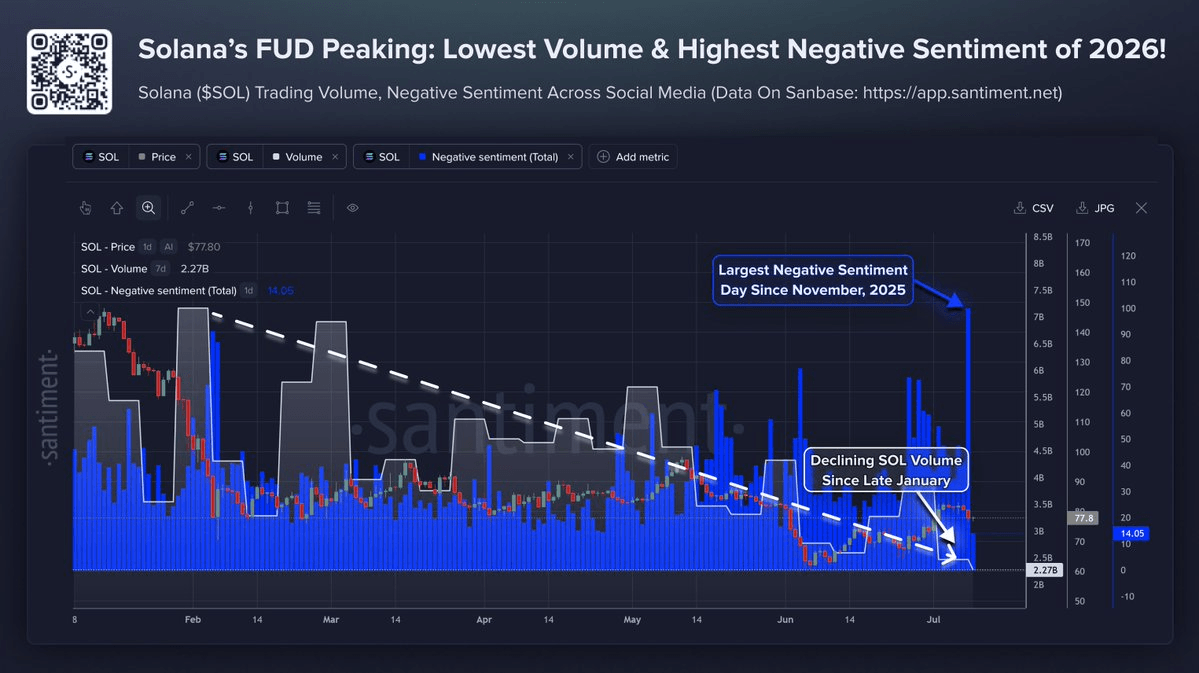
Much of the disappointment stems from expectations that strong narratives around tokenized stocks and real-world asset (RWA) activity would translate into stronger price performance, something traders have yet to see.
Santiment noted that this combination of elevated fear, uncertainty, and doubt alongside weak trading volume has historically created conditions that favor a rebound. With retail participation low and sentiment deeply negative, there may be less resistance if large stakeholders decide to drive Solana’s price higher, potentially setting the stage for a sharp move that catches traders off guard.
Pointing to positive signals, the Solana network added 1.60 million new addresses over the past two weeks. The Super Trend indicator on SOL’s three-day chart also flashed a new buy signal for the first time since October 10, 2025, when the Average True Range (ATR) trailing stop moved below the price.
Analyst Ali Martinez noted that the previous SuperTrend sell signal was followed by a 74% price correction, and says the latest signal points to a bullish trend that could send SOL toward $100. Michael van de Poppe also observed that SOL has re-entered its trading range and may briefly pull back before continuing upward, with the $75-$77 range as potential support opening the door to gains toward $100 and potentially $120.

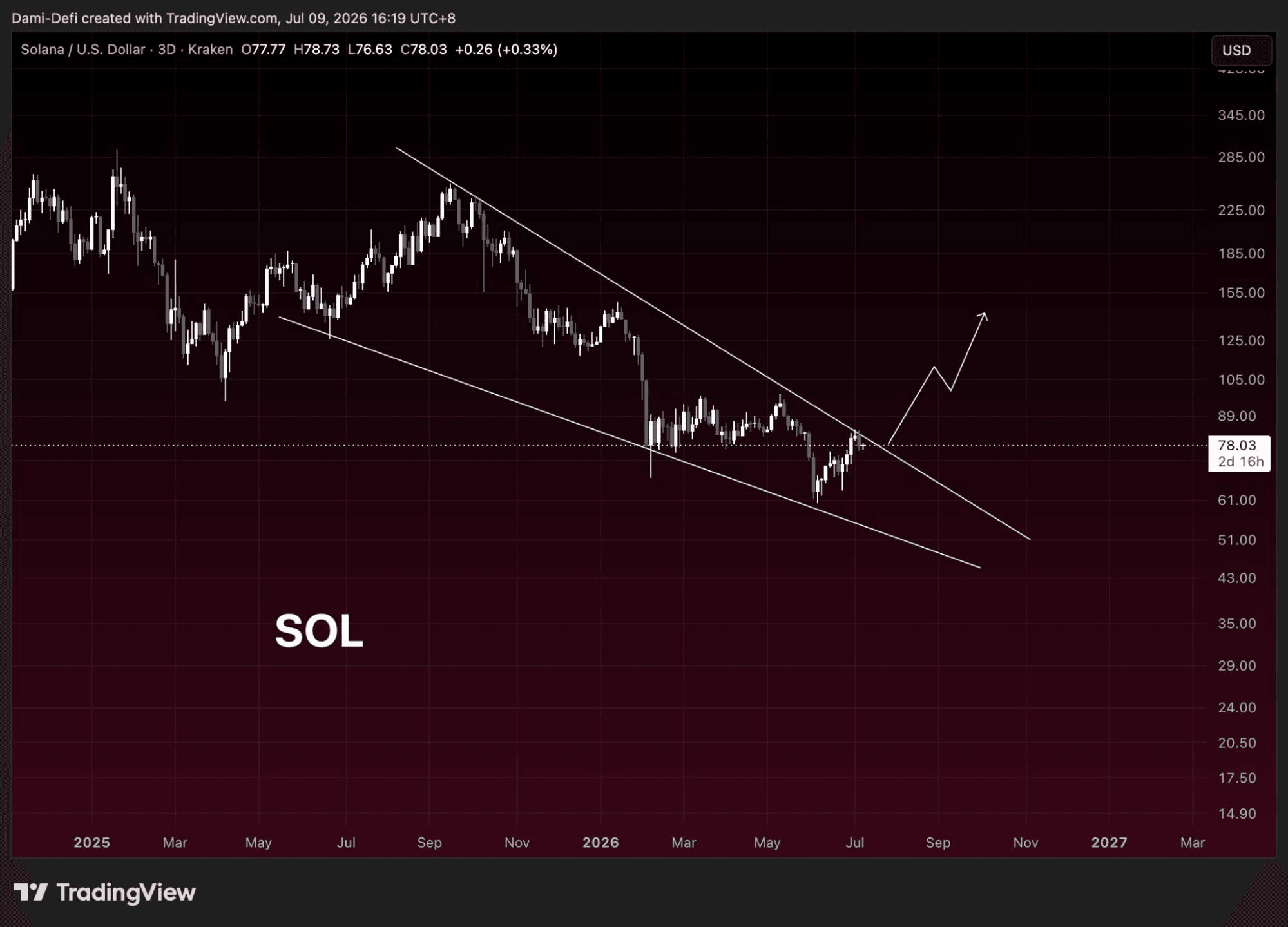
Analyst Dami-Defi also pointed to a potential breakout, with SOL currently testing the upper boundary of a descending channel in place since September 2025. According to the analysis, a three-day close above $78 would confirm the breakout and open the door to an initial move toward $105, followed by $125 and $155 if momentum continues.
Zypto launches Share Studio for real-time crypto content
Zypto has introduced Share Studio, a new feature that lets users turn live crypto data from Zypto.com v2 into ready-to-post social content in just a few clicks. Built directly on top of Zypto’s upgraded market data platform, Share Studio is designed for traders, creators, and brands who want to publish timely crypto visuals without juggling multiple tools.
Share Studio sits on Zypto.com v2, which now hosts over 25,000 cryptocurrency pages, as well as charts, heatmaps, and curated educational content. From that data layer, users can instantly generate graphics based on live prices, performance, or trending assets, then customize layouts and export them for social platforms. The goal is to compress the entire workflow from checking markets to sharing a chart into a single, browser-based experience.
Instead of screenshotting exchange interfaces or manually designing posts in external software, Share Studio lets users select a coin, chart, or heatmap view on Zypto.com and convert it into a clean, branded visual. Templates are optimized for social feeds, so creators can focus on their message while relying on Zypto’s market engine for the underlying data. Because the visuals are generated from live feeds, they reflect current prices and moves at the moment of sharing.
The launch of Share Studio extends Zypto’s positioning beyond a crypto wallet and payments app toward a broader ecosystem that includes research, analytics, and content tools.
Closing remark
Hyundai’s Avalanche proof-of-concept shows that stablecoin-based cross-border remittance is moving from theory to practice at major corporations. Polymarket’s FCM license application signals growing ambition to bring institutional-grade margin trading to prediction markets, with Kalshi already ahead in the race.
SpaceX’s $88 Bitcoin test send has revived speculation about the company’s 18,712 BTC treasury, though precedent suggests custody housekeeping rather than a sale. Ethereum whales continue to accumulate, with negative exchange netflow sustaining the longest streak of the year. Despite record negative sentiment, Solana’s on-chain signals may be setting up a bullish reversal for patient traders.
Haaland’s Viking-themed meme coins reflect the cultural energy that the World Cup continues to inject into crypto markets. Zypto’s Share Studio extends the platform’s utility beyond wallets and payments, turning live market data into social content at the click of a button.
FAQs
What did Hyundai implement?
Hyundai completed its first proof-of-concept testing of a stablecoin-based remittance system on the Avalanche blockchain, processing a $20,000 USDT transfer between its U.S. and Mexican entities in an average of seven minutes.
What are the Haaland-themed memecoins?
They include $HAALAND and $VIKINGROW, anonymous meme coins launched on Solana to capture retail interest around Norway's World Cup run. Neither carries any utility or verified link to Erling Haaland.
What is the latest on Polymarket?
Polymarket has applied for a Futures Commission Merchant license in the U.S. through its affiliate, Coming Home GBA LLC. If approved by the CFTC, this would allow it to offer margin trading to U.S. users.
What did SpaceX do with Bitcoin?
SpaceX sent an $88 test transaction between two of its internal tagged wallets, its first on-chain Bitcoin move in six months. The company holds 18,712 BTC, unchanged since its June 2026 IPO filing.
How much ETH did the whales purchase?
Two whale entities purchased a combined 11,306 ETH worth approximately $20.59 million, according to Lookonchain and Onchain Lens data.
Prices, fees, features and availability mentioned in this article were correct at the time of publishing and may have changed since.