
Gm frens, welcome to our third news story for August.
PLUMBER surges 10,000%, NBA champion discloses his Bitcoin ritual, as Ethereum’s next upgrade targets privacy. DOGE may be ready to explode, TRON’s $1B stablecoin surge outpaces every chain, and Solana’s $20M whale just loaded up again. Lastly, Zypto launches a free online crypto course for beginners.
Let’s get into it.
An X post spawns a 10,000% meme coin rally
A meme coin called PLUMBER has surged more than 10,000% since its launch, riding a viral crypto X argument over whether early crypto traders once beat weaker rivals. The token’s market capitalization climbed from below $1 million to above $5 million on its first day, then pulled back and held in the multimillion-dollar range.
According to analyst Stitch, it all began with a simple post. Trader Frank DeGods claimed crypto veterans were trading against weaker retail players he called “plumbers.” Commentator Threadguy pushed the point further. He suggested that legendary traders from 2017 to 2019 simply faced softer competition.
Trader Ansem pushed back. He argued those years were brutal, full of scams, leverage wipeouts, and tokens that later collapsed to near zero. The exchange hardened into a running theme on Crypto Twitter, framed as “oldheads versus plumbers.” A developer then created the PLUMBER meme coin. Moonshot also verified it earlier today.
Trading volume has surged to $14.2 million as the meme spread across group chats and timelines. Well-known accounts amplified it. Cobie posted plumber memes, and traders, including traderpow and ResellCalendar, bought into the token.
That created a familiar feedback loop. Social attention drew key opinion leaders (KOLs), capital followed, volume rose, and fresh visibility pulled in more buyers. The chart tracked the frenzy.
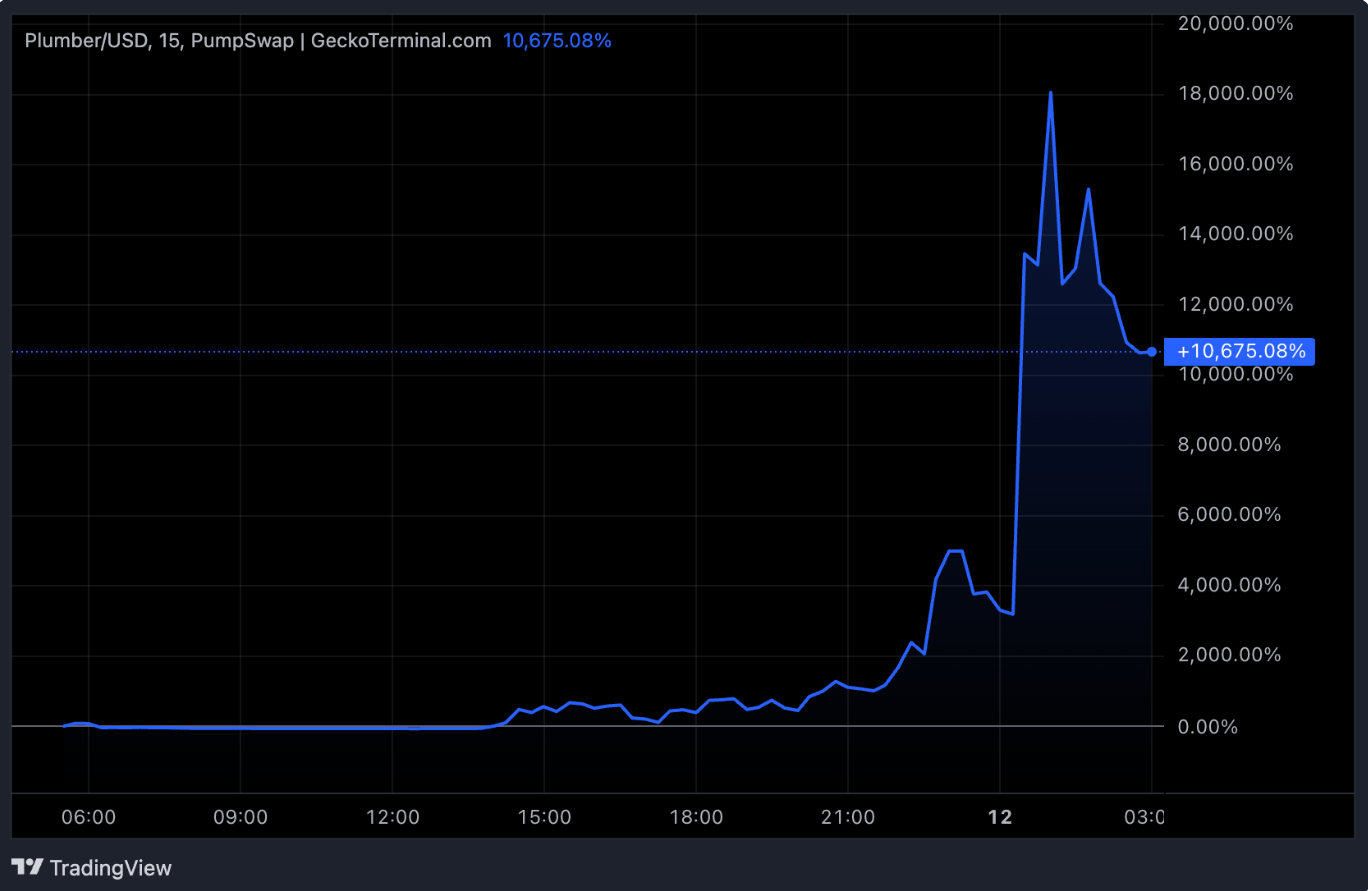
Yet, the token carries risks. Similar attention-driven rallies tend to fade. Cash Cat (CASHCAT) jumped roughly 4,000% in a week during July before the rally lost momentum. For now, PLUMBER’s momentum depends on the meme staying loud. Whether the developer builds anything beyond the joke remains an open question.
NBA champion discloses his daily Bitcoin ritual
NBA champion Tristan Thompson says he buys Bitcoin every single day and tells teammates calling him mid-season to do the same, regardless of what the chart shows. The Cleveland Cavaliers veteran joins a growing list of basketball figures turning into vocal crypto advocates.
In economic terms, Dollar-Cost Averaging (DCA) means buying a fixed amount of an asset at regular intervals, regardless of price, to smooth out volatility over time. Thompson described that exact approach on The Pomp Podcast.
His pitch to teammates avoids price predictions entirely. He frames the purchase as stacking digital gold, warning them that they will have to explain to their grandchildren why they hesitated at $63,000.
The reasoning behind his conviction differs from most. Thompson says he does not own Bitcoin because he expects the dollar to fall, but because he expects the internet to keep winning.
His timeline traces back to 2008. That year, the global financial system cracked, and Bitcoin emerged as what he calls a “Robin Hood” figure in the pursuit of financial freedom. Geography shapes his view, too. He considers the U.S. still early in adoption compared with Asia and the Middle East, where crypto payments already appear in everyday commerce.
He cites one concrete example. Emirates now accepts cryptocurrency for flight bookings. Regulation features in his outlook. Thompson pointed to the GENIUS Act and possible passage of the CLARITY Act as catalysts that could unlock substantially more institutional capital.
Furthermore, his advocacy extends beyond the asset itself. Thompson has taken on a financial literacy mission since shifting from playing to investing. He tells them to read and understand how compounding actually works. Still, he is far from alone in that space.
Scottie Pippen tokenized the 1991 NBA Finals Game 5 ball as a blockchain asset. LeBron James partnered with a crypto company on blockchain education, while Spencer Dinwiddie attempted to tokenize his NBA contract. Conversely, Stephen Curry, Klay Thompson, and Andre Iguodala all lost money on crypto ventures during previous cycles.
Ethereum’s next upgrade targets privacy
Ethereum developers are considering changes that could let privacy pools pay their own transaction fees. This effectively reduces their reliance on third-party services that can expose wallet activity.
In a post on X on Monday, Ethereum Foundation researcher Toni Wahrstätter said the Protocol Architecture team wants to prioritize two proposals for Hegotá, among others.
The first is the major Ethereum upgrade scheduled for 2027: Frame Transactions (EIP-8141), which would give wallets more control over how transactions are executed. The second is Fork-Choice Enforced Inclusion Lists, or FOCIL (EIP-7805), which would make it harder to censor eligible transactions.
Frame Transactions would work with Keyed Nonces and Recent Roots (EIP-8272) to let privacy pools pay their own fees without an intermediary. The package also includes Transaction Assertions (EIP-7906), which would let wallets set conditions on what a transaction can do after it is submitted.
The posts come as Ethereum co-founder Vitalik Buterin has pushed for major changes to the network, including greater privacy, quantum-resistant security, and less reliance on Layer-2 networks.
In February, Buterin outlined plans to replace cryptography vulnerable to quantum computers, while Ethereum researchers proposed a roadmap for faster transactions, native privacy, and quantum-resistant security through 2029. He also said privacy and quantum resistance had become greater priorities for Ethereum, alongside simplifying and scaling the network.
Hegotá will follow Glamsterdam, which developers aim to ship by the end of 2026, with Wahrstätter cautioning that developers “can’t do everything at once and still expect to ship on time.”
DOGE may be ready to explode
The meme coin mania is long gone and perhaps not even a distant memory, as evidenced by the substantial decline in the price of its leader. Dogecoin (DOGE) recently slumped below $0.07 for the first time in almost three years, a level that it’s still unable to reclaim.
Although it remains 90% away from its 2021 all-time high, several popular analysts believe precisely these depressed conditions could be setting it up for the next major expansion wave.
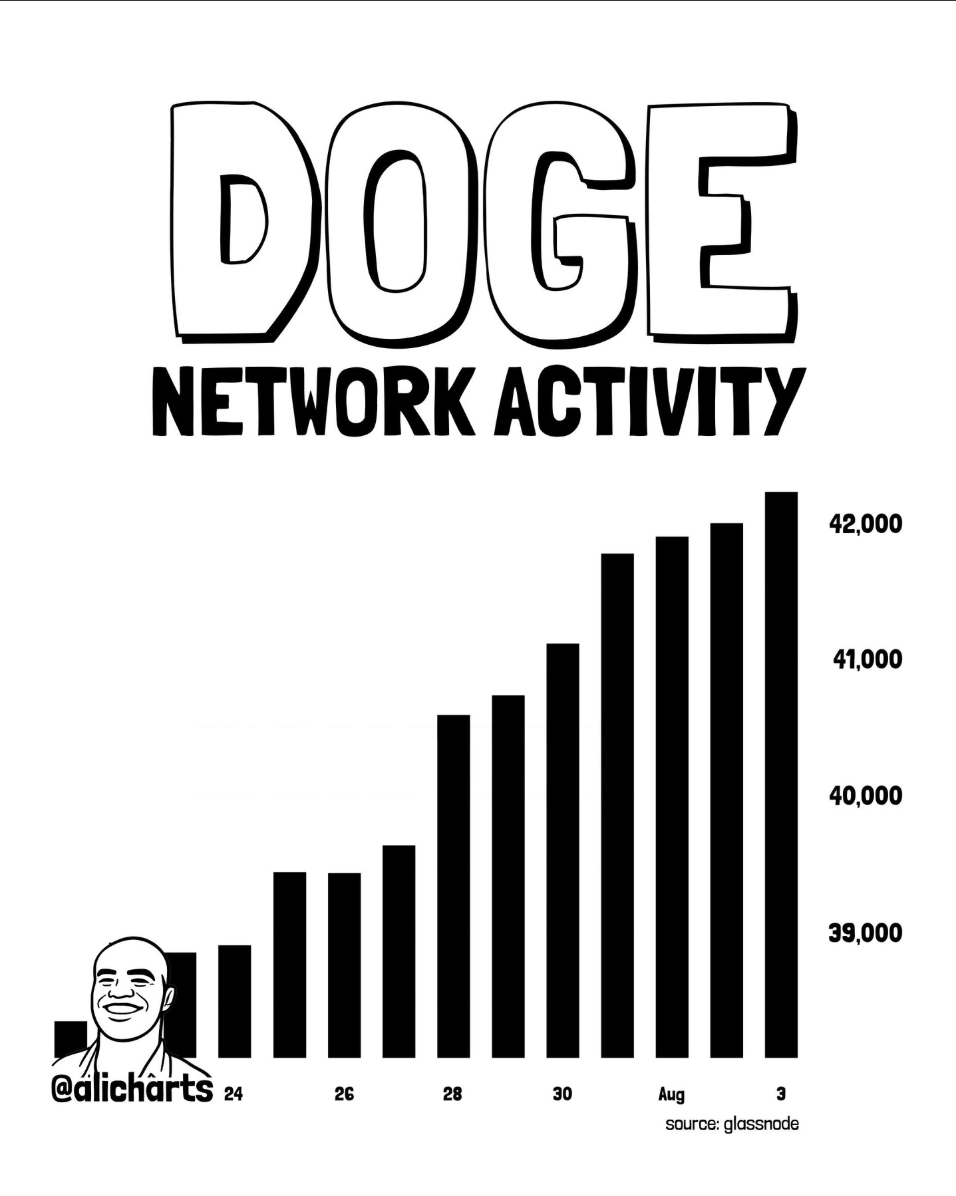
First, Ali Martinez mentioned on X that several indicators have aligned to support a bullish thesis for DOGE. He argued that the OG meme coin has approached a parabolic phase after the asset returned toward the bottom of the large price channel that has contained its movements for years.
As recently reported, Martinez also claimed that Dogecoin’s weekly TD Sequential indicator has produced multiple consecutive buy signals. This is described as a possibly important warning of an upcoming release. Also, active DOGE addresses increased from 38,000 in July to 44,000 earlier in August.
Secondly, Crypto Patel also highlighted the asset’s current position within its long-term accumulation structure. He repeatedly identified the $0.07-$0.10 region as DOGE’s major accumulation zone and believes another successful hold could pave the way toward much more ambitious targets.
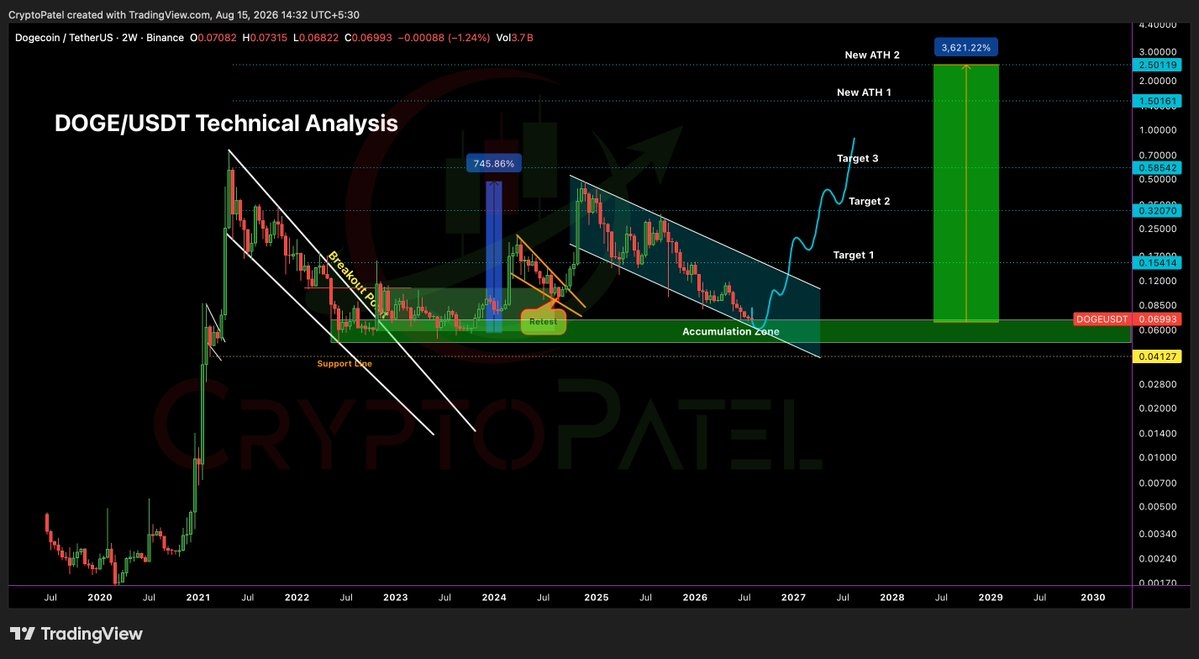
Some of his long-term projections sound far-fetched right now, with the highest at $4. To get there, though, the meme coin would have to reach $0.28, the most realistic target, before it targets new all-time-high territory at $1 and $2.
Popular trader Lucky told his almost two million followers to “keep an eye” on the largest and first meme coin. They suggested it could produce a considerable run over the coming weeks and months.
TRON’s $1B stablecoin surge outpaces every chain
Liquidity in crypto does not seem to be an issue as the stablecoin market cap continues to grow. This growth was seen both chain-wise and across issuers. TRON has maintained its lead as the largest execution layer, especially for USDT, with 49.35% deployed on the network.
According to Token Terminal data, the stablecoin market cap on the TRON network added $1 billion as of August 13. That was more than tenfold the growth of any other chain during this period, with BNB Chain and Aptos following behind.
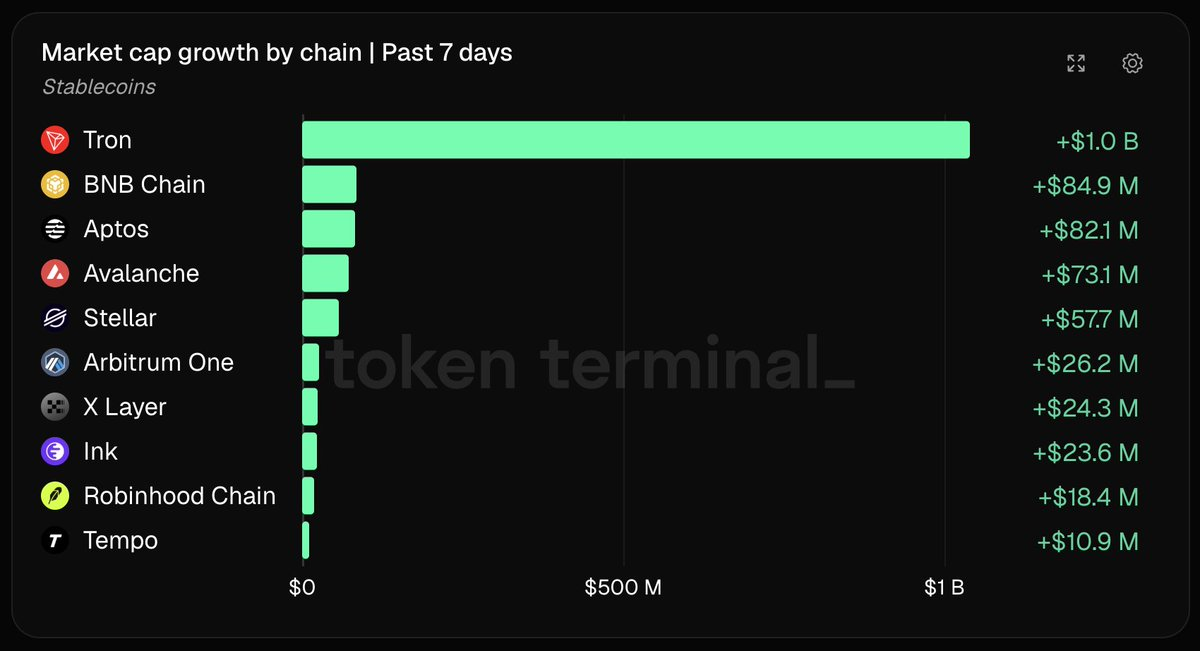
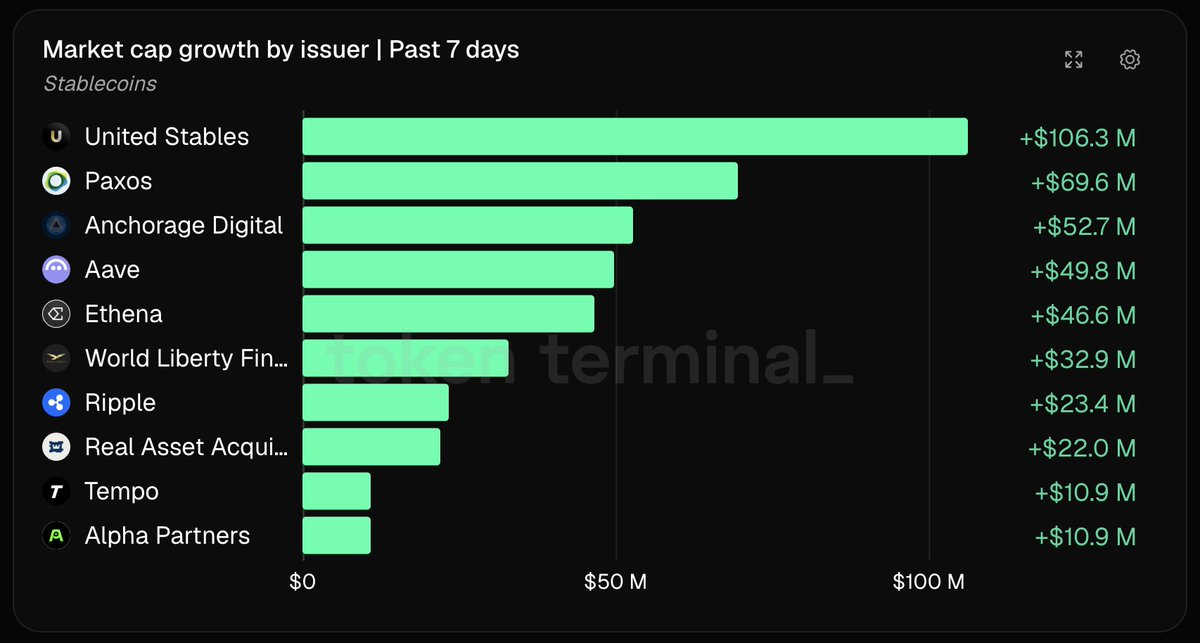
In terms of market cap growth by issuer over the same period, United Stables led, with Paxos and Anchorage Digital not far behind. The minting of more stables by issuers suggests demand is rising.
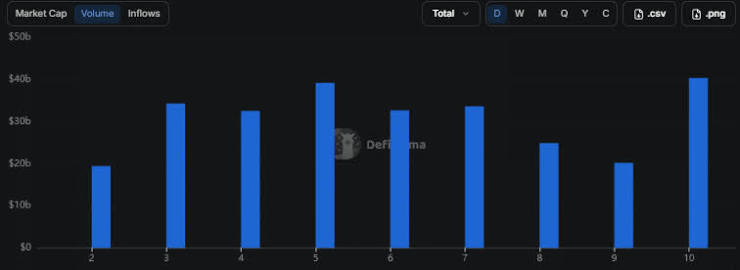
At the same time, a spike in stablecoin DEX volume reinforces demand for liquidity. For instance, stablecoin volume hit a new daily peak this month, reaching $40.37 billion on August 10.
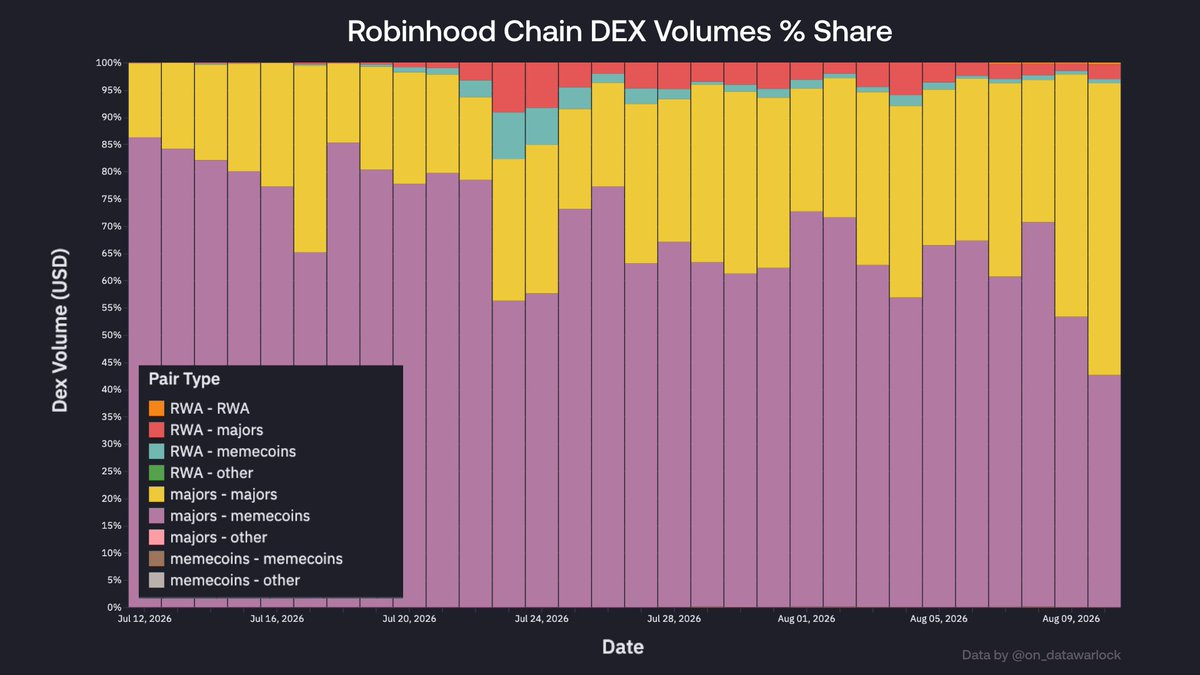
Platform-wise, Robinhood Chain peaked on the same day with $366 million in stablecoin DEX volume. ETH-stablecoin represented $193.2 million, more than half the total. Of Robinhood’s daily stablecoin DEX volume, over 50% was exchanged between major pairs. This indicated traders were rotating to major cryptos like BTC, ETH, XRP, and SOL, among others.
Solana’s $20M whale just loaded up again
A Solana whale that banked more than $20 million in 2023 has resurfaced after two years, buying $3.6 million in SOL. Blockchain tracker Lookonchain flagged the purchase. This comes as SOL trades roughly 74% below its January 2025 record high.
The buy totaled 47,535 SOL. The wallet, tagged GvHYQQ, accumulated in 2023, before SOL began its climb. It bought 291,790 SOL for $6.82 million across the August and October dips that year, averaging $23.37 per token. SOL then started climbing in late 2023.
The whale sold 191,789 SOL for $24.62 million at an average price of $128.36, locking in more than $20 million in realized profit. The address stayed silent for over two years afterward. Now, after two years of inactivity, the whale is buying the SOL dip again, according to Lookonchain.
According to Arkham data, the wallet still holds roughly 100,000 SOL from its original 2023 stack. The fresh buy lifts that position to about 147,535, worth close to $11.1 million at current prices.
Overall, the backdrop is split. Several on-chain signals, like reduced trading volume and increased exchange inflows, turned bearish in mid-August. Exchange netflows flipped positive, while decentralized exchange volume sat close to 80% below its April peak.
Institutional flows point the other way. Solana ETF inflows climbed to $10.26 million in the week ending August 14, nearly 70 times the prior week’s total. With the macro and geopolitical backdrop still volatile, whether the bet pays off a second time is an open question.
Zypto launches free online crypto course for beginners
Zypto has launched “Understand Crypto,” a free online learning course designed to help beginners build a practical understanding of cryptocurrency, blockchain technology, self-custody, and everyday crypto use.
The course consists of 21 short lessons written in plain language, taking users through the fundamentals of crypto in a structured order rather than relying on technical jargon or trading-focused content.
Understand Crypto covers core concepts including how digital assets work, the role of wallets and private keys, how to keep crypto secure, and how users can spend or move their assets.
By making the course freely available, Zypto is expanding its wider ecosystem beyond wallet services, payments, cards, and swaps, while addressing one of the sector’s biggest barriers to adoption: the complexity of getting started.
The educational platform is aimed at people new to crypto who want to understand the technology before using it, rather than being immediately pushed toward buying, trading, or investing in digital assets.
Zypto said the lessons are designed to explain crypto “in the order it makes sense to learn it,” giving users a clearer foundation before they begin managing wallets, making transactions, or exploring DeFi.
The launch supports Zypto’s broader ambition to build an accessible crypto ecosystem, combining education with practical tools for holding, swapping, and spending digital assets.
Closing remark
PLUMBER surged more than 10,000% after a viral crypto X dispute about whether early crypto traders profited by outperforming less experienced “plumbers” inspired the token’s creation.
While athlete endorsements have historically preceded both durable adoption stories and expensive disappointments, Thompson’s framing acknowledges the uncertainty. Play the long game, he admonishes, and worry less about the price.
Ethereum developers are weighing a package of proposals for the 2027 Hegotá upgrade that could allow privacy pools to cover their own transaction fees, improve wallet-level transaction controls, and make transaction censorship harder.
DOGE’s drop below $0.07 has led several analysts to argue that the token may be entering a long-term accumulation and potential breakout phase. TRON added roughly $1 billion in stablecoin market cap by August 13, reinforcing its dominance as a USDT settlement network.
A Solana wallet that realized more than $20 million in profit during SOL’s 2023 rally has returned after two years to buy 47,535 SOL worth $3.6 million. As crypto platforms compete to bring more mainstream users into self-custody and on-chain services, education is becoming an increasingly important part of the user experience. Zypto is positioned to do this effectively with Understand Crypto.
FAQs
Which memecoin surged from an X argument?
PLUMBER surged more than 10,000% since its launch, riding a viral crypto X argument.
Which NBA player spoke positively about Bitcoin?
Cleveland Cavaliers' Tristan Thompson says he buys Bitcoin every single day.
Which upgrades are Ethereum developers working on?
Ethereum developers are weighing a package of proposals for the 2027 Hegotá upgrade.
What is the latest on TRON?
TRON is currently the blockchain with the largest market cap growth.
Will DOGE rise again?
Some crypto analysts have argued that the OG meme coin has approached a parabolic phase.
Related topics