
Gm frens, welcome to the fourth news roundup for September!
XRPL payments get upgraded, Hana Bank issues South Korea’s first digital bond, while Ripple whales load up on XRP. Google and Apple seek to hire crypto talent, Cardano enters the race for AI agent payments, and Elon Musk’s X offers crypto and stock trading. Lastly, Zypto App upgrades to v1.29.
Let’s dive in.
XRPL payments upgrade draws institutional interest
According to reports, Ripple says asset managers and other commercial projects are preparing to use an XRP Ledger feature that can make several linked transactions settle together. In the same vein, a rebuilt version of the upgrade is approaching activation after an extensive security review.
The feature, called “Batch V1.1,” can combine as many as eight transactions into a single operation. Its all-or-nothing mode ensures every transaction succeeds or the entire group is canceled, avoiding cases where one side of a deal settles while the other fails.
This is particularly important for use cases like delivery-versus-payment, where the asset and payment must move atomically. Delivery-versus-payment links asset transfer to payment. Instead of trusting one party to send first, the ledger completes both legs together, or neither.
Batch V1.1 could also let exchanges, wallets and marketplaces attach their service charges directly to a customer transaction. A payment and the platform’s fee could be processed as one operation rather than through separate transfers. The amendment has support from 30 of the XRP Ledger’s 35 tracked validators, above the 28 votes required to enter its activation countdown.
That countdown began September 15 at 14:06:41 UTC. Batch V1.1 is projected to activate shortly after the same time on September 29, provided support remains at or above 80% for the full 14-day window. Validators can change their votes, making the date conditional. The approaching activation follows a security failure that caused developers to withdraw the original version.
Researchers found a critical flaw in Batch V1.0’s signature-validation process in February. Under certain conditions, the code could stop checking signatures early, allowing an attacker to include transactions from another account without the owner’s authorization.
Validators were still considering the amendment, and it had not been activated, meaning the vulnerable code never governed the live ledger and no funds were exposed. As previously highlighted, the amendment will remain in its countdown through September 29. If validator support drops below 80% before then, the clock stops, and a new 14-day window must begin after the proposal regains the required majority.
Hana Bank issues South Korea’s first digital bond
South Korea’s Hana Bank has reportedly issued a five-year, $100 million digital bond using Euroclear’s blockchain-based platform. On Monday, Yonhap News Agency reported that the bank used Euroclear’s Digital Financial Market Infrastructure (D-FMI) to issue the foreign-currency bond.
The report described the transaction as South Korea’s first digital bond issuance to use Euroclear’s blockchain infrastructure directly. Hana Bank ranks second by market position in South Korea, while Euroclear is a Brussels-based financial services company and one of the world’s largest central securities depositories (CSDs).
Euroclear issued the foreign-currency digital bond via its blockchain platform. It handles issuance, registration, and settlement of securities on a distributed ledger rather than through conventional systems. Using the technology for bond allocation and payment settlement reportedly shortened the process from three to five business days to the same day.
South Korea is racing to build a tokenized securities infrastructure ahead of a February 2027 launch date set by its Financial Services Commission (FSC) for a full tokenized framework. Hana’s bond is the first live proof that Korean banks can plug directly into established global blockchain settlement infrastructure without waiting for domestic rules to catch up.
The D-FMI platform connects to Euroclear’s existing settlement network, meaning institutional investors could buy and trade the bond through their current Euroclear accounts without installing separate systems.
Ripple whales load up on XRP
Large XRP holders have gone on a spectacular buying spree as the token reels from the CLARITY Act setback in the US Senate. The bill, meant to create a framework for legislative oversight, was rejected. This pushed the token’s price down sharply.
Yet, popular crypto analyst Ali Martinez noted that over the weekend, Ripple whales accumulated about 1.54 billion XRP in about 96 hours. At current prices, this amounts to about $2 billion. This short-term accumulation helped the asset recover after the Senate vote.
Martinez believes that this buying can soon “translate into price action, leading to a bullish breakout.” Similarly, other on-chain and technical signals suggest that the recent selling pressure might be easing. Other analysts also opine that XRP might be preparing for another leg up.
Crypto Patel noted that XRP is sitting above a major long-term accumulation zone on the 2-week chart, and it has reclaimed its long-term structure. As such, the analyst outlined major targets, starting with a potential run toward the first crucial resistance at $1.70. If that one falls, the asset could head toward $3.00, and Patel’s long-term target remains at a whopping $10 or even beyond.
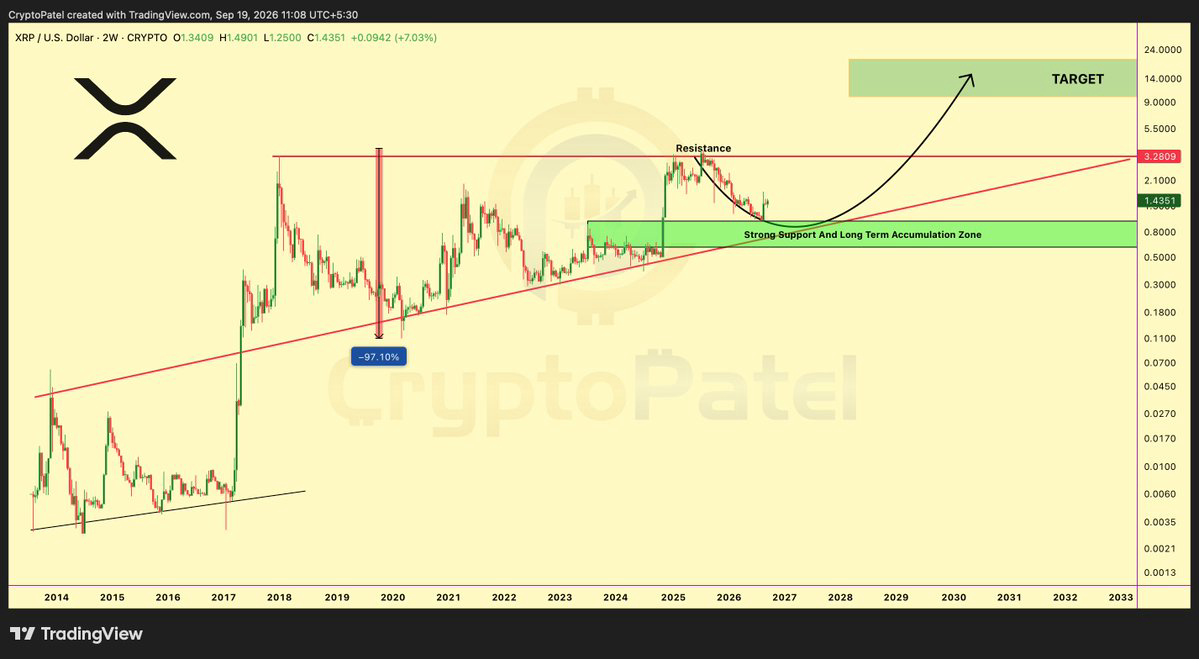
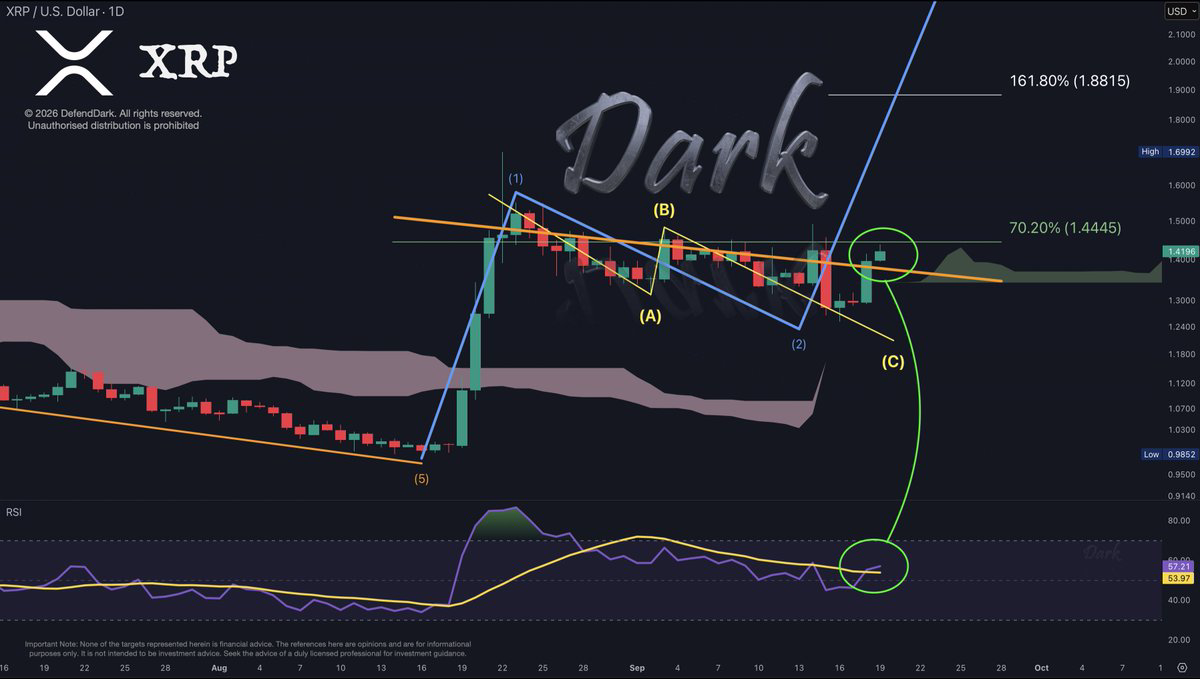
Meanwhile, Dark Defender said XRP’s 5-wave structure is “rock solid,” after the asset “said bye-bye” to a key resistance capping its breakout attempts. The analyst was slightly more modest in their predictions, saying XRP’s next targets are $1.70 and $1.88.
Google and Apple seek to hire crypto talent
Google and Apple are seeking employees with expertise in crypto-related digital assets. This adds to signs that Big Tech firms are preparing for a larger role for stablecoins, tokenization and blockchain-based payments.
Google Cloud is hiring an Industry Principal Architect in Hong Kong to work with protocol foundations, exchanges, custodians and financial institutions to tokenize real-world assets across the Asia-Pacific (APAC) region. Google said the hire would advise executives and help shape its Web3 product roadmap as it seeks to become the preferred cloud provider for digital-asset builders.
Apple is also expanding into digital assets. It is looking for an Apple Pay Financial Product Strategy Lead based in Cupertino, California, or New York. The listings do not confirm that either company is launching a new crypto product. Still, they do show that stablecoins and tokenized deposits are becoming relevant within the world’s tech ecosystems.
Apple’s role focuses on strategy for Apple Card, Apple Cash, peer-to-peer payments and other consumer financial products. The company is seeking someone to assess new products, partnerships and commercial models across wallets, payments and commerce.
Google’s job is more explicitly tied to digital assets. Its prospective architect would focus on cloud infrastructure, transaction-signifying systems, blockchain nodes and compliance requirements in markets including Hong Kong.
CME Group, a marketplace for institutional derivatives trading, previously announced an expanded partnership with Google Cloud to explore asset tokenization and blockchain payments. It also announced the first phase of integration and testing of the Google Cloud Universal Ledger (GCUL).
The hiring notices follow Samsung’s plan to add stablecoin features to Galaxy smartphones through Samsung Wallet. The move could give hundreds of millions of users access to digital-asset payment tools by default. For many, Samsung’s scale could be a distribution advantage for stablecoins.
Cardano enters the race for AI agent payments
Cardano has been added to the official x402 software kit, giving developers the code needed to let an app or AI agent pay for an online service using ADA or tokens issued on the network.
x402 turns the web’s largely unused “402 Payment Required” response into a checkout built directly into an internet request. A service sends back its price and payment instructions; the agent signs a payment and receives the requested data or computing power after the transaction is verified.
That means an agent preparing a report could buy a single dataset when it needs it, without a person opening an account, entering card details, or paying for a monthly subscription.
Linux Foundation announced the operational launch of x402 in 2025, with members including Amazon Web Services (AWS), Cloudflare, Google, Ripple, Shopify, Polygon Labs, etc. Solana, the XRP Ledger and several Ethereum-compatible networks already support the standard.
Cardano Foundation engineers began with a specification accepted in June, then built the client and server software needed to request payments, along with a so-called facilitator that verifies and submits them. The initial release supports TypeScript, with Python planned next.
The facilitator’s documentation says it completed a real transaction on Cardano’s pre-production network but has not yet been run on mainnet. Developers can begin integrating Cardano, but the release does not show agents already paying for commercial services with ADA at scale.
Cardano is joining the same race as Solana and XRP Ledger: getting its assets installed wherever developers eventually choose to build machine payments.
Elon Musk’s X offers crypto and stock trading
Elon Musk’s X has widened its U.S. Cashtag system, connecting stock, ETF and cryptocurrency pages to five outside trading platforms. The announcement came Tuesday in a post, unveiling the U.S. Cashtag Partner program with platforms like Interactive Brokers and Moomoo, among others.
Users can now tap “Trade” after opening a supported ticker such as $BTC or $TSLA. Once a user selects a Cashtag, X displays a live price chart alongside related posts, then shows available trading partners. The user then signs in to an existing account or creates a new one to complete the trade.
X is just letting users act quickly on financial chatter on their timeline, without acting as a broker. The actual buying and selling still happens on a partner exchange, not on X. This gives users a faster route from financial posts to order execution.
Cashtags have been available on X for years as a way to follow financial market chatter. Earlier this year, the company upgraded them with real-time prices and charts. Adding a direct path to trade is the next step in Elon Musk’s effort to turn X into a broader finance destination.
X has millions of users globally. Active daily engagement is said to be around 132 million via mobile devices and over 245 million globally across all devices. X is also an undisputed central hub of the crypto community. A single post from a prominent figure can instantly shift liquidity across crypto exchanges worldwide.
That ‘town-square’ effect helps X stand out from other platforms like Discord and Telegram, where conversations are fragmented across private channels. The new feature could widen that gap further.
Zypto App upgrades to v1.29
Zypto has released version 1.29 of its crypto app. It introduces a redesigned home screen, a dedicated notifications center, prepaid virtual cards, upgrades to bill payments, card top-ups, and wallet imports.
The new notifications center gives users a central place to view important updates from across the app. This helps them keep track of wallet activity, payment-related updates, card actions, and other account events without navigating between separate features.
Zypto has also refreshed the app’s Home experience and navigation, aiming to make frequently used tools easier to find. The company said the release includes redesigned menus and settings, along with configurable homepage shortcuts that let users prioritize the functions they use most.
Zypto App v1.29 also improves bill payment flows and crypto card top-ups, addressing two areas that matter most for users trying to use crypto for routine spending rather than only trading or holding assets.
On the wallet side, the release introduces smarter wallet-import functionality, designed to make it easier for users to bring existing wallets into Zypto while maintaining a self-custodial experience. Additionally, Zypto has expanded reloadable crypto card availability to more countries and U.S. states.
Zypto said the release also includes stronger biometric authentication and session-management controls, alongside interface refinements, performance improvements, and general bug fixes. These changes are intended to make the app easier to use as users manage wallets, payments, swaps, cards, and other crypto services in one place.
Find out more here.
Closing remark
Ripple’s Batch V1.1 amendment is nearing a conditional September 29 activation after securing support from 30 of 35 tracked validators. Hana Bank’s digital bond reportedly reduces issuance and settlement time, while connecting the bond to Euroclear’s institutional network.
Large XRP holders supposedly accumulated about 1.54 billion XRP over 4 days after the token’s decline. This fueled analyst forecasts about an upward move. Google Cloud and Apple are recruiting for roles tied to blockchain infrastructure, signaling that major tech companies are building expertise around next-generation financial products.
Cardano’s addition to the x402 software kit gives developers TypeScript tools to let applications and AI agents make HTTP-native payments using ADA or Cardano-issued tokens. X has expanded its U.S. Cashtag feature to link stock, ETF, and crypto pages with external trading partners.
The Zypto App v1.29 update expands its effort to combine self-custodial crypto management and everyday payment tools in a more streamlined mobile experience.
FAQs
What is the XRPL payments upgrade?
It is a feature that can make several linked transactions settle together.
What did Hana Bank do?
Hana Bank issued South Korea's first digital bond using Euroclear's blockchain-based platform.
Which Big Tech firms want crypto talent?
Google and Apple are seeking employees with expertise in crypto-related digital assets.
What is the latest on Cardano?
Cardano is giving developers the code needed to let an app or AI agent pay for an online service using ADA or tokens issued on the network.
What is the latest on X?
X has widened its U.S. Cashtag system, connecting stock, ETF, and cryptocurrency pages to five outside trading platforms.
Related topics