
Gm frens, welcome to this week’s crypto news roundup!
Ripple moves into high-value real estate, SHIB unlocks real-world travel utility, and South Korea moves to regulate stablecoins. Claude reportedly solves a 17-year Bitcoin mystery, Sony bets on AI royalties, and Solana could be heading for a major breakout. Lastly, Zypto launches a free crypto course for beginners.
Let’s dive in.
Ripple moves into high-value real estate
Real estate settlement provider CryptEscrow announced a strategic partnership with Ripple, drawing on the blockchain giant’s experience serving businesses and institutions. Now, homebuyers holding cryptocurrency could find it easier to fund property purchases.
Under this model, CryptEscrow converts cryptocurrency into U.S. dollars for property purchases. Sellers, developers, title companies, and other closing participants will continue handling conventional funds. The collaboration will support large transactions while maintaining compliance, transparency, and security throughout the closing process.
The arrangement focuses on buyers with substantial cryptocurrency holdings they can exchange or use for payment. CryptEscrow founder and CEO John Ioannou Jr., a real estate attorney, has previously spoken highly about how crypto wealth is moving beyond investing into real-world assets, particularly real estate.
Ripple’s involvement in real estate predates the CryptEscrow partnership, back to its work with tokenization infrastructure provider Ctrl Alt in Dubai. In July 2025, Ripple and Ctrl Alt partnered to support custody of tokenized property title deeds issued on the XRP Ledger for a Dubai Land Department project.
By February, the Dubai initiative had progressed to controlled secondary trading of tokenized properties, allowing eligible holdings to be resold. That project concerns digital property ownership records and trading, while the CryptEscrow collaboration addresses funding conventional purchases with cryptocurrency.
Ripple’s stablecoin is also gaining institutional support. Standard Chartered separately opened custody for Ripple USD (RLUSD) on the XRP Ledger. Eligible institutions can safeguard the dollar-backed token through the bank’s digital asset custody service.
SHIB unlocks real-world travel utility
Dog-themed cryptocurrency Shiba Inu (SHIB) is gaining another real-world utility opportunity. Crypto-native travel booking platform Travala lets users pay for car rentals with SHIB in more than 50,000 locations worldwide.
According to Travala, customers can book rental cars for their next journeys and pay with SHIB. This adds a travel-related use case to the popular dog cryptocurrency. The development gives SHIB holders another way to spend their tokens beyond trading and holding.
Prominent community members, including Japanese Shiba Inu members Kuro, Shiba Xanders, and Mazrael, welcomed the news on X.
In a related development, Mazrael unveiled ‘ShibPayment,’ which supports SHIB, BONE, LEASH, or TREAT on 14 networks. These include Ethereum, Shibarium, Base, and Solana. This innovation lets users set up a payment link or drop-in button on any website, including via a WooCommerce plugin, and optionally burn a portion of every sale.
As of this writing, SHIB rose 1.8% in the last 24 hours to $0.00000493. Yet the broader crypto market saw choppy action as the Federal Reserve’s two-day monetary policy meeting kicked off and investors digested a spate of economic data releases.
South Korea moves to regulate stablecoins as payment instruments
South Korea’s government and the Bank of Korea plan to revise the Foreign Exchange Transactions Act this year to regulate stablecoins as payment instruments. According to Digital Asset, the Bank of Korea said it is coordinating with the government on measures to regulate cross-border digital asset transactions.
The central bank said it intends to work with the government to prepare a bill that amends the forex law to regulate stablecoins as a means of payment. The bill will also include a monitoring framework for virtual assets.
This follows last year’s National Assembly audit, in which lawmakers asked the Bank of Korea to expand local payment infrastructure to global standards. Examples include extending the operating hours of large-value payment systems to 8 p.m. and establishing measures to prevent money-laundering risks linked to the entry of global crypto exchanges.
The Bank of Korea also stated it would focus on building an international cooperation framework to combat illegal digital asset transactions. The central bank explained that crypto transactions enable cross-border transfers outside traditional financial institutions, while tools like mixers and unhosted wallets increase anonymity.
Meanwhile, South Korea is developing the Digital Asset Basic Act to establish a comprehensive crypto framework. This includes licensing regimes for exchanges and rules for stablecoin issuance. Lee Eog-weon, chairman of the Financial Services Commission, said during a hearing that discussions on the bill were nearing completion and that the government would work to introduce it as soon as possible.
The central bank said it will keep consulting with relevant ministries to minimize regulatory arbitrage that could arise from temporary legislative gaps as the Digital Asset Basic Act takes shape.
Claude reportedly solves a 17-year Bitcoin mystery
For 17 years, a small mystery surrounded Bitcoin’s creation. Satoshi Nakamoto published the cryptocurrency’s original code, but no one has recreated the exact Windows program he released in 2009.
Now, a developer has reportedly cracked it with AI. The developer, known as T4T5, used Anthropic’s Claude Opus 5.5 to reconstruct Satoshi’s computer setup. The result was remarkable. The rebuilt bitcoin.exe matched the original file’s SHA-256 hash exactly, byte for byte.
The problem was surprisingly complicated. Bitcoin’s original software was never designed to be reproducible. A different compiler, software library, or even a single line ending could change the final file. T4T5 had to reconstruct an entire development environment using software packages from 2006 to 2008.
The GitHub project now reveals details about Satoshi’s working habits. Satoshi apparently used Windows XP with MinGW GCC 3.4.5. He compiled most of Bitcoin in debug mode but enabled maximum optimization for the hashing code used in mining.
He also upgraded part of his development toolchain midway through the project. But the investigation uncovered something more surprising. The executable widely known as Bitcoin 0.1.0 was actually version 0.1.1, compiled on January 10, 2009, at 23:16 UTC. That was two days after Bitcoin’s public announcement.
No verified copy of the January 8 launch-day executable is known to survive. The reconstruction provides strong evidence that the preserved 2009 software matches Satoshi’s published source code, with no unexplained code hidden inside.
The discovery’s immediate security implications are limited. Still, it gives Bitcoin historians something valuable: a reproducible record of how the early software was built. While AI is helping investigate Bitcoin’s origins, the launch-day program remains missing. The search for Bitcoin’s earliest executable continues.
Sony bets on AI royalties for blockchain comeback
On Monday, October 26, Sony-backed Soneium announced a new AI licensing system, entertainment investments, and plans for its own cryptocurrency. The company wants AI companies to pay creators automatically when they use their work.
Sony’s blockchain venture plans to deliver that, even as deposits in its financial applications have collapsed. Deposits in Soneium’s DeFi applications have fallen 95%, from $203 million in May 2025 to approximately $9.4 million, according to DefiLlama.
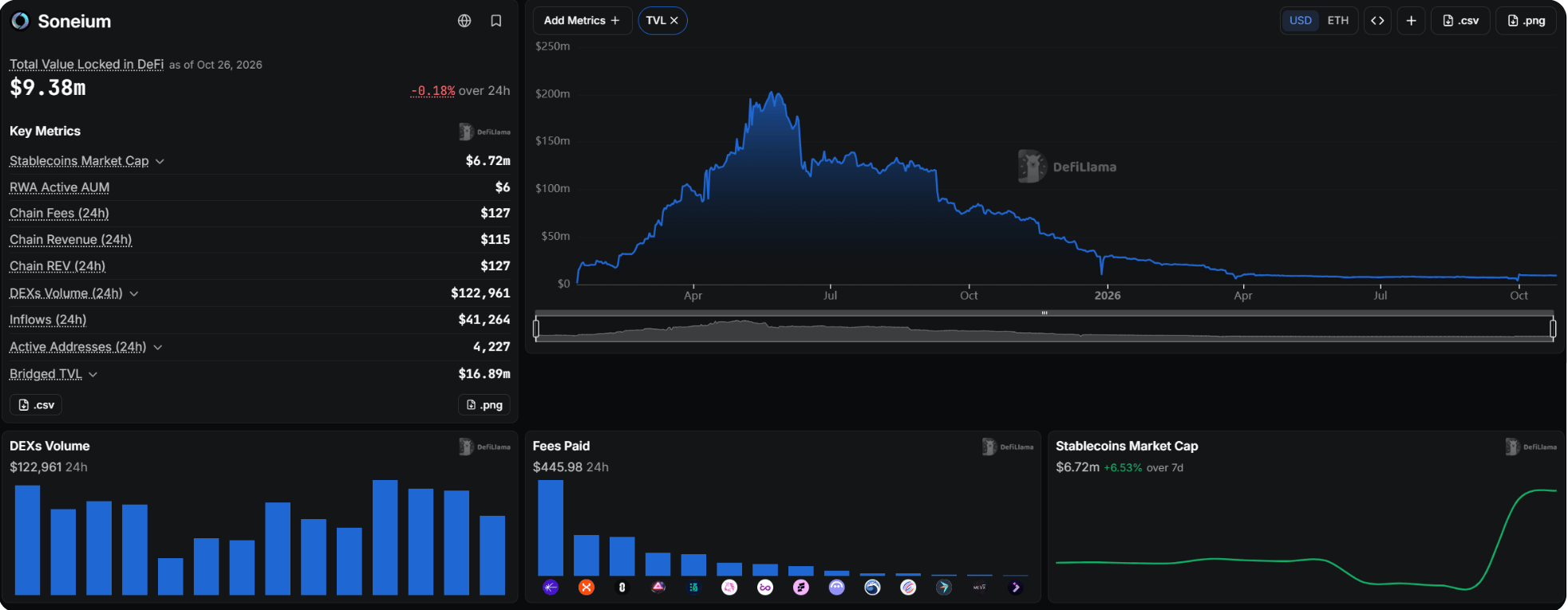
Four major applications, including Kyo Finance, Sonex, Untitled Bank, and Sake Finance, collectively held around $159 million at their peak. Today, they hold roughly $1.5 million. The network processed 163,691 transactions in 24 hours but generated about $115 in revenue. These figures reveal weak financial activity, though DeFi deposits don’t capture all assets held on Soneium.
Soneium, developed with Japanese crypto firm Startale, wants creators to register their work on the blockchain so AI programs can check licensing conditions and automatically arrange payments.
It plans to support ERC-8432, a proposed Ethereum standard designed for machine-readable licensing. Meanwhile, fans could invest in the Moriusa character franchise through tokens. A partnership with K-pop company DayOneDream also aims to offer investments linked to concert royalties.
Separately, Sony Music is already suing AI companies over unpaid content. In July 2026, it filed another lawsuit against AI music generator Udio, alleging infringement involving more than 30,000 recordings. Potential statutory damages could exceed $4.5 billion if Sony prevailed across the claims.
Universal Music and Warner Music have already reached licensing arrangements with Udio without using blockchain. Soneium has not yet named an AI company committed to its proposed licensing system. Its planned $SONEIUM token also has no confirmed launch date.
The question now is whether entertainment companies and AI developers will adopt the technology, and whether it will generate enough business to reverse Soneium’s financial decline.
Is Solana preparing for a major breakout?
Solana’s native token has declined significantly over the past month and is currently consolidating just above $100. Some analysts think the asset is at a pivotal moment and that no one can predict the direction of the next big move. Others are clearly bullish, expecting a sharp price rise.
Popular X user Merlijn The Trader shared a chart that “every SOL holder needs to see.” They believe SOL is printing a textbook head-and-shoulders pattern on the weekly chart, which could open the door to a major increase toward $210. When asked whether they were waiting for further signals, the analyst said they had already accumulated SOL at around $88.
Just a few days ago, X user Sweep spotted the same formation, suggesting the asset is poised for heightened volatility and could eventually rise to about $200. Joep Gerla also weighed in. They believe SOL is gearing up for a massive run after two years of accumulation, a shakeout to $60, and a recent reclaim of “the old range floor” near $100. They predicted that the next major expansion could send SOL toward $500.
Crypto Tice is bullish as well, albeit making a more modest forecast. They claimed SOL broke above a trendline that had held for 52 weeks, and that holding support above $95 could pave the way for a move to $126.
Unlike the optimists above, another analyst, FOUR, offered a more cautious outlook. They said SOL is in “a very interesting spot” at the moment, with its next move largely depending on the $100 level. In addition, Jia Crypto expects “a big move” at the end of October but isn’t sure whether it will be up or down.
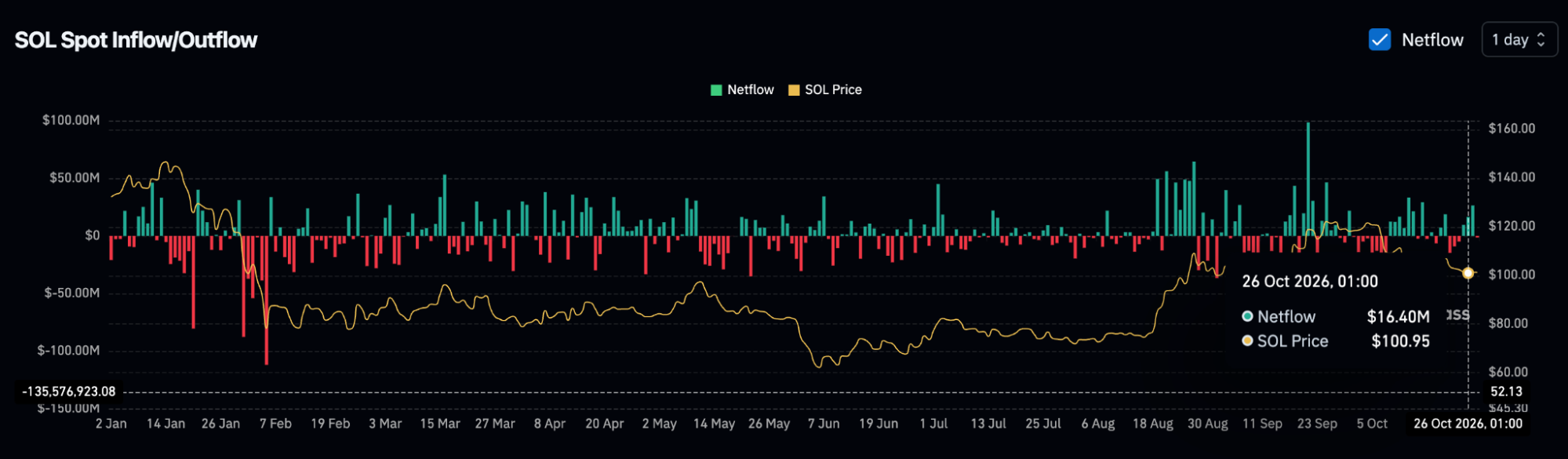
Meanwhile, weak institutional demand supports the bearish scenario. Spot SOL ETFs saw notable outflows, with over $17 million leaving these products last week. Solana’s exchange netflow flashes a similar signal. Over the past several weeks, inflows have dominated outflows, suggesting investors have shifted from self-custody to centralized platforms, increasing immediate selling pressure.
Zypto launches a free crypto course for beginners
Zypto launched “Understand Crypto,” a free online course designed to help beginners learn how cryptocurrency works, from managing their private keys to using digital assets for everyday payments.
The course includes 21 lessons across six sections and takes about 125 minutes to complete. Written in plain language, it introduces concepts in a structured sequence intended to make crypto easier to understand without requiring prior technical knowledge.
Rather than focusing solely on buying and holding tokens, the course walks learners through the practical steps of owning, moving, protecting, and using cryptocurrency. Topics extend from understanding what a wallet actually holds to paying a bill with crypto.
Ownership is a central theme. Zypto puts private-key control at the start of the learning journey, linking self-custody fundamentals to the practical responsibilities of managing digital assets.
Each lesson ends with a short quiz to check understanding. Learners who pass all 21 quizzes earn a shareable certificate, marking completion and reinforcing the course’s educational content.
That initiative adds a structured learning resource to Zypto’s broader crypto offering. It gives newcomers a starting point for understanding wallets and transactions before putting that knowledge into practice. The course’s emphasis on everyday use connects crypto education with activities beyond trading.
Find out more here.
Closing remark
Ripple has partnered with CryptEscrow to simplify crypto-funded property purchases by converting buyers’ digital assets into U.S. dollars while keeping the closing process conventional. Travala now lets SHIB holders pay for car rentals at more than 50,000 locations worldwide, expanding the token’s practical uses beyond trading and holding.
South Korea’s government and central bank plan to bring stablecoins under foreign exchange rules as payment instruments. A developer reportedly used Anthropic’s Claude AI to recreate a preserved early Bitcoin executable byte for byte.
Sony-backed Soneium is pursuing automated AI licensing payments, tokenized entertainment investments and a planned cryptocurrency. Solana’s consolidation near $100 has analysts divided between bullish breakout forecasts and downside risks.
By combining short lessons, knowledge checks, and practical examples, Zypto is positioning “Understand Crypto” as an accessible introduction to digital asset ownership.
FAQs
Who did Ripple partner with?
Ripple partnered with real estate settlement provider CryptEscrow.
Which travel booking platform uses SHIB for car rentals?
Travala lets users pay for car rentals with SHIB.
What is the South Korean government’s plan?
South Korea’s government plans to regulate stablecoins as payment instruments.
What did Claude solve?
A developer reportedly cracked a 17-year-old Bitcoin mystery with Claude Opus 5.5.
What is Sony’s plan?
Sony-backed Soneium announced a new AI licensing system, entertainment investments, and plans for its own cryptocurrency.
Prices, fees, features and availability mentioned in this article were correct at the time of publishing and may have changed since.
Related topics