
Gm frens, welcome to our second weekly October news round-up!
Dogecoin launches public testnet for dApps, Ethereum powers private AI payment tools, as Bitcoin is sent offline via Apple’s Find My Network. Brazil sparks blockchain battle for Ripple and Cardano, while Solana targets instant settlements, and a Solana breakout could be imminent. Finally, learn how to buy crypto in Zypto App.
Let’s dive in.
Dogecoin launches public testnet for dApps
DogeOS opened the public testnet for its Dogecoin application layer last week, according to its press release. A testnet is a trial version of a network, where developers test apps before real money is involved. DogeOS wants to add what Ethereum is known for: applications.
In plain terms, Dogecoin is the ledger, and DogeOS is an attempt to build the software on top of it. The team behind the MyDoge wallet founded the project, and it runs as a separate layer rather than changing the coin itself.
Its documentation calls it an “Application Layer rollup network on Dogecoin” running on a zkVM, software that generates cryptographic proofs that validate transactions. It is also EVM-compatible, meaning the smart contracts (self-running programs), along with the wallets and tools built for Ethereum, work there too.
Testnet fees are paid in DOGE, the native coin of the Dogecoin network. The faucet, a tap that hands out free test coins, gives 42.069 test DOGE per day on DogeOS. The release lists teams already building, including Barkswap, Snag, Superposition Finance, Derps, USDoge, and PlaysOut.
DogeOS founder and CEO Jordan Jefferson framed the launch as a shift in Dogecoin’s evolution from asset to ecosystem. The push to give Dogecoin more to do has context. DOGE has fallen about 75% since its all-time high and is one of the few big coins that is still in a confirmed bearish trend. That happened even as multiple Dogecoin ETFs launched. The release sets no date for a mainnet launch; the live version that would run with real money.
Ethereum powers private AI payment tools
The Ethereum Foundation launched zkAPI on Ethereum’s main network, a system that lets people pay for AI services without revealing their identities. It was built with the Open Anonymity (OA) Project, an open-source AI privacy effort. Alongside the launch comes OA Chat, a browser-based private chatbot that needs no installation.
zkAPI implements “ZK API Usage Credits,” a design Vitalik Buterin and Davide Crapis published on the Ethereum Research forum on February 11. Crapis leads the Ethereum Foundation’s dAI team, which develops ERC-8004, a standard for AI agent identity that launched on mainnet in January.
To use zkAPI, users must first deposit tokens such as ETH or USDC into a vault contract on Ethereum, which records the user’s balance as a private note. To spend the tokens, software on the user’s device generates a zero-knowledge proof that shows that a funded note backs the request. However, it does not reveal which note or deposit funds it.
A zkAPI server checks the zero-knowledge proof and issues a temporary API key with a spending cap. The user then sends their prompts directly to the AI model provider along with that key, and when it expires, the server deducts the usage from the user’s private balance. A serial number called a “nullifier” is also published each time a user pays for AI usage.
The post lists AI chat and agents as the first use cases. Other listed applications include blockchain RPC queries, image and video generation, VPN bandwidth, and machine-to-machine payments between AI agents.
The zkAPI system does not provide network anonymity. The gateway can potentially correlate requests sent from a stable IP address, and users seeking stronger privacy may route traffic through Tor, an anonymity network that relays traffic through several servers.
Sessions can be re-linked through prompt content, such as personal details, writing style, or conversation history. The zkAPI project’s GitHub repository describes the protocol as experimental.
Bitcoin sent offline via Apple’s Find My Network
A developer has sent Bitcoin over Apple’s Find My network with a small device that relays Cashu eCash tokens through nearby iPhones. The sending device needs no internet connection during the transfer. The proof of concept turns the tracking system behind AirTags into an unusual payment channel. However, its builder says it should carry only tiny amounts.
A Cashu developer shared the experiment on X, calling it possibly the most absurd way to send Bitcoin yet. Cashu is an ecash protocol that aims to keep Bitcoin payments private through bearer tokens issued by mints. The open-source code, published on GitHub, runs on cheap ESP32 boards. The device packs a token into Bluetooth signals that imitate lost-item beacons.
Passing iPhones pick up those signals and relay them through Apple’s Find My network, as they would for a missing AirTag. Meanwhile, the recipient pulls those reports with an Apple account and rebuilds the token piece by piece.
A Python script checks the rebuilt token for errors before printing it. Each signal carries only bits of data, so a typical token needs well over 1,000 broadcasts. The developer warns that every broadcast token is public. Because Cashu tokens work like digital cash, anyone who recovers one can spend it.
The weak point is the transport itself. According to the protocol notes, the payload carries no encryption, and the IDs needed to look it up are public. Therefore, the documentation advises sending only giveaway amounts. It adds that delivery is slow, unofficial, and not guaranteed.
The receiver also taps Apple’s Find My network through an unofficial interface. As a result, the tool could stop working if Apple changes that interface. The Find My experiment remains a novelty rather than a payment product. Still, it joins other efforts to make Bitcoin payments feel like texting, only this time without the internet. Other developers are chasing private Bitcoin transfers on the base layer instead.
Brazil sparks blockchain battle for Ripple and Cardano
Ripple and Cardano both struck major partnerships in Brazil, pushing blockchain infrastructure deeper into the country’s regulated financial and energy sectors. The deals highlight growing institutional interest in Latin America’s largest economy, even as both tokens posted only modest price reactions.
CSD BR, Brazil’s financial market infrastructure operator, began testing XRP Ledger as a parallel record-keeping system for investment funds. The pilot uses XRPL’s Multi-Purpose Token standard combined with Ripple’s custody infrastructure. BTG Pactual fund shares now get mirrored on the blockchain, while CSD BR’s traditional systems still handle official registration and settlement.
CSD BR manages more than $4 trillion in registered assets and plans to explore native asset issuance next. The company may also expand into fixed-income products once the pilot phase concludes.
Cardano Foundation separately unveiled two blockchain applications built with Petrobras, Brazil’s state-controlled energy company. The first tracks sustainable aviation fuel using a Book-and-Claim model. The second application traces renewable diesel across production, transport, and use.
Access remains limited to corporate and banking clients that meet strict identification requirements. Ripple’s Latin America director, Silvio Pegado, described the launch as a major industry milestone. Also, Rafael Fraga, Cardano Foundation’s Latin America lead, defended the partnership’s broader purpose.
Brazil’s oil and gas market could reach $28.82 billion by 2031, underscoring the stakes behind the deal. Together, the two partnerships suggest Brazil is becoming a testing ground for real-world blockchain adoption.
Solana targets instant settlements via new DvP tool
The Solana Foundation announced the launch of Solana DvP, an open-source settlement program for financial institutions, aimed at cutting settlement times. Solana DvP provides an open-source application programming interface (API) for delivery-versus-payment (DvP) settlement on Solana.
The program aims to cut securities settlement from one to two days to seconds by transferring assets and payment in a single transaction that either completes in full or takes no effect. It is designed to offer institutions a reusable alternative to custom smart contracts.
The settlement standard is the type of “foundational infrastructure” institutional market participants need to “operate at scale without introducing settlement risk and counterparty exposure,” said Rhodel D’Souza, head of markets digital assets at JPMorgan. The bank provided input on institutional settlement practices and requirements during work on Solana DvP.
The announcement adds to efforts to speed up financial settlement using blockchain infrastructure. In June 2025, Chainlink, JPMorgan’s Kinexys and Ondo Finance completed a cross-chain DvP pilot involving Ondo’s tokenized US Treasury fund and payment through Kinexys.
The Solana Foundation is making a direct play for institutional finance, enabling banks to settle trades on the network with the certainty they expect from traditional markets. Solana DvP gives financial institutions a standardized API for delivery-versus-payment settlement, which is the bedrock mechanism that ensures an asset and its payment change hands simultaneously.
Is a Solana breakout imminent?
SOL had quite a successful September, posting a price increase of almost 15%. Notably, analysts now eye further gains toward $150 and beyond. However, certain technical indicators suggest that a short-term pullback may also be on the horizon.
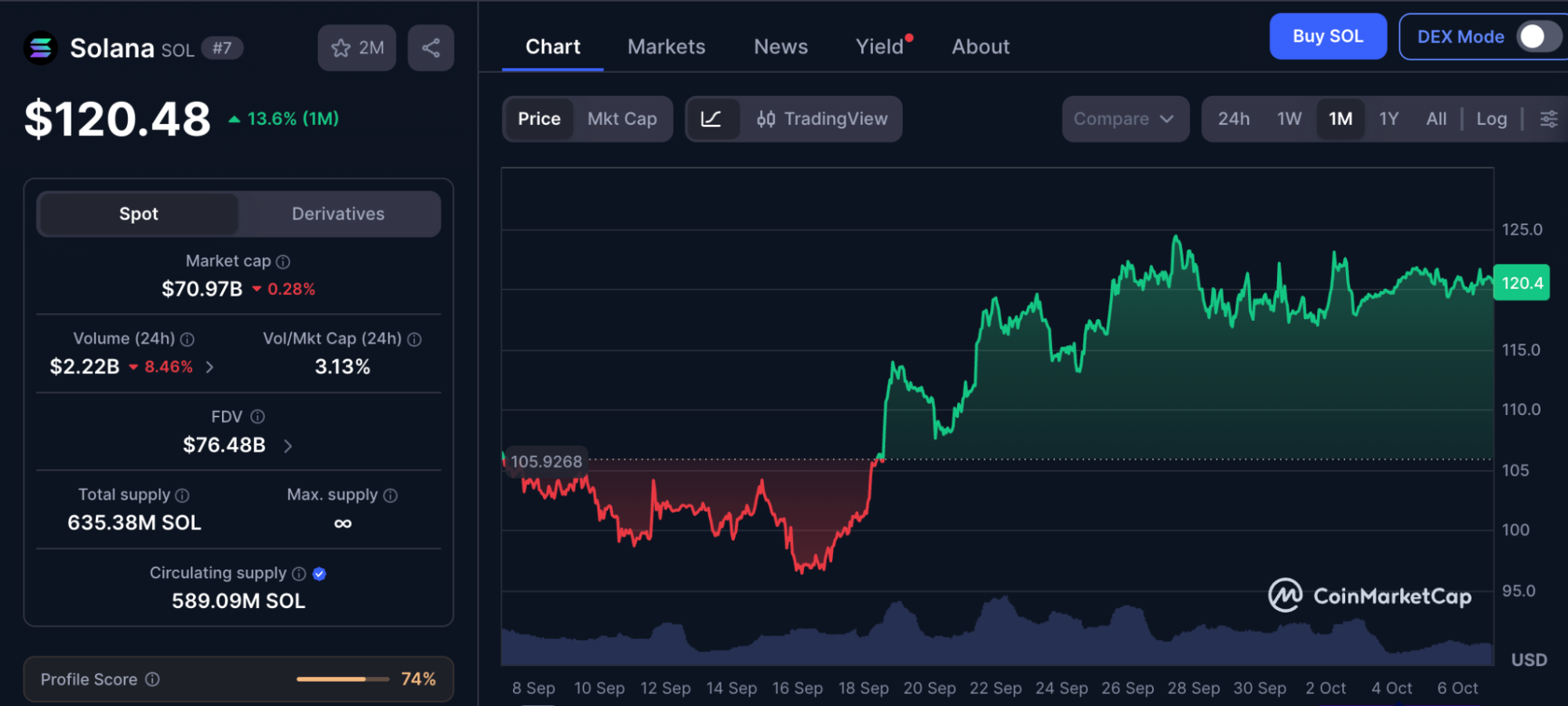
Ali Martinez paid special attention to the strong institutional demand, noting that spot US SOL ETFs continue to absorb Solana. He said these products have accumulated roughly 4.37 million coins (worth $450 million) since July 13, marking 11 consecutive weeks of net inflows. That said, he assumed that SOL might be headed toward $150.
Two analysts on X also weighed in. Gordon said “dips are for buying,” adding that the perfect trading strategy would be to accumulate SOL around $100 and sell above $500. Scient expects a sell-off at the start of October and plans to short Solana at approximately $120-$121 and open a long position around $110.
However, the actions of a certain mysterious whale support an entirely bullish scenario.
Another user, Max Crypto, revealed that the anonymous market participant opened a $20.2 million long position on SOL. The liquidation price is set at $98 (assuming the whale doesn’t add more collateral to prevent that outcome).
What’s interesting is that the investor has made four trades so far and has a 100% win rate, making $4.7 million in profits. This, of course, has sparked speculation that they might have access to inside information the rest of us don’t.
For its part, SOL’s Relative Strength Index (RSI) now sits at 51.00. In simple terms, this means the valuation has cooled off and entered neutral territory. This indicates a balanced market with no immediate signal for a breakout or a correction. Conversely, a surge past 70 suggests overbought conditions primed for a pullback, while a drop below 30 is interpreted as a buying opportunity.

How to buy crypto in the Zypto App
Zypto has streamlined crypto purchases inside its self-custodial wallet app, giving users two in-app routes to fund their wallets: local fiat onramps and MoneyGram cash purchases for USDC.
The process begins from the Zypto App home screen, where users select “Buy Crypto” and choose either “Buy via Local Onramp” or “Buy via MoneyGram,” depending on their preferred payment method and location.
To buy crypto through a local onramp, users select the blockchain, choose their preferred cryptocurrency, enter the amount, select a payment method, and complete checkout. The crypto can arrive in the Zypto wallet within seconds or minutes, depending on the blockchain and payment provider.
For users who prefer cash, Zypto’s MoneyGram option offers a separate route: users can pay cash at a participating MoneyGram location and receive USDC in their Zypto wallet. The feature forms part of Zypto’s wider USDC-to-cash infrastructure, which supports cash-in and cash-out services across participating MoneyGram locations in multiple countries.
The local-onramp option connects users with payment methods available in their market, including credit and debit cards, bank transfers, Apple Pay, Google Pay, Revolut Pay, SEPA Instant, Skrill, Pix Pay, and other regional alternatives. Zypto affirms that its onramp partners collectively support more than 130 payment methods.
Rather than requiring users to buy assets on a centralized exchange and then transfer them to a separate wallet, Zypto sends purchased crypto directly into the user’s self-custodial DeFi wallet. That means the user controls the wallet and its private keys from the first purchase.
Users should note that available payment methods, asset availability, fees, purchase limits, identity-verification requirements, and processing times can vary by country, provider, transaction size, and local compliance rules.
Find out more here.
Closing remark
DogeOS has opened a public testnet to bring Ethereum-compatible apps to Dogecoin, giving developers a testing ground ahead of a mainnet launch. The Ethereum Foundation has launched zkAPI to let users pay for AI services without linking requests to their deposits.
A developer used Apple’s Find My network to relay Bitcoin-backed Cashu tokens from an offline device. Time will tell if it can become a reliable action. Ripple and Cardano are expanding blockchain use in Brazil through separate projects for investment-fund recordkeeping and renewable-fuel tracking.
Solana’s September gains, sustained ETF inflows and a large bullish whale position have fuelled hopes of a move toward $150, but neutral momentum and divided analyst forecasts leave a breakout uncertain.
Solana has emerged as a leading venue for tokenized equities, and infrastructure like DvP aims to deepen that lead by giving regulated players a trusted way to settle on-chain faster. By combining onramps with self-custody and real-world payment tools, Zypto aims to make buying crypto easier in a wider, app-based financial workflow.
FAQs
What did Dogecoin launch?
DogeOS opened its Dogecoin application layer public testnet.
What is Ethereum powering?
The Ethereum Foundation launched zkAPI, a private AI payment tool.
How was the Bitcoin sent?
A developer sent Bitcoin over Apple's Find My network with a small device.
What is the latest in Brazil?
Ripple and Cardano both struck major partnerships in Brazil.
What is the Solana DvP?
Solana DvP is an open-source settlement program that aims to cut settlement times for financial institutions.