Gm frens, welcome to our first June round-up series! There’s plenty happening across the crypto landscape this week, so let’s get straight into it.
A Pi Network whale’s wallet crosses 400 million PI; a Trader’s World Cup $341 meme coin surges over 30,000%; and a dormant Bitcoin wallet moves 20 BTC after 16 years of inactivity.
Then, Post-crash BTC eyeing $73K recovery for summer breakout, Kalshi secures CFTC approval to offer bitcoin perps, and The Open Network plans a rebrand to GRAM. Finally, Zypto App becomes the official wallet for Electroneum, expanding what ETN holders can do across the wider crypto ecosystem.
Let’s dive in.
Pi Network whale’s wallet crosses 400 million PI
One PI address, tracked as “GAS…ODM,” has now surpassed 400 million tokens, making it the largest single holder. Recent on-chain data show the wallet adding more than 1.5 million PI in a single day. The pattern of near-daily accumulation has held through May.
Some analysts have speculated that the address could serve a buyback or treasury role. No party has confirmed the ownership of the mysterious whale wallet. Several Pi commentators have framed it as a form of whale-driven price support absorbing supply during the drawdown.
PiScan data show that tagged exchange wallets now hold about 546 million PI in total, with a net inflow of roughly 1.5 million PI over the past 24 hours, as of this writing. Inflows of exchanges typically signal incoming sell pressure rather than accumulation. The whale’s buying has not been enough to offset the broader supply moving back toward trading venues.
Mainnet usage has expanded as more Pioneers complete Know Your Customer (KYC) verification and second migration steps. Pi Network reports 18.1 million verified users, 16.72 million migrations, and more than 119,000 second migrations completed.
Three upgrades anchor the June calendar. Pi Network set June 2 as the deadline for Protocol 24 node upgrades. Protocol v25.1 follows on June 8, and v26.0 on June 22. The releases target node performance, scalability, and smart contract maturation after the Protocol 23 rollout in May.
Trader’s World Cup $341 meme coin surges over 30,000%
A lucky trader bought $341 of a World Cup-themed Solana meme coin in mid-May, when it had a market capitalization of less than $40,000. Since then, the token has soared more than 30,000%, with the trader notching a 14,000% gain after selling more than $49,000 in holdings.
World Cup Coin ($WORLDCUP) launched on May 11, ahead of the 2026 FIFA World Cup, which starts in June and has historically been the most-watched sporting event in the world. Alongside this token, meme coins for each nation competing in the tournament were launched on the Solana token launchpad Pump.fun.
Just hours after launch, per DEX Screener, the aforementioned trader bought $341 worth of the World Cup Coin via five transactions. Over the next 12 hours, the token traded sideways before surging to a $2.18 million market cap, then to $6 million the day after. Through these two pumps, the trader sold $35,700 worth of tokens.
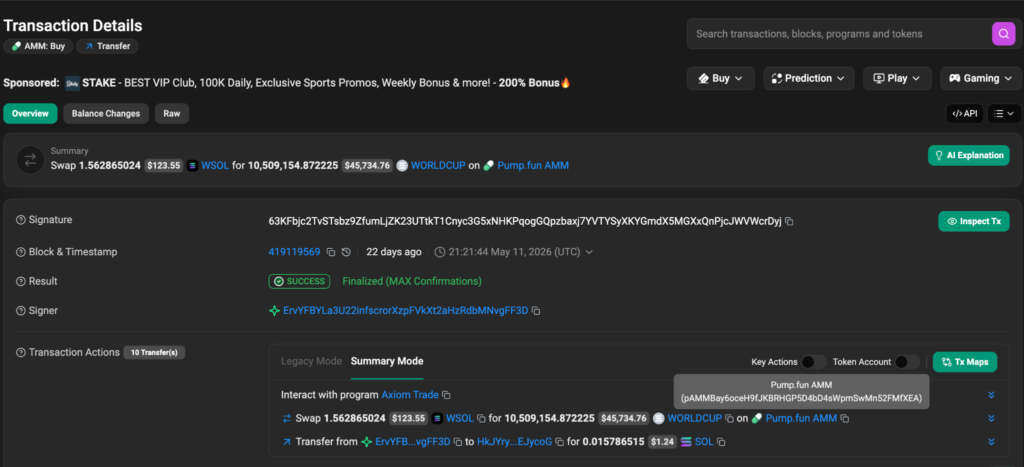
World Cup Coin then traded down 49% to a $3.15 million market cap over the coming week, just before it spiked to an all-time high of $12.2 million on May 21, up more than 30,000% from the trader’s first purchase. Again, the trader sold a chunk of his bag, bringing his total realized gains to $49,400 across 78 transactions, according to block explorer SolScan.
In addition to holding the World Cup Coin, traders have accumulated coins named after specific nations competing in the tournament. It appears that traders are purchasing tokens based on what they deem most likely to perform well in the tournament.
Unsurprisingly, France, Spain, and Portugal have the highest market cap tokens at $315,000, $255,000, and $225,000, respectively, per Pump.fun. The lucky trader also owns a sizable amount of national coins, with $9,400 in Spain as his largest single-nation holding.
Bitcoin wallet moves 20 BTC after 16 years of inactivity
A Satoshi-era Bitcoin wallet that sat untouched since August 2010 moved 20 BTC over the weekend, ending almost 16 years of total dormancy. The transfer, worth roughly $1.47 million at current prices, drew immediate attention from on-chain analysts.
Galaxy Research first flagged the event in block 951828, mined at 05:14 UTC on May 31, 2026. Bitcoin was trading at $73,608 around the time of the transfer, off 0.3% on the day.
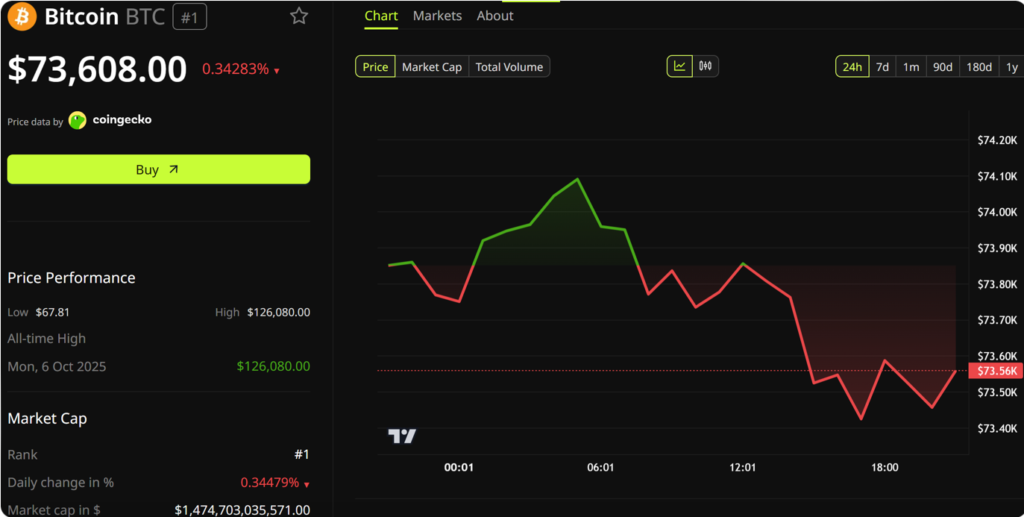
The address starting with “1CDSyXAQxro4FPUoqAQb,” last received coins nearly 16 years ago. That places the wallet firmly within Bitcoin’s earliest mining era.
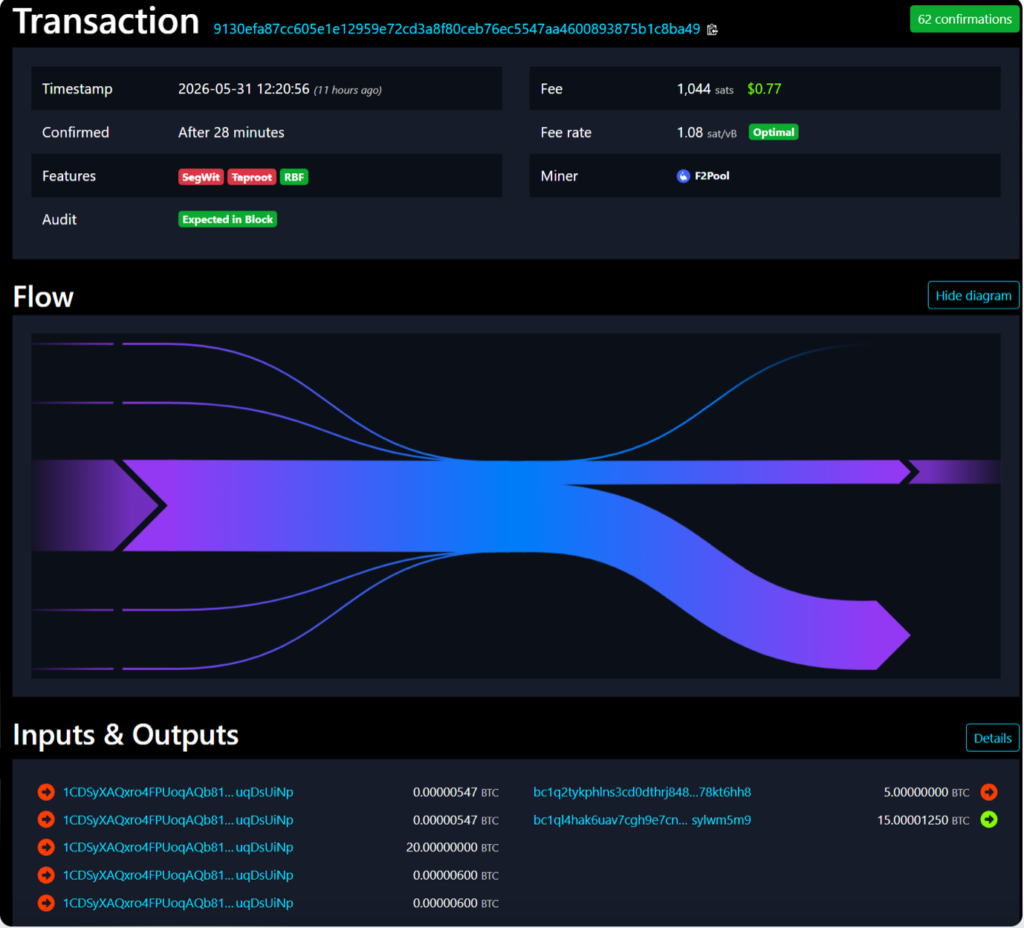
CPU mining was common at the time, and only a small circle of enthusiasts ran the network. Alex Thorn, head of firmwide research at Galaxy, quickly ruled out any connection to Satoshi Nakamoto via a post on X.
Galaxy distinguishes likely Satoshi clusters from other early wallets through on-chain heuristics. The 20 BTC amount here did not match the amounts in those profiles. Similar Satoshi-era miner movements have surfaced repeatedly through 2025 and 2026, often without market consequence.
A similar pattern accompanied the reactivation of a dormant miner wallet, which produced limited price impact. Bitcoin’s slow redistribution from earliest holders has accelerated alongside higher prices. An 80,000 BTC whale movement earlier this year sent coins to exchanges without triggering panic.
Whether this anonymous owner sells, consolidates, or simply rotates to modern address formats remains unclear. The answer surfaces only if the 20 BTC reaches an exchange. The transfer adds to a broader long-term holder redistribution trend defining Bitcoin’s 2026 cycle.
Post-crash BTC eyeing $73K recovery for summer breakout
Bitcoin’s recent overnight pullback to around $65,300 is characterized by analysts as a necessary shakeout designed to build momentum for a significant summer price rally toward new highs. While short-term volatility broke immediate bullish trends, experts suggest the market is preparing for a swift recovery, with key attention on reclaiming the $73,000 level.
On June 1, crypto analyst Michael van de Poppe laid out a clear conditional case for BTC, saying that once the $73,000 area holds and history repeats itself, we could see two strong weeks of upward momentum that could push the OG crypto coin to new highs this summer. He also suggested that there may be a broader altcoin rally alongside the Bitcoin surge.
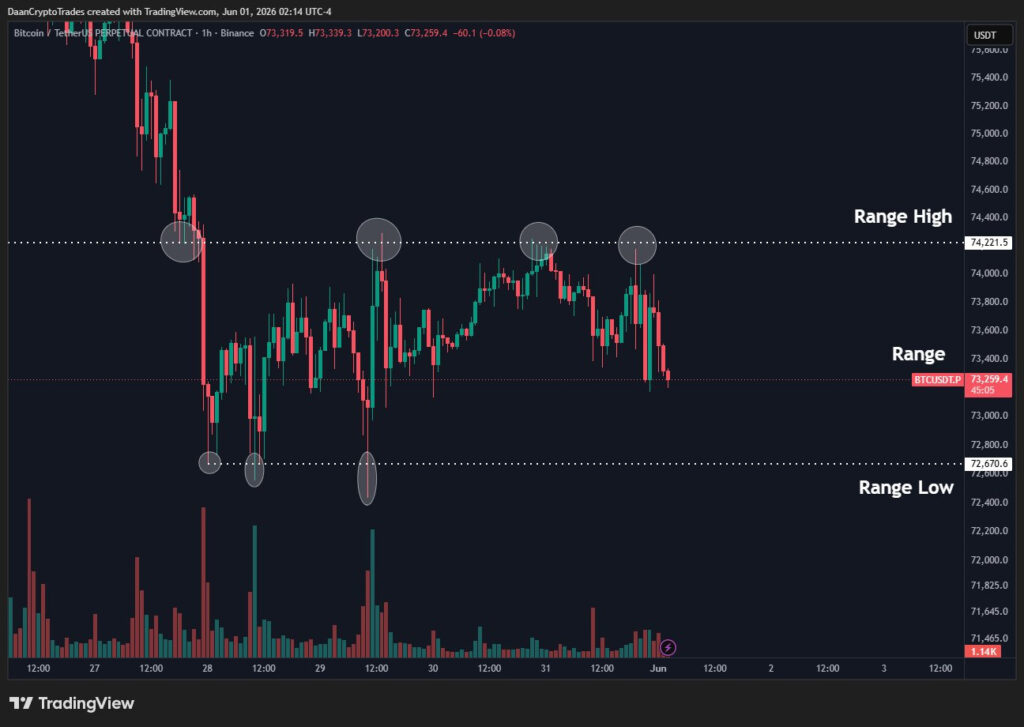
Its price was stuck within a narrow band for the better part of the past week, with resistance around $74,200 and support around $72,700, according to market watcher Daan Crypto Trades, who posted that these are the levels to watch in the short term.
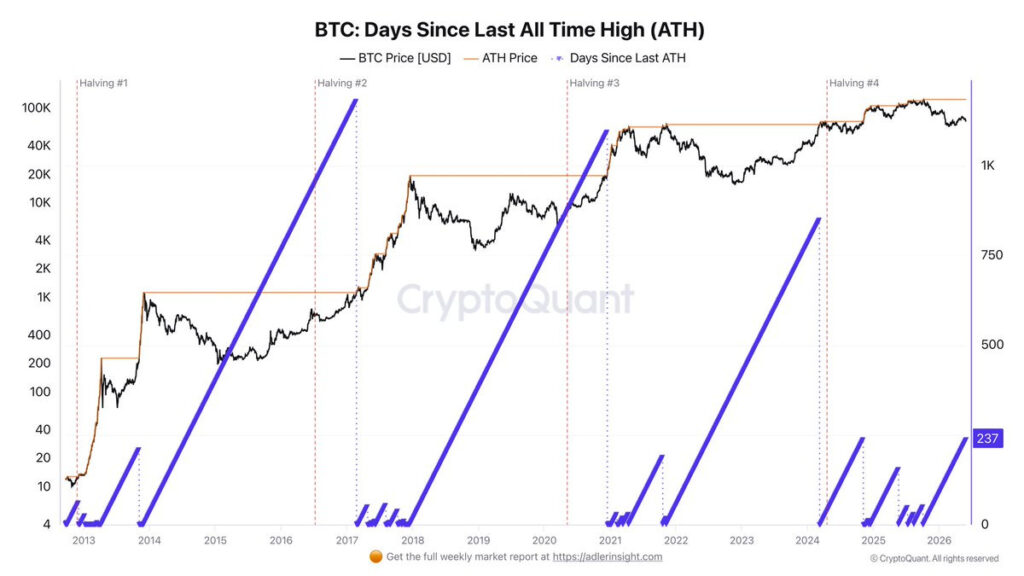
Another thing noted is that BTC is now entering the longest correction of this entire market cycle. According to pseudonymous analyst Darkfost, the cryptocurrency is set to surpass the 237-day correction that occurred in 2024. It is a sober fact to note that, even if it falls short of the brutal drawdowns seen in past bear markets, it took 849 days to reach a new all-time high in 2023 and 1,180 days to reach a peak in 2015.
There is also a seasonal dimension to things, as described by crypto observer Markus Thielen, who pointed out that in the past decade, June has delivered average returns of just 0.7% for BTC, making it one of the weakest months for the asset.
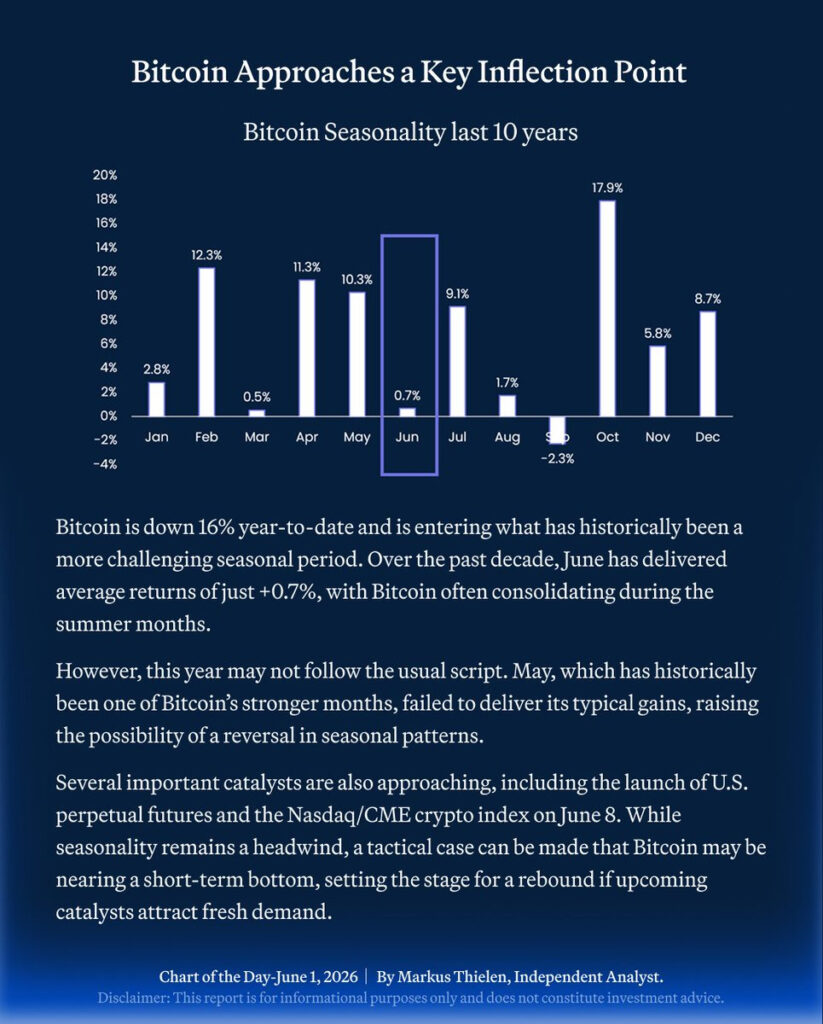
However, Thielen did raise the possibility that seasonal patterns may shift, given that May, normally a strong month, failed to deliver this year. In the analyst’s opinion, that divergence from historical norms could mean that some of the expected weakness has already been priced in.
Since the ‘June slump’ happened overnight in one aggressive crash, the market has hastened the pain. The overnight bottom is the ultimate accumulation zone, and touching this level historically triggers massive buyer demand. The market is now fully priced in, arguably clearing the schedule for an early summer rally.
Kalshi secures CFTC approval to offer Bitcoin perps
The CFTC has issued an order allowing Kalshi to offer perpetual futures tied to Bitcoin’s prices in the U.S., reflecting the regulator’s growing acceptance of the derivatives. Although the prediction market described the debut in a blog post as the “first-ever perpetual futures in America,” the CFTC flashed a green light for Bitnomial in December, albeit with a 25-year limit, making them not truly ‘perpetual’ in nature despite underlying similarities.
Kalshi described the development as its most significant product expansion since the introduction of event contracts, enabling new ways for customers to speculate on the platform that has emerged as a leader in the sector alongside Polymarket. Also, there are speculations that Kalshi aims to launch in June.
In the blog post, Kalshi claimed that the asset class, which supported over $90 trillion in trading volume last year, has been entirely closed off to American institutions until now. In an announcement, the CFTC said the order requires Kalshi to comply with rules enforced under the Commodity Exchange Act, which the regulator has cited in court as legislation that places event contracts under its remit and exempts them from state rules.
Meanwhile, the CFTC recognized that the perpetual contract design may not be suitable for all asset classes. Since the war involving the U.S., Israel, and Iran broke out in February, perpetual futures tied to oil, which trade around the clock, have come into vogue.
Polymarket mentioned in April that it plans to offer customers perpetual futures, citing companies like Nvidia and commodities such as silver and gold in its marketing materials. The announcement also references trades using 10x leverage.
The Open Network plans a rebrand to Gram
The Open Network says it plans to rebrand its Toncoin (TON) token as Gram (GRAM), the original name of the network’s cryptocurrency in its first white paper. TON founder Pavel Durov posted on Telegram on Monday, affirming a return to their roots and paving the way for the future.
The change revives the original token name from TON’s 2018 whitepaper, which Telegram abandoned after the US Securities and Exchange Commission blocked its $1.7 billion initial coin offering (ICO) in 2020. It also follows Telegram’s takeover from the TON Foundation as the network’s primary driver and largest validator in May.
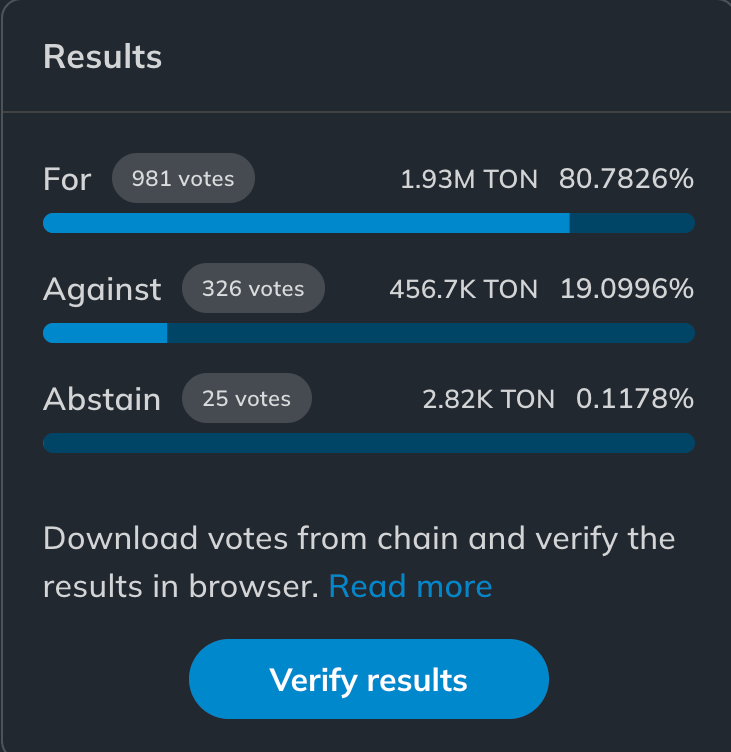
The Open Network launched a vote on the proposal, explaining that there is no swap, migration, bridge, claim, or conversion, and that every balance, address, contract, and position remains exactly as it is.
At the time of writing, there were 1.8 million TON, or almost 80%, pledged in favor of the rebrand. Durov has positioned the token rebrand as part of the “Make TON Great Again” roadmap.
The rebrand is the fourth stage of the roadmap, with the first three coming earlier this year, which included an upgrade to Catchain in April to boost blockchain speed, a decrease in transaction fees, and the Telegram takeover.
The endgame is to power a smooth Web3 ‘super app’ experience inside Telegram for its one billion users, turning the messenger into a global platform for payments, mini-apps, digital ownership, AI agents, and more.
Zypto becomes the official Electroneum wallet
Zypto App has become the official wallet for Electroneum (ETN), providing the Electroneum community with a multichain home for storing, sending, receiving, and managing ETN.
The integration enables users to access ETN directly within Zypto App while also connecting to a wider ecosystem of digital assets, cross chain infrastructure, payments, and real world crypto utility.
By supporting Electroneum within its existing infrastructure, Zypto continues to evolve into a connected crypto ecosystem that combines asset management, payments, and multichain interoperability within a single mobile app.
Electroneum, known for its focus on accessibility and real world utility in developing economies, aligns with Zypto’s broader strategy of supporting digital currencies designed for everyday transactions, particularly in regions with limited banking infrastructure.
The move allows ETN holders to manage Electroneum alongside thousands of other supported digital assets, opening access to multichain functionality, DeFi services, rewards, and practical crypto use cases without switching between platforms.
The addition further strengthens Zypto’s growing ecosystem of supported blockchains and assets as the company continues to focus on practical applications such as remittances, merchant payments, mobile based financial services, and everyday crypto utility.
Find out more here.
Closing remark
Despite Pi’s buying activity, rising exchange inflows and long-term unlocks continue to signal broader sell pressure and expanding supply. The World Cup-themed Solana memecoin’s rally reflects speculative momentum tied to global sports narratives, with parallel demand emerging for country-specific tokens ahead of the 2026 FIFA World Cup.
The dormant wallet’s transfer appears insignificant relative to market volume and fits a broader trend of early holders gradually redistributing assets without major price disruption.
Bitcoin’s recent overnight correction is viewed as a healthy reduction of leverage, strengthening the foundation for a potential summer rally to new highs, provided the $73,000 level is reclaimed.
Kalshi has received CFTC approval to offer Bitcoin-linked perpetual futures in the U.S., marking a significant step toward regulated access to a derivatives market long dominated by offshore platforms.
The Open Network plans to rebrand its TON token back to Gram, reviving its original identity as part of a broader roadmap tied to Telegram’s deepening involvement in the ecosystem.
Zypto App has become the official wallet for Electroneum, giving ETN holders access to a broader ecosystem of multichain tools, DeFi, payments, rewards, and real world crypto utility within a single mobile app.
FAQs
What is the largest single amount of Pi held in wallets?
A mysterious PI address tracked as “GAS…ODM” crossed 400 million tokens.
How high did the World Cup Coin soar?
The World Cup-themed Solana meme coin surged over 30,000%.
How much did the dormant Bitcoin wallet have?
The Satoshi-era Bitcoin wallet moved 20 BTC, ending almost 16 years of total dormancy.
What does The Open Network want to rebrand to?
The Open Network says it is planning to rebrand its Toncoin (TON) token as Gram (GRAM).
Prices, fees, features and availability mentioned in this article were correct at the time of publishing and may have changed since.