
Gm frens, welcome to this week’s crypto news round-up!
Crypto in 401(k) nears Trump administration approval, gamers could soon earn crypto with their GPUs, and Nigeria’s Central Bank rolls out new crypto licensing. Telegram launches in-chat TON payments, a major reversal for altcoins might be coming, and Visa launches weekend stablecoin settlements. Lastly, Zypto integrates Why Not exchange into its crypto app.
Let’s dive in.
Crypto in 401(k) nears Trump admin approval
Last Thursday, a proposed rule that would open up 401(k) retirement accounts to alternative assets, including cryptocurrencies, landed at the White House for consideration. The review is the last step before the rule is published.
The Department of Labor (DOL) filed a proposal with the White House’s Office of Information and Regulatory Affairs (OIRA) to further President Trump’s executive order. Thus, it directed the department to pave the way for including alternative assets in 401(k) plans.
No plan is forced to offer new assets. Instead, employers who weigh six factors get a legal shield, known as a safe harbor. The factors are performance, fees, liquidity, valuation, benchmarks, and complexity. Courts would then presume those employers acted prudently.
This comes months after the DOL unveiled its initial rule outlining steps those 401(k) plan managers should take when considering incorporating alternative assets into their investment menus. In May 2025, the DOL also withdrew its 2022 guidance, discouraging retirement managers from considering crypto as an investment option in 401(k) plans after the department raised concerns about those plans.
The proposal to allow for crypto in 401(k) plans has also garnered scrutiny on Capitol Hill. Earlier this year, Senators Bernie Sanders and Elizabeth Warren pushed the DOL to scrap the rule, saying it would expose investors to volatile assets. In the filing, when describing the costs and benefits, the DOL noted it had not yet estimated the rule’s full costs.
Gamers can mine crypto on their GPUs
According to industry leader Arthur Hayes, your gaming PC could soon start earning crypto. He believes the graphics cards already sitting in people’s homes could help power artificial intelligence (AI).
His latest venture, Flop Labs, wants to turn spare computing power into a source of income. Now, a developer has shown that the idea can work on a single gaming PC. On November 8, Hayes shared a demonstration of FLOP mining running on an Nvidia RTX 5080 graphics card.
The developer reported completing 12 AI processing sessions without failure and published a free Windows setup guide. The experiment suggests gamers could participate without renting expensive data-center hardware. But can gamers actually earn crypto?
Well, the idea is relatively simple. AI systems need powerful chips to answer questions and perform tasks. FLOP wants to connect that demand with people who own graphics cards. Instead of leaving a gaming PC idle, its owner could let the FLOP network use the GPU to process AI requests. In return, the network plans to distribute FLOP tokens as mining rewards and payments for completed work.
The successful test has one major limitation. FLOP mining currently pays nothing of real value. The network remains in development, and tokens generated during testing cannot be cashed out.
Hayes has confirmed that current participation does not qualify for an airdrop. A planned 90-day testnet will determine future allocations, while real mining rewards are expected after the mainnet launches. Even then, earnings will depend on demand for AI processing, electricity costs, and the token’s market value.
Nigeria’s Central Bank rolls out new crypto licensing
The Central Bank of Nigeria (CBN) has introduced new licensing requirements for stablecoin issuers and non-security virtual asset service providers. According to a circular issued to relevant stakeholders, the regulations establish separate licensing categories for naira-referenced and foreign-currency-referenced stablecoins.
The CBN said the rules cover activities carried out in Nigeria or affecting the country’s payments system, financial sector, or foreign exchange market, even if the operator has no physical presence in the country.
Under the framework, foreign-currency stablecoins can be offered, distributed, exchanged, or otherwise made available to Nigerians only as ‘Class 2 tokens’ issued through a Nigerian-incorporated entity holding a Foreign Currency Issuer License.
The CBN also requires issuers to obtain written approval for each token, covering its classification, reference currency, reserve arrangements, name, ticker, and supported blockchain networks, per the circular.
The rules also enforce compliance with anti-money laundering and counter-terrorist financing obligations. Entities must implement customer due diligence, sanctions screening, transaction monitoring, and Travel Rule compliance across all custodial wallets, peer-to-peer services, and remittance channels.
Meanwhile, some tokens are prohibited under the rules, including algorithmic stablecoins. The central bank said the ban covers tokens that rely primarily on market dynamics, rather than eligible reserve assets, to maintain their value.
The framework gives the CBN authority over stablecoins and virtual assets used for payments, transfers, remittances, foreign exchange, and settlement. Nigeria’s Securities and Exchange Commission (SEC) retains oversight of securities and capital-market activities.
Companies operating across both areas must obtain the relevant approvals from each regulator. The regulations took effect on November 5, 2026, giving existing operators 180 days to apply for the appropriate license or authorization, subject to transitional requirements.
Telegram launches in-chat TON payments
Telegram has introduced interactive widgets that run inside chat messages and can request payments through its native TON wallet. The feature is live, but for now it only works in a limited set of chats. Telegram’s developer documentation says production widgets work only in private chats between users and bots. Group widgets, inline distribution through bots, and forwarding are available on the test server, not in production.
For TON builders, the change puts a small interactive interface directly in a message bubble rather than behind a button that opens a web page. The 4KB limit applies to compressed code, not a requirement that every app be that size. Each widget is a self-contained HTML document with inline styling and JavaScript, capped at 32KB before compression and 4KB afterward.
Telegram runs the JavaScript in a QuickJS sandbox and draws the interface itself, rather than using a browser-style WebView. Widgets have no direct network access: they send requests through Telegram to their bot, which can update the widget’s data. Their code stays fixed after the message is sent.
That makes widgets distinct from existing Mini Apps, which are developer-hosted web pages opened on demand. Widgets remain visible as users scroll the chat, but cannot accept keyboard input. Telegram’s guide directs developers to link to a bot or Mini App for anything larger.
The documented payment flow uses Telegram’s built-in wallet and TON Connect transaction formats. Developers can reuse their TON Connect code without setting up a separate wallet connection or bridge for the widget. It builds on Telegram’s native Gram (TON’s native coin) wallet, which is described as a non-custodial wallet.
A widget asks its bot to prepare a transaction, then opens Telegram’s wallet confirmation window showing the bot, amounts, and destinations. The user must approve. Wallet access depends on app support and regional availability.
Telegram also instructs developers to verify the sender, recipients, amounts, and transaction outcome on-chain before treating a payment as complete.
Is an altcoin rebound on the way?
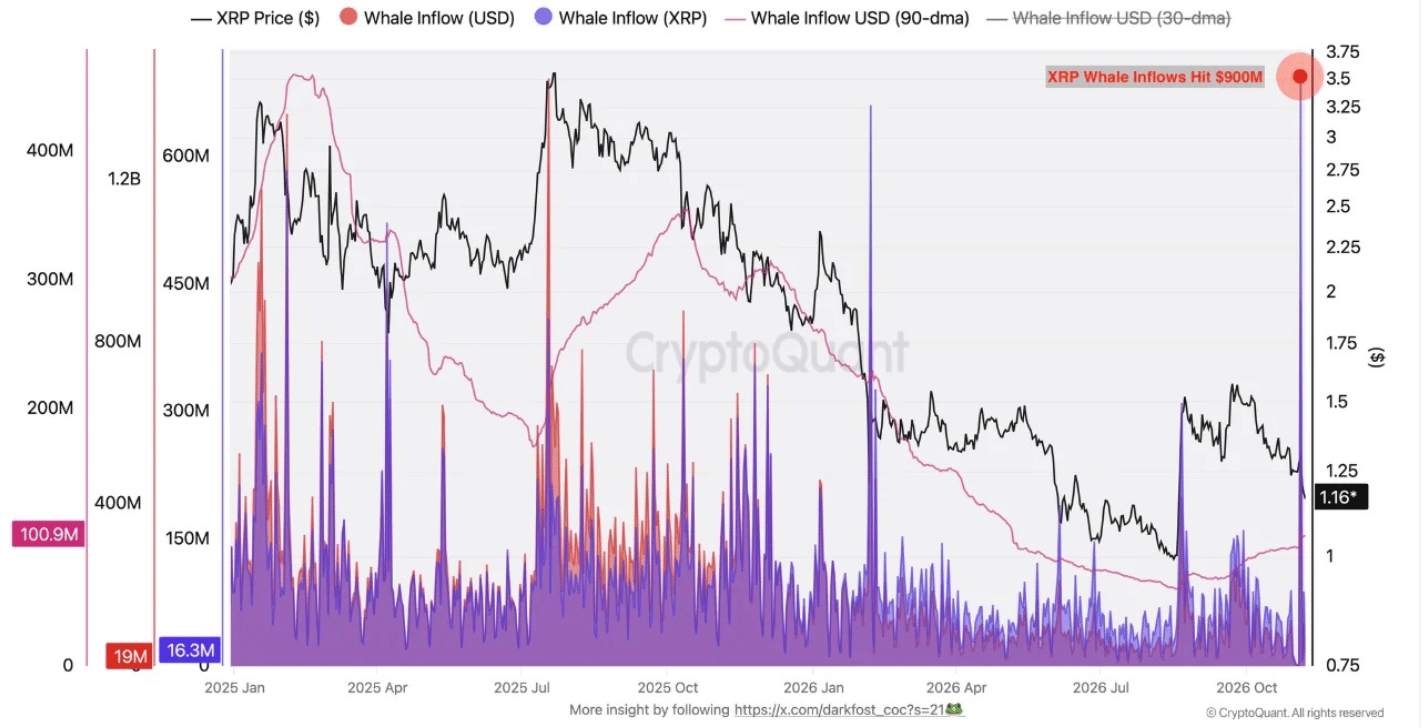
Altcoins have had a rough few weeks, and XRP is a good example. The token has fallen toward $1.05 for the first time in several months. Yet, several indicators are starting to move in the opposite direction. Perhaps the most bullish factor is that whales are accumulating, alongside recovering pressure, prompting multiple analysts to predict the current decline may be reaching its final stages.
According to Ali Martinez, large holders returned to the XRP scene once again after the asset was rejected at $1.34 earlier this month. On-chain data show whales have awakened during this period, with the largest single-day inflow since 2024. The analyst believes this creates a divergence between falling prices and growing large-wallet exposure.
Fellow XRP commentator BankXRP highlighted another potentially important divergence. The 14-day moving average of XRP’s Taker Buy/Sell Ratio is climbing back toward 1.0, even while the token’s price keeps dropping. A reading below 1.0 means sellers are more aggressive than buyers, so moving toward 1.0 means buyers are catching up.
CrediBULL Crypto is also leaning toward a rebound, saying XRP’s next major move is likely a rally of more than 40%. Nevertheless, the analyst acknowledged that lower-timeframe price action has been difficult to navigate recently.
Celal Kucuker, though, is not certain that the cross-border token has bottomed. In a recent analysis, Kucuker commented that XRP could still test the $1.05-$1.10 region before reversing. Once the move breaks the descending trendline, he expects a much more aggressive advance toward a target of $4.15, which could mimic the token’s major 2024-2025 rally.
Dark Defender has repeatedly outlined $1.12 as the crucial support, as the level capped price recoveries in July and August declines. The analyst maintained that the broader Elliott Wave structure remains intact as long as XRP holds that region. He believes the current weakness represents the latter stages of Wave 2 rather than the start of a prolonged collapse. He calls for an eventual Wave 3 expansion, with targets well above current levels.
Visa launches weekend stablecoin settlements
Visa has expanded its stablecoin settlement network so transactions can now settle on weekends and holidays. That may sound like a small scheduling change. For banks that have spent years waiting on Monday, it is quite a big deal.
The move turns Visa’s stablecoin rails into a seven-day operation. Traditional settlement only runs Monday to Friday, so money sent on a Friday evening often waits until Monday.
Interestingly, the groundwork started before now. The groundwork was laid in 2025, when Visa launched USDC settlement in the U.S. The goal was to speed up cross-border transactions and let transfers happen outside the standard banking timetable.
A year later, Visa now supports other stablecoins like USDG, EURC, PYUSD, and SBC. Those tokens run across ten blockchains: Ethereum, Solana, Avalanche, Stellar, Arc, Base, Canton, Polygon, Tempo, and Monad.
The weekend capability got a real-world workout in September 2026, when Lloyds Bank Corporate Markets Jersey completed a $750,000 USDC settlement through Visa over the weekend. The transaction finished in under an hour.
The test also showed that Visa could bolt blockchain settlement onto its existing infrastructure without disrupting the consumer card experience. Cardholders do not see any of this. When you tap a card, the purchase is approved almost instantly. The stablecoin layer sits behind the scenes, where Visa and its financial institution partners move money between themselves.
Visa’s latest push is projected to improve treasury liquidity for financial institutions by letting them settle outside normal banking hours. Visa has been careful not to pick a single winner. Its stated strategy is to stay agnostic on both the stablecoin and blockchain.
Zypto integrates Why Not exchange into its crypto app
Zypto has integrated Why Not exchange into its crypto wallet app. This adds thousands of cross-chain swap routes to its existing network of more than one million routes across over 20 blockchains.
The integration is available in Zypto App v1.29 and lets users compare Why Not exchange quotes with those from other supported swap engines directly in the app’s swap screen.
Users select the asset they want to send, the asset they want to receive, and an amount. Zypto then requests quotes from compatible swap engines, displaying Why Not exchange alongside other available providers whenever it supports the selected pair.
Each route shows its expected output and fees before confirmation, allowing users to compare costs and choose the option that suits them. Users sign the swap from their own wallet, with transactions typically taking between 30 seconds and 15 minutes, depending on the blockchains involved.
The additional routes expand both asset coverage and quote availability. Because each swap engine supports a different combination of assets and networks, the integration can provide a path for previously unsupported pairs while adding another option for pairs already available.
Why Not exchange joins Zypto’s existing cross-chain infrastructure, including ChangeNOW, SwapKit, and Chainlink CCIP. The app also integrates single-chain swap venues such as Uniswap, PancakeSwap, Raydium, SunSwap, ShibaSwap, and Aftermath.
Find out more here.
Closing remark
The DOL’s proposed rule would make it easier for 401(k) plans to include crypto and other alternative assets. A gaming PC demonstration suggests Arthur Hayes’ FLOP network could let gamers earn tokens by processing AI requests, although current test tokens have no cash value.
Nigeria’s central bank has introduced licensing and token-approval requirements for stablecoin issuers, alongside compliance obligations. Telegram has launched interactive chat widgets that can request TON payments through its built-in wallet.
Whale accumulation and recovering buying pressure have fuelled analysts’ hopes for an XRP rebound, although some warn that prices could fall further before reversing. Visa has expanded stablecoin settlement to weekends and holidays, allowing participating financial institutions to move funds outside traditional banking hours.
The addition of Why Not exchange builds on Zypto’s broader approach of combining multichain asset management, swaps, DeFi access, and real-world payments within a single self-custodial app.
FAQs
Which rule nears Trump’s approval?
It is a proposed rule that would allow 401(k) retirement accounts to hold alternative assets, including cryptocurrencies.
Whose venture is spearheading GPU crypto mining?
Arthur Hayes’ Flop Labs wants to turn spare computing power into income.
What did the Central Bank of Nigeria do?
The Central Bank of Nigeria introduced new licensing requirements for stablecoin issuers.
What did Telegram launch?
Telegram introduced interactive widgets that run inside chat messages and can request payments through its native TON wallet.
What did Visa launch?
Visa launched weekend stablecoin settlements.
Prices, fees, features and availability mentioned in this article were correct at the time of publishing and may have changed since.
Related topics