
Gm frens, we’ve come to the last news round-up for August!
Telegram aims to give users new websites, Solana reduces slot time, while Pi Network is upgrading to Protocol 27. X trade buttons are coming, as BTC’s next rally could push ETH to $20K, and World Liberty Financial launches USD1. Lastly, Zypto unlocks cross-wallet crypto payments.
Let’s dive in.
Telegram aims to give users new websites
Telegram has applied for its own top-level domain. Founder Pavel Durov said approval would give the app’s one billion users a personal web address like “yourname.gram.” Durov posted the news on X. The filing entered ICANN’s 2026 round, the first such window since 2012.
The Internet Corporation for Assigned Names and Numbers (ICANN) governs the internet’s address system. ICANN counted more than 1,600 primary applications in that round. Applicants filed 1,100 additional requests for backup strings. Therefore, .gram now waits in a crowded queue.
Durov built the pitch around Telegram usernames. Holders could claim yourname.gram, then publish an interactive site that Telegram hosts. Those usernames already work as identity across the app. A matching web address would carry that handle beyond chat.
Moreover, he promised that a single artificial intelligence prompt would generate those pages. The plan stretches Telegram’s TON blockchain push from payments into web publishing. Telegram would run the hosting itself. That setup keeps users off outside providers and inside the app’s orbit.
Brand top-level domains already exist, and Google and Amazon run their own. Telegram’s version would differ, since it opens the space to ordinary account holders. ICANN has approved nothing yet. The body will publish the list of cleared strings by mid-October. Evaluation, contention resolution, and contracting follow. Those stages can take months.
Durov cannot set a launch date, because ICANN controls the schedule. On that path, a working .gram address looks unlikely before 2027. He also gave no word on whether every account would receive one for free.
Solana reduces blockchain slot time to 350ms
Solana reduced its slot time to 350 milliseconds. This means applications on Solana will now confirm transactions a bit quicker, increasing its efficiency. The Solana Foundation’s vice president of technology, Jacob Creech, confirmed the news.
In June, the Solana Foundation shared plans to reduce slot times from 400ms to 200ms. Although three further 50ms reductions are planned, all four stages are targeted for mainnet activation in Agave v4.2, a validator client. Yet, the schedule is tentative.
The change is the first cut to Solana’s slot length since its inception, and it’s the opening move in a plan to reach 200ms. For context, that’s far shorter than Bitcoin’s 10-minute block and Ethereum’s 12-second blocks.
A slot is the fixed window in which a leader (the validator temporarily in charge of building the block) produces it. Shrink the window and transactions reach finality faster, meaning the point at which a Solana transaction can no longer be reversed.
The reduction was first floated in SIMD 469, shorthand for a Solana Improvement Discussion, which is how network changes are proposed and finalized. It was then formally approved as SIMD-0525. The change is expected to impact the network in some major ways.
First is latency: the protocol becomes more competitive on confirmation speed. It leans on performance gains already shipped in the validator clients, especially in Turbine (how blocks fan out across the network) and Replay (how validators re-process them).
Secondly is censorship resistance. A shorter slot narrows the monopoly a leader holds over block building, and paired with a separate proposal to cut consecutive leader slots, it limits how long any single validator controls the pipeline.
The slot-time cut is real infrastructure work, but it’s a multi-month rollout, and the final 200ms step isn’t live yet. Markets tend to price this as a quiet competence signal, not a catalyst.
Pi Network is upgrading to Protocol 27
In an X post, the Core Team said Protocol 26 was completed on Pi Mainnet. It highlighted that Protocol 27, scheduled to be the last, must be implemented on September 15.
The long process of upgrading the protocol began in February when the Core Team introduced version 19.6. Numerous others followed, including v20.2, which laid the foundation for smart contract capabilities.
Most subsequent updates were successfully deployed, but the team admitted there were delays. One of those was version 25, which was supposed to be implemented by July 22. Although it was delayed, it was eventually incorporated.
Protocol 27 will introduce more flexible and secure smart contract authentication capabilities and enable more advanced ways for accounts and apps to authorize transactions. The upgrade will continue the project’s work to incorporate newer protocol features and expand the network’s smart contract capabilities.
Perhaps the most notable part of the recent experiment was that five volunteer Node operators participated in an initial distributed computing test; all received jobs, performed the required computations, and returned the results to a Pi coordinator.
In addition, Pi Network updated its pricing model for creating and editing applications on August 24. The current model charges just 0.25 PI to create an app and another 0.25 PI to edit it, while the difference, which could be significantly higher on some occasions, is covered by the project itself.
The new model will take a different approach, as standard prices will reflect the actual costs more closely and may vary depending on the resources required for each action. Apps that demonstrate real utility and usage from distinct users will remain eligible for the previous subsidized pricing.
X trade buttons are coming soon
Nikita Bier, the former X head of product, says X trade buttons arrive soon. He replied to a post blaming him for throttling Crypto Twitter. He credited his own features, then pointed to Washington rather than X for the current rally.
An X user opened the exchange with a jab, accusing Nikita of shadow banning Crypto Twitter. A shadowban quietly limits how many people see an account without telling its owner. Bier answered directly. He said he built Cashtags and claimed X gave crypto traders nothing before he joined.
He also flagged contract addresses, the string of characters that identifies a token on its blockchain. Traders can already paste one straight into a post on X. That matters because scam tokens routinely copy the names of real projects, so buyers check the address before they send funds.
X trade buttons would close the last gap. Today, a user spots a token on X, then leaves for a wallet or an exchange. A one-tap order removes that detour. Also, it lets users trade tokens straight from their timelines.
Bier refused the idea that X itself sparked the current rally. Instead, he pointed to the US Treasury’s double long-term bond buybacks helping to spark a crypto rally. It lowered bond yields and triggered a massive short squeeze.
Bier no longer heads product at X. He stepped back this month and stayed on as an adviser, which hands the rollout to his successor. So the timing question for X’s trade button remains. Neither Bier nor X has named a launch date.
Bitcoin’s next rally could push Ethereum to $20K
Ethereum could reach $20,000 in the next few years, according to Credible Crypto. As explained in the No Bs Crypto podcast, ETH has been trading in a range of around $1,500 to $5,000 for about five years now. This forms what he considers a large higher timeframe range.
Additionally, while BTC is trading above the 2021 high, ETH is lagging. According to Credible Crypto, the ETH/BTC ratio has reached levels that could allow ETH to catch up with BTC.
His basic target is $10,000. He argued that doubling Ethereum’s previous range high near $5,000 would produce that level, while a larger range expansion could push ETH toward $8,000 and $9,000. The $20,000 target will rely heavily on Bitcoin’s price. If BTC stands at $80,000, with ETH/BTC recovering to its earlier high of 0.156, Credible says Ethereum will hit above $12,000.
“Now, if we take a more optimistic scenario with Bitcoin at $100k, that gives us over $15,000 Ether. And if we take the most realistic scenario, in my opinion, the Bitcoin highs at $126k will be broken and we’ll actually trade above those levels. Now we’re pushing $20K Ethereum and above.”
Also, he pointed to ETH’s higher risk compared to BTC. In his view, this creates room for the former to deliver a larger return during a bull cycle. But his case rests on Ethereum defending a higher-timeframe low near $1,388. He believes a break below would invalidate the bullish structure. However, he considers a move below $1,500 increasingly unlikely.
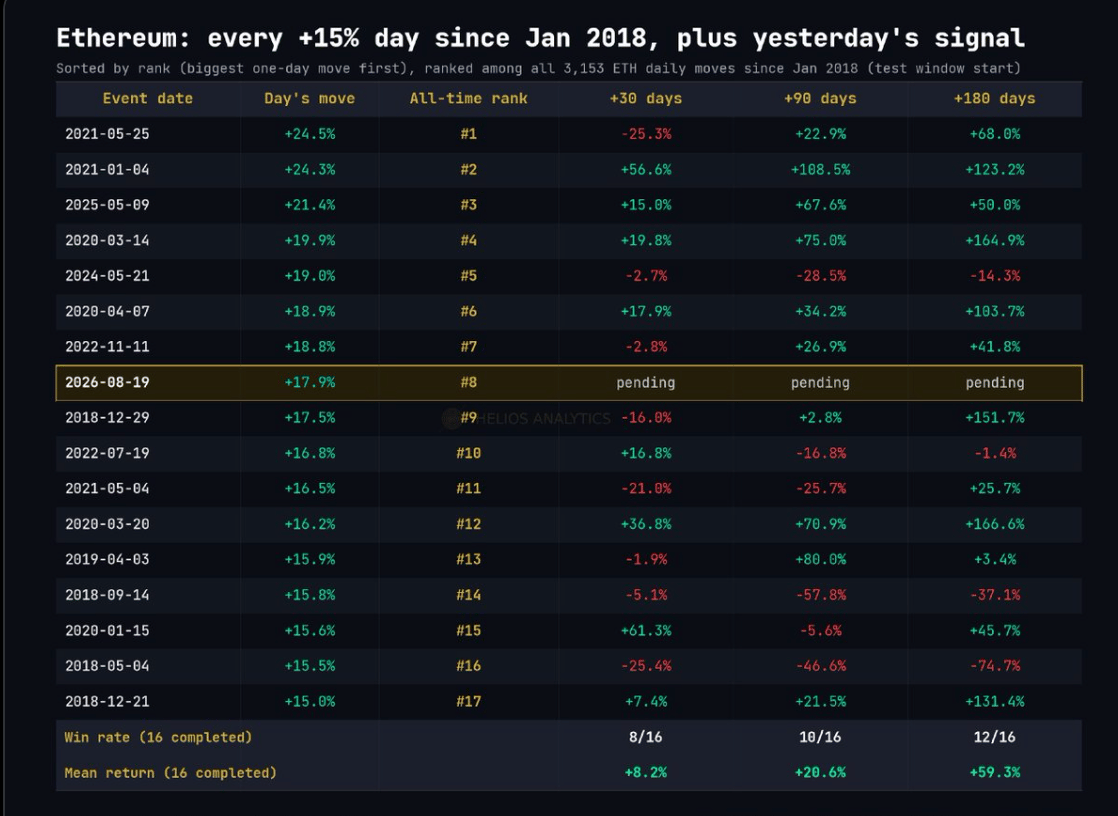
ETH’s recent double-digit one-day pump has attracted historical comparison. Market watcher Jamie Coutts noted that several similar upticks in the past helped push ETH prices up as much as 60% over 180 days.
Other altcoins have also started moving faster, and that segment added $215 billion between August 19 and 22, pushing its total market cap above $1 trillion. According to Credible Crypto, some assets with stronger fundamentals could outperform ETH if the cycle continues. They could potentially deliver even bigger returns if Ethereum goes up tenfold from $2,000 to $20,000, as he predicts.
World Liberty Financial launches USD1
World Liberty Financial has launched its USD1 stablecoin natively on the Canton Network. This enables institutions to settle transactions involving tokenized real-world assets.
The stablecoin can be used as the cash leg for transactions including derivatives collateral, institutional lending, asset issuance and redemptions, according to a Tuesday announcement.
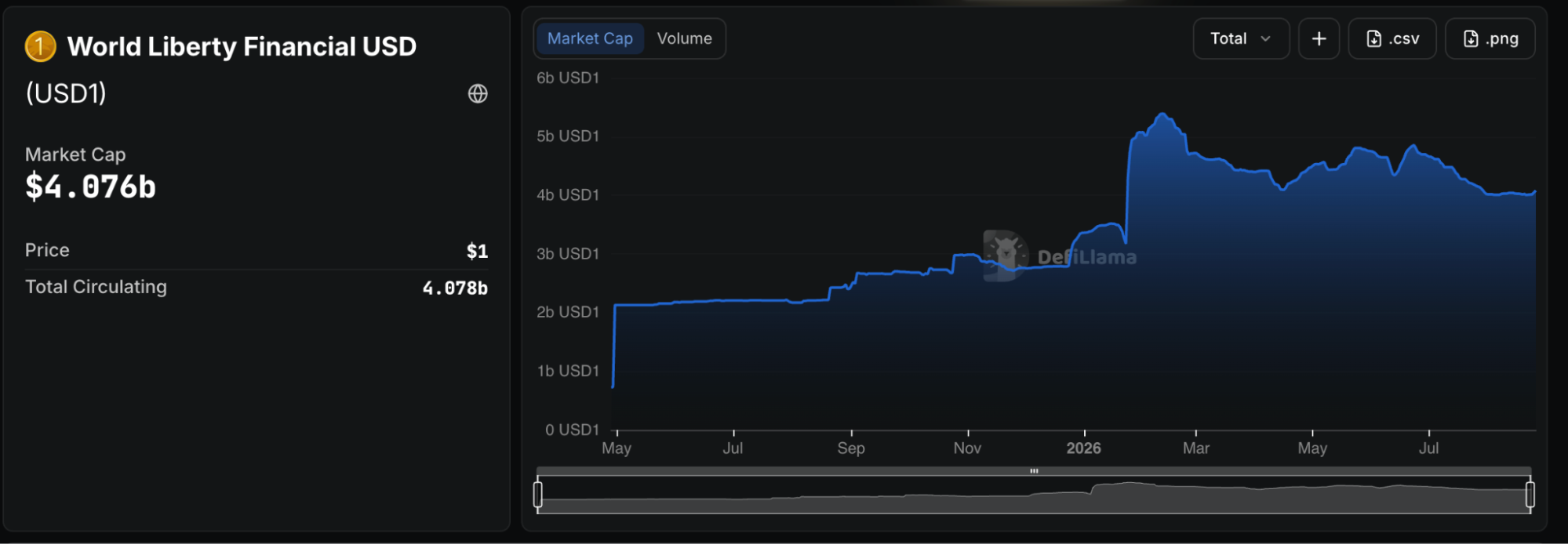
Native issuance allows USD1 to settle alongside tokenized assets in the same transactions while using Canton’s privacy and permissioning controls. USD1 has a market capitalization of about $4.08 billion, making it the sixth-largest stablecoin. BitGo Bank & Trust issues the token, manages its reserves, and processes minting.
World Liberty Financial is a Trump family-backed crypto venture launched in 2024. USD1 debuted in March 2025 and is backed by reserves including short-term US Treasuries, government money market funds, and dollar deposits.
Canton, a public, permissionless blockchain designed for institutional finance processes and issues over $9 trillion in tokenized assets each month. It also has more than $350 billion in onchain US Treasurys moving across the network daily.
The integration follows another Canton expansion announced last week. Digital Asset and former US House Speaker Paul Ryan’s American Idea Foundation unveiled plans to pilot a Canton-based system for distributing state-administered benefits across three US states from 2027.
Zypto unlocks cross-wallet crypto payments
Zypto has expanded its crypto payment capabilities with External Payments, allowing users to pay for Zypto products and services directly from external crypto wallets and exchange accounts.
The feature removes the requirement to first transfer assets into a Zypto App wallet before completing a purchase. Users with crypto in a hardware wallet, another self-custody wallet, or a supported exchange can instead initiate payment from those existing balances.
By opening Zypto’s ecosystem to externally held crypto, the company is making its services more accessible to users who manage assets across multiple platforms. That includes customers who prefer to keep funds in wallets, as well as those holding crypto on exchanges.
External Payments can be used for Zypto products and services, including crypto card loads and bill payments, while users retain the flexibility to choose where their payment funds originate.
Zypto says its own in-app wallet remains the most streamlined option, but external payment support gives users another route to spend crypto without consolidating holdings first.
The update reflects a broader push across the crypto industry to make moving between self-custody, exchange-held balances and real-world spending easier. Rather than forcing users to move funds between platforms before they can pay, Zypto is positioning its app as a bridge between existing crypto holdings and payment services.
The capability also supports Zypto’s wider payments ecosystem, which includes bill payments in more than 120 countries and access to more than 100 cryptocurrencies. Users can select a biller, enter their payment details, choose a crypto asset, and complete the transaction from a Zypto wallet, an external wallet, or an exchange.
For users, the main benefit is flexibility: crypto can remain where it is stored until it is needed for a payment.
Find out more here.
Closing remark
Telegram has applied for the .gram top-level domain, which could let users turn Telegram usernames into AI-generated, Telegram-hosted websites. Solana has cut block-production slot time from 400ms to 350ms, aiming to improve transaction responsiveness.
Pi Network says it will deploy Protocol 27 on September 15 to add more flexible, secure smart-contract transaction authorization. Former X product head Nikita Bier says trading buttons are forthcoming, potentially allowing users to execute token trades directly from posts.
Analyst Credible Crypto argues that Ethereum could reach $20,000 in a continued Bitcoin-led bull cycle if ETH/BTC recovers and Bitcoin clears higher price levels. World Liberty Financial has issued its USD1 stablecoin, enabling institutions to use it as a privacy-controlled settlement asset for tokenized real-world-asset transactions.
Zypto’s update makes moving between self-custody, exchange-held balances and real-world spending easier, positioning the app as a bridge between where your crypto sits and where you spend it.
FAQs
What is Telegram's plan?
Telegram aims to give its users new websites.
What did Solana do?
Solana reduced its slot time to 350 milliseconds, aiming to increase its efficiency.
What is Pi Network working towards?
Pi Network plans to upgrade to Protocol 27.
What is the latest on X?
X trade buttons are reportedly coming soon.
What did World Liberty Financial launch?
World Liberty Financial launched its USD1 stablecoin natively on the Canton Network.