Ownership showed its edges today. Apple and Nvidia shares became transferable tokens on Base, Standard Chartered started handing a licensed Hong Kong dollar stablecoin to corporate clients, and a peer-to-peer platform told 2.5 million people to empty their balances.
- Apple, Nvidia, Meta and Alphabet now trade as B20 tokens on Base, around the clock.
- Standard Chartered is the first bank cleared to distribute HKDAP, Hong Kong’s first regulated local-currency stablecoin.
- Withdrawal-only: NoOnes closed its marketplace and left Bitcoin and Tron-based USDT as the exits.
- Four in ten UK bank transfers to exchanges are still blocked or delayed, Bitcoin Policy UK told Parliament.
Each story puts a different hand on the same switch. A broker holds the share behind the token, an issuer holds the promise behind the stablecoin, a platform held the balances until it couldn’t, and a bank decides whether the payment leaves at all.
Coinbase puts Apple and Nvidia onchain
 Source: Cointelegraph
Coinbase’s tokenized US stocks went live on Base on Monday as B20 tokens covering Apple, Nvidia, Meta and Alphabet, with more expected over the coming weeks. They’re open to non-US users in eligible jurisdictions and tradable around the clock, and each token is a claim on an underlying share held with regulated broker and custodian Alpaca under an Abu Dhabi Global Market structure.
Chainlink data feeds price the tokens continuously so lending markets and decentralized exchanges can work with them. The wider tokenized-stock market sits near $2.48 billion across 2.1 million holders.
Zypto take: Equities that settle into a wallet you control expand what a wallet is for, and the honest detail sits in the custody chain: you hold the token, a broker holds the share.
Zypto already keeps tokenized treasuries, gold and credit beside the rest of your crypto in real-world assets, with the keys on your device.
Standard Chartered starts handing out a Hong Kong dollar stablecoin
 Source: FinanceFeeds
Standard Chartered Bank (Hong Kong) is the first bank authorized to distribute HKDAP, Hong Kong’s first regulated local-currency stablecoin. It starts with eligible institutional clients and partners, pointed at settlement for tokenized money market funds, transfers between entities inside the bank’s own network, and cross-border payments.
The structure keeps most of the pieces in one group. Anchorpoint, the issuer, is a subsidiary of Standard Chartered Bank (Hong Kong) and a joint venture with Hong Kong Telecom and Animoca Brands, while Standard Chartered Trustee holds the reserve assets in trust.
Zypto take: Name the terms and the picture gets clear. A company issues HKDAP, an affiliate of that company holds the reserves, and clients it approves get access.
Even the stablecoins you hold in your own wallet keep an issuer standing behind them, which is why the tier of asset you’re holding tells you more than the app it sits in.
A platform with 2.5 million users goes withdrawal-only
 Source: CryptoSlate
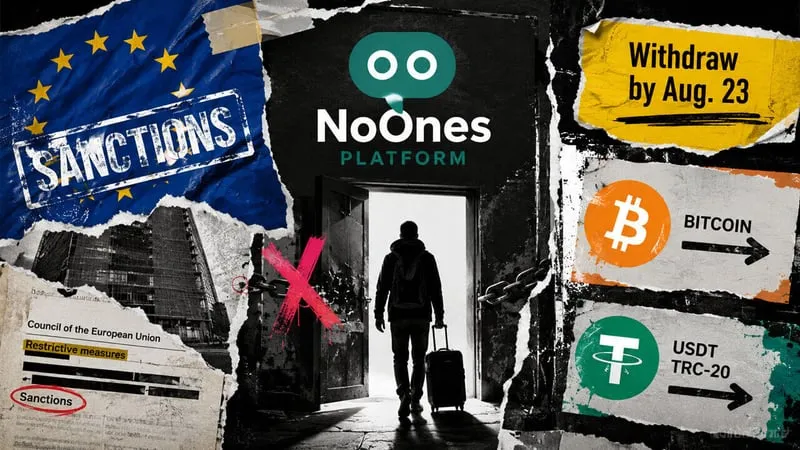
Peer-to-peer marketplace NoOnes has moved to withdrawal-only after the EU added its operator, NoOnecrypto INC., to its sanctions list with effect from August 23. The wind-down began on August 17, the marketplace closed on August 21, and users were strongly advised to move their full balances out.
Bitcoin over the Bitcoin network and USDT over Tron are the remaining exits. The platform says it served more than 2.5 million users across more than three years, and no final date for withdrawals has been published.
Zypto take: A platform balance is a line in someone else’s ledger, and a wind-down makes that concrete fast: the coins already sitting in your own wallet needed no notice and no deadline.
That’s the whole case for holding keys on your own device across 20+ blockchains. Download Zypto App.
UK banks still block four in ten transfers to exchanges
Source: Bitcoin Magazine
Bitcoin Policy UK told the Crypto and Digital Assets All-Party Parliamentary Group that around 40% of bank-to-exchange transfers are blocked or delayed, almost three years after the group first raised blanket banking restrictions with the City Minister. Government guidance since 2023 has asked banks to assess activity case by case instead of restricting a whole sector.
The submission leans on earlier evidence too. A 2025 industry survey found half of UK fintech and crypto firms were refused bank accounts or had them closed, and an IG Group survey put blocked or delayed payments at 40% of active crypto investors.
Zypto take: A transfer that clears on the second attempt is still a transfer somebody approved, and that’s a gap in banking policy rather than anything wrong with owning Bitcoin.
Routes that leave the bank rail out already work: USDC to Cash turns USDC into physical local currency, with no bank account required.
Key Takeaways
- Tokenization keeps arriving with a custody chain attached. Ask who holds the underlying asset before you decide what the token is.
- Banks becoming stablecoin distributors widens access, and it leaves the permission exactly where the issuer put it.
- A wind-down and a blocked bank transfer teach the same thing from opposite ends: value you hold yourself keeps moving when a company or a policy stops.
- The useful audit for anyone holding assets in several places is short. Which balances need someone’s approval to move, and which don’t?
- Hong Kong is the one to watch through the fourth quarter, when tokenized fund settlement is due to run on HKDAP.
Related topics