Today’s news is about exits. Who can close one, who can watch one, and who can quietly take what walks through it.
- America’s bank lobby wants a customer file opened before a stablecoin turns back into dollars.
- Japan’s regulator, treasury and central bank are rebuilding how stocks and government bonds settle.
- Thirty-nine state banking associations want a chain of their own by 2027.
- Five months, forty malicious Firefox add-ons, and a steady harvest of recovery phrases.
Each story asks the same question from a different direction: where does your value sit when you’re not looking at it, and who has to agree before it moves?
The bank lobby wants a customer file before you cash out
 Source: CryptoSlate
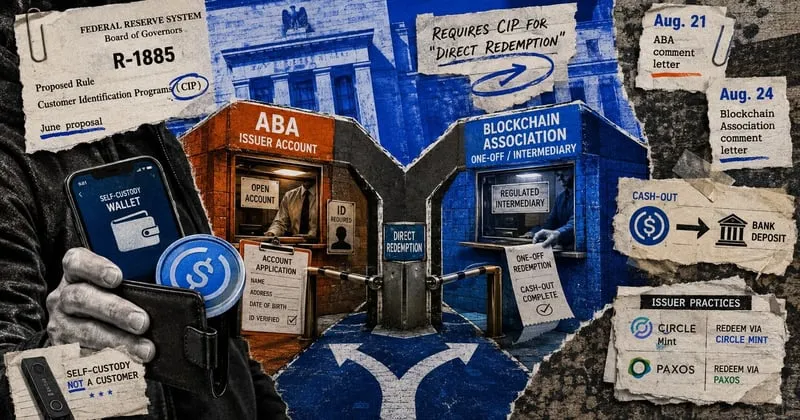
The American Bankers Association has asked federal regulators to require an account before anyone buys or redeems a payment stablecoin directly with its issuer, complete with customer identification procedures. The comment was filed on August 21, answering a joint regulatory proposal from June that asked whether a direct redemption creates a customer relationship at all.
The Blockchain Association filed the opposite position three days later, on August 24. Its argument is that a one-off redemption, or one routed through an intermediary, shouldn’t automatically open an account. If the ABA’s reading prevails, holders of USDC and tokens like it would need an issuer account standing before dollars could reach them.
Zypto take: An issuer that can demand an account before returning your dollars can also decline to open one. That’s the honest shape of a redeemable token, which is yours to move and someone else’s to settle.
The way out doesn’t have to run through the issuer’s front door. USDC to Cash converts USDC into physical local currency at participating MoneyGram locations, with no bank account required. Download Zypto App.
Japan puts its stocks and government bonds on a shared ledger
 Source: The Block
Japan’s Financial Services Agency, Ministry of Finance and Bank of Japan are jointly building a blockchain settlement system for stocks and government bonds with domestic financial institutions, according to Nikkei. A development plan is due in early 2027, with the system fully operational in the early 2030s.
Settlement would move from today’s two-day cycle to real time. Around 40 regional and online banks are already running tokenized deposit transfer trials, and separate amendments reclassify roughly 105 cryptocurrencies as financial instruments from fiscal 2027, applying a flat rate near 20% in place of rates that currently reach 55%.
Zypto take: Two days to settle a share trade was never a technical requirement. It was the speed of the paperwork underneath, and a central bank rebuilding that layer is a fair measure of how ordinary this technology has become.
The same tokenization that lets a government bond settle in real time is what puts real world assets in a self-custody wallet next to everything else you hold.
Thirty-nine banking associations set out to build their own chain
 Source: Cointelegraph
Thirty-nine US state banking associations have formed the BankChain Alliance to build a nationwide blockchain network owned by the banking industry, targeting a 2027 launch. Banks around the country will be invited to buy ownership stakes in it.
The design point is that its tokenized deposits stay claims on an individual bank rather than becoming independent stablecoins, so customer funds remain on that bank’s balance sheet while transfers run around the clock. Governance, funding and which banks have committed were all left undisclosed. It joins The Clearing House’s onchain money network, Cari’s regional lender network and the DTX Consortium in the same space.
Zypto take: A tokenized deposit is a claim on a specific bank, and it behaves like one, which includes who may hold it and when it can be stopped. That’s a real product, and it’s worth naming for what it is rather than filing it next to everything else that moves on a chain.
Stablecoins move value between people who share no bank and have never met. A deposit token moves value inside the institution that issued it. Knowing which one you’re holding tells you who has to agree before it moves.
Forty Firefox add-ons spent five months hunting wallet keys
 Source: Decrypt
Security firm Socket linked 77 Firefox extension identities to a single campaign, 40 of them confirmed malicious, all impersonating OKX, Rabby Wallet and TronLink through near-identical naming. Nine started out publishing genuine sports-score apps before an update quietly turned them into wallet stealers.
Around twenty showed a convincing wallet screen and asked the user to import an existing wallet, capturing whatever recovery phrase got typed in. Thirteen were modified builds of Rabby that worked normally while shipping stored account data to an outside server, and five collected saved credentials and clipboard contents. Mozilla’s signing records run from March 9 to August 3. Socket’s advice is blunt: anyone who entered a phrase into one of these should treat it as permanently compromised, because uninstalling doesn’t recall what was already sent.
Zypto take: A key that lives in software can be read by other software running beside it. Five months of signed, updated, entirely ordinary-looking add-ons is what that reads like in practice.
Moving the approval off the machine is the answer to that specific problem. The Vault Key Card splits signing authority between the phone and the card, so a compromised device still can’t approve a transaction unless the card is physically tapped.
Key Takeaways
- The stablecoin argument has moved on from who may issue one to who may leave one. Redemption is where the control sits, and that’s what the ABA filed about.
- Institutions are adopting the mechanics of this technology, meaning instant settlement and tokenized deposits, well ahead of adopting its openness.
- A deposit token and a stablecoin both move on a chain. Whose balance sheet each one sits on is the part worth reading.
- Software keys share a machine with whatever else runs on it, which is what a physical approval step is for.
- When Japanese government bonds settle in real time in the 2030s, the interesting question won’t be whether value can move instantly. It’ll be who still has to agree before it does.
Related topics