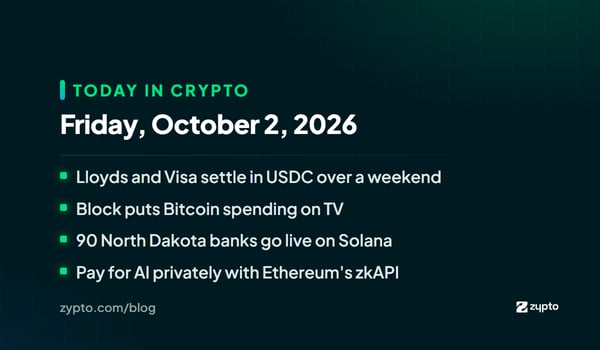
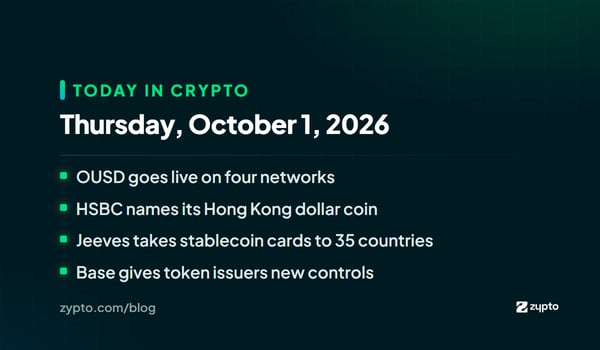
The clock is the last thing traditional money still runs on, and today’s news is mostly about taking it out. Swift’s ledger started accepting tokenized deposits, Block gave software a way to pay in Bitcoin by the fraction of a cent, and ARK’s venture fund now prices itself every day on a public chain.
- IBM plugged its Digital Asset Haven platform into Swift’s shared ledger, with 17 institutions already testing tokenized deposits.
- Lightning joined x402, the standard AI agents use to buy data and API access on their own.
- OpenAI, Anthropic, Stripe and Databricks exposure landed on Ethereum through Securitize.
- The Federal Reserve put numbers on what has to sit behind a regulated stablecoin.
Three of these turn a process that used to keep office hours into one that runs continuously. The fourth writes down who is answerable when it does.
Swift’s ledger starts taking tokenized deposits
 Source: The Block
IBM connected its Digital Asset Haven platform to Swift’s shared blockchain ledger through a beta ISO 20022 messaging adapter, letting banks move tokenized deposits using the message format they already send every day.
The reach behind that is the story. Swift connects more than 12,500 financial institutions across 200-plus markets. Over 40 of them worked on the ledger’s design, and 17 are running tokenized deposits in the pilot now.
The adapter is beta, and so is the on-premises version that runs on IBM Z and LinuxONE. The messaging standard underneath is not, which is why banks can reach this without replacing what they already run.
Zypto take: A tokenized deposit is a bank’s promise with the opening hours stripped out, which beats a transfer that waits until Monday. It remains the bank’s promise. Value you hold yourself and move through Zypto’s crosschain routes travels at 3am on a Sunday because you decided it should. Download Zypto App.
Lightning joins the standard AI agents pay with
 Source: Cointelegraph
Block added Bitcoin Lightning support to x402 and joined the x402 Foundation. x402 is an open payment standard that lets AI agents and web services pay for API access, data and digital services by themselves, without a person approving each charge.
Google, Microsoft, Amazon Web Services, Coinbase and the Solana Foundation already back the standard through the Linux Foundation. Block’s Steve Lee said Lightning suits “the low-cost, high-volume payments that agentic commerce will depend on”.
That’s Bitcoin doing something it’s been able to do for years, finally handed a customer built entirely around payments worth a fraction of a cent.
Zypto take: Software that pays per request is just another customer who needs a checkout, and the economics decide whether a merchant bothers. Zypto Pay settles in fiat or 100+ cryptocurrencies with 0% merchant-side processing fees, which is what makes a tiny payment worth accepting at all.
ARK puts its venture fund on Ethereum
 Source: CoinDesk
ARK Invest tokenized its ARK Venture Fund with Securitize, putting an actively managed interval fund that holds OpenAI, Anthropic, Stripe and Databricks onto Ethereum. Securitize runs the onchain issuance and the investor experience, calculates a daily net asset value, and opens the fund to blockchain-based markets.
Ethereum comes first, with other networks possible later. Eligible investors only. What gets tokenized is the fund interest rather than the underlying company shares, so a holder owns a claim on the fund, the way they did before.
Zypto take: A daily net asset value published onchain, with a market open around it, is the part worth noticing here. Assets that used to sit in a registry are turning into things you can hold in a wallet, which is the whole premise of real world assets and the reason the category keeps expanding.
The Fed writes down what backs a stablecoin
 Source: Decrypt
The Federal Reserve proposed two rules implementing the GENIUS Act. The first requires Board-supervised issuers to hold full reserves in permissible assets such as short-term Treasury bills, and sets capital requirements for credit and operational risk plus safekeeping standards for the reserves themselves.
The second creates an application process for supervised banks that want to issue a stablecoin: business plan, financial information, and a route for appeals and hearings.
The comment period runs 60 days from publication in the Federal Register. The Office of the Comptroller of the Currency is aiming to finalize its own rules by November, ahead of a January statutory deadline.
Zypto take: Rules like these describe what sits behind a token and who answers for redeeming it, which is worth knowing before you hold one. A USDC balance is yours to move and the issuer’s to freeze, and no reserve schedule changes that. Zypto App carries stablecoins across 20+ blockchains, because where a token can travel is what decides how useful it is to you.
Key Takeaways
- Continuous settlement is arriving inside the message formats banks already send, so adopting it doesn’t mean replacing what they run.
- Machine-to-machine payments need settlement that’s small, instant and cheap, which is what Lightning was built for.
- Tokenizing a fund changes how often it gets priced, and a daily value on a public chain matters more than the token wrapper.
- Reserve rules tell you what backs a token. Who can freeze it is a separate question, and that answer decides what you own.
- Across all four stories, the always-on version of a financial process is the one gaining ground. Public blockchains have run that way since the first block.
Related topics