Every story on the desk this morning sits in the gap between holding digital value and using it. The US Senate votes Tuesday on who gets to build the tools, tokenized stocks on Base cleared $100 million in a single day, and nearly eight in ten consumers say they’d open a crypto wallet if it lived inside an app they already have.
- Senate Republicans put out a final Clarity Act text late Sunday night, with a procedural vote on Tuesday.
- $100 million of tokenized stocks traded on Base in one day, 26 days after the listings opened.
- Seventy-one percent of stablecoin holders would spend through a linked card. Nearly half say merchants are what’s missing.
- A fake government email walked out of Revolut with passports and full Bitcoin transaction histories.
Three of those are about closing the gap. The fourth is a reminder of what gets carried across it, because the information a company holds about you travels in ways the assets you hold yourself do not.
A final Clarity Act text lands before Tuesday’s vote
 Source: The Block
Senators Cynthia Lummis, John Boozman and Tim Scott released the final draft of the Digital Asset Market Clarity Act late on Sunday night. The text carries 126 substantive changes requested by Democrats, and a procedural cloture vote is set for Tuesday.
Republicans hold 53 seats and need 60, so at least seven Democrats or independents have to come across.
Two of the changes matter beyond the vote count. One gives the Treasury secretary an 18 month circuit breaker on stablecoin rewards if payment stablecoins start pulling deposits out of banks. The other amends the Blockchain Regulatory Certainty Act to narrow when software developers have to register as money transmitters.
Zypto take: That developer registration line is the one to watch. Software that never touches a customer’s assets is a different thing from a business that holds them, and putting that distinction into statute is how self custody stays an ordinary product rather than a licensed one. Keys sit on the user’s own device in Zypto App, which is exactly why the distinction is worth writing down.
Tokenized stocks clear $100 million in a day
 Source: crypto.news
Tokenized stocks on Base have passed $100 million in daily decentralized exchange volume, 26 days after Coinbase opened the listings on August 24. Token Terminal counted $730.9 million across the preceding 30 days.
Aerodrome carried $557.1 million of that monthly figure and Uniswap v4 took $139.3 million. The tickers run from AAPLc and NVDAc to GOOGLc and METAc, with Amazon, Microsoft, Tesla and SpaceX alongside them. Base founder Jesse Pollak marked the day as going from zero to $100 million in daily stock volume in under a month.
Zypto take: The volume is less interesting than the clock. A share that used to move for six and a half hours a day now moves whenever its owner decides to, which is the whole argument for real world assets onchain. Worth holding the distinction clearly, though: a tokenized share is a claim on an issuer, not an asset with no company standing behind it.
Stablecoin holders are waiting on the checkout
 Source: PYMNTS
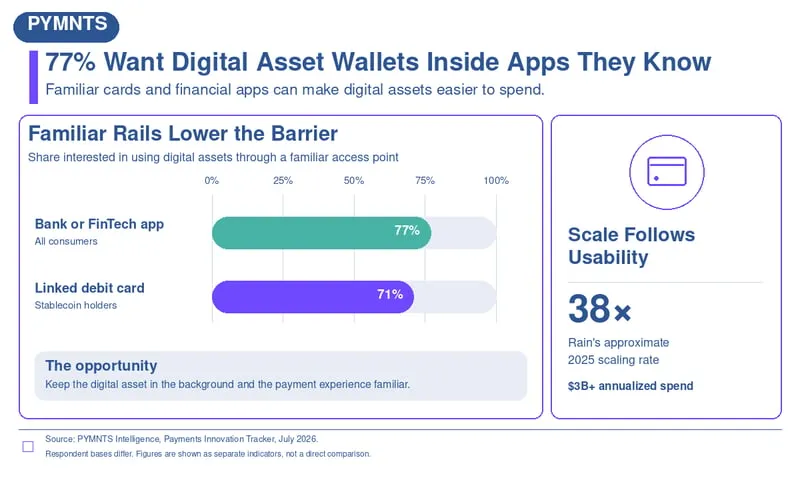
PYMNTS Intelligence published its July 2026 Payments Innovation Tracker on Monday, and the finding is that demand is running ahead of availability. Forty-two percent of stablecoin holders want to use digital assets for major purchases and 28% already do. Nearly half name limited merchant acceptance as the thing stopping them.
Seventy-one percent say they’d use a linked card to close that gap. Seventy-seven percent of consumers say they’d open a crypto or stablecoin wallet through the banking or fintech app they already use, which is the report’s wider point: this moves faster when it asks people to change less.
Zypto take: A card answers the merchant acceptance problem by asking merchants for nothing at all. Zypto Premium VISA Cards load from 100+ cryptocurrencies and work wherever Visa is accepted, with the conversion happening at load rather than at checkout. Download Zypto App.
A fake government request walks out with passports
 Source: Decrypt
Revolut disclosed customer records to an unauthorized third party that submitted fraudulent requests from an email account on a legitimate government agency domain. The company called it a sophisticated external impersonation scam, said it blocked the address once it was identified, and said its systems and customer funds were unaffected.
What may have gone out is the rest of it: names, dates of birth, postal and email addresses, phone numbers, copies of identity documents including passports and driver’s licenses, plus account statements, IBANs, withdrawal records and full transaction histories, Bitcoin ones included. Revolut says a limited number of customers were affected and has contacted them directly, while declining to say how many or which agency domain was used.
Zypto take: The funds were never the exposure. What left the building was the link between a person’s identity documents and everything they had ever done with their money, and that link existed because one company was holding both halves of it.
Self custody doesn’t make a blockchain private. It does mean no single company is sitting on your passport and your transaction history in the same file, which is what keys on your own device buy you in a multichain wallet.
Key Takeaways
- What decides whether digital money reaches everyday use is legal and commercial now, not technical. The engineering question was settled a while ago.
- People aren’t waiting for a better asset. They’re waiting for somewhere to use the one they already hold, and nearly half of them say the merchant is the missing piece.
- Most people want this inside an app they already use. The question worth asking of any such app is who holds the keys once the assets are in it.
- An issuer’s token and an asset with no company behind it can sit in the same wallet and look identical. Only one of them has a company that can freeze it.
- Tuesday’s vote won’t change what you can do with crypto this week. It will shape who is allowed to build the next thing you do it with.