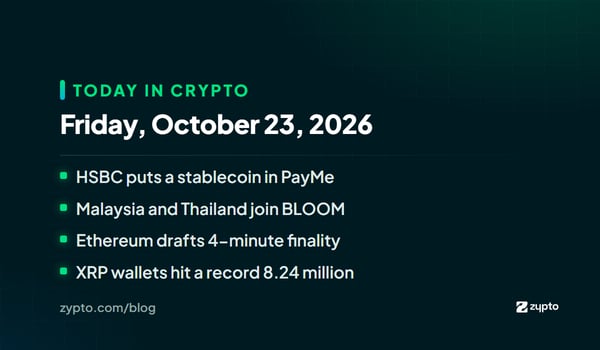
A 125-year-old ratings agency just tested moving credit data across chains it doesn’t control. A German bank went live holding Bitcoin for clients who don’t control their own keys. South Korea gave exchanges a new reason to freeze an account before anyone confirms what happened.
- Deutsche Bank went live with custody for Bitcoin, Ether and three stablecoins, institutional clients only.
- Moody’s and Chainlink moved a credit rating across several blockchains at once, chain-agnostic by design.
- South Korea will let exchanges freeze withdrawals on suspicion of a hack, not proof of one.
Every one of today’s stories answers the same quiet question: who is in charge of this asset. A bank, a network a ratings agency picked, or the person holding the keys. None of those answers is wrong, but they’re not the same answer.
Deutsche Bank goes live with institutional crypto custody
 Source: Decrypt
Deutsche Bank’s Digital Asset Custody service is live for institutional and corporate clients in Europe, five years after the bank started building it. The service holds Bitcoin, Ether, and three stablecoins, Circle’s USDC and EURC plus EURAU, with hardware-based key protection split across warm and cold storage.
Deutsche Asset Management, which oversees about €1.22 trillion, has already signed on to explore tokenized money market funds on the same rails. “In the medium term we aim to deliver a fully integrated, regulated ecosystem that supports the custody, tokenisation, and settlement of digital assets,” said Paul Maley, the bank’s global head of trust and securities services.
Zypto take: Deutsche Bank still holds the keys here, which is custody working exactly as designed: the institution controls access, and the institution can freeze it if it needs to.
A Zypto App wallet runs on the other model. Same Bitcoin, same Ether, same reach across 20+ blockchains, except the keys stay with the person holding the phone. Download Zypto App.
Moody’s and Chainlink move a credit rating across multiple blockchains at once
 Source: Decrypt
Chainlink and Moody’s Ratings ran a testnet pilot that distributed a single credit rating across several blockchains simultaneously, using Chainlink’s Cross-Chain Interoperability Protocol and Moody’s own Token Integration Engine. The test spanned both permissioned and permissionless networks, with no live ratings published onchain yet.
Moody’s has rated or assessed more than 70 digital issuances since 2017. “As more financial assets move onchain, credit intelligence has to move with them, across chains and through every rating change,” said Johann Eid, Chainlink Labs’ chief business officer.
Zypto take: That cross-chain network is the same rail Zypto already runs on. It carries the $ZYPTO token across five blockchains and powers the Multi-Chain Wallet’s 1,000,000+ cross-chain routes inside Zypto App.
When a 125-year-old ratings agency picks that infrastructure to move something as conservative as credit data, the rest of finance is catching up to what Zypto users already use every day.
South Korea lets exchanges freeze withdrawals on suspicion alone
 Source: Cointelegraph
South Korea’s Financial Services Commission will let crypto exchanges suspend deposits and withdrawals the moment a hack is suspected, rather than waiting for a breach to be confirmed. The regulator is issuing a no-action letter permitting the preventive freeze, alongside new rules on round-the-clock monitoring and higher cold-wallet reserves.
The trigger: GOPAX suspended services over a hacking threat with no confirmed breach, and Prabang lost about $70,000 to abnormal hot-wallet withdrawals in October. A separate FSC review found cybersecurity gaps at 130 of 555 financial firms checked nationwide.
Zypto take: This is a sensible rule for the model it governs. When an exchange holds the keys, freezing first and confirming later protects every other balance sitting on the same platform too.
It’s also the clearest version yet of a distinction Bitcoin made obvious from the start. Its keys answer to whoever holds them, not to an issuer who could choose to suspend access on suspicion alone. The tradeoff just moves from an exchange’s judgment call to the user’s own responsibility.
Key Takeaways
- Custody is splitting into two parallel tracks: institutions building vaults they control, and individuals holding their own keys, with real money moving through both at once.
- Chainlink’s cross-chain rails, the same ones carrying Zypto’s own swaps, are becoming the default pick for traditional finance’s own cross-chain problems too.
- Regulators are tightening the rules around custodial platforms, not around crypto itself, a maturity signal in its own right.
- Expect “who holds the keys” to keep resurfacing as the real question behind every institutional crypto headline from here.
Prices, fees, features and availability mentioned in this article were correct at the time of publishing and may have changed since.