Welcome to this week’s crypto news.
Tether makes some new investments, Fireblocks launches a stablecoin payment network, Ethereum ETF withdrawals total nearly $1 billion, DeFi Development Corp’s holdings surpass 2 million SOL, Pi Coin has a new update, and XRP whales accumulate $630 million.
Let’s get to it.
Tether invests in gold mining firms & AI chat app
According to the Financial Times, Tether is reportedly considering using part of its crypto earnings to acquire stakes in gold-mining firms. The company has discussed investing in the entire gold supply chain with mining and investment groups.
In June, Tether Investments paid $105 million for a minority stake in Elemental Altus, a Toronto-listed gold royalty company. Last Friday, Tether increased its investment by $100 million as Elemental merged with rival EMX.
The move appears to reflect its strategy to deploy sizable crypto-derived earnings into more traditional, commodity-linked assets, with gold increasingly viewed internally as a digital counterpart or “natural Bitcoin.”
Tether reported a $5.7 billion profit in the first half of the year, providing ample capacity for such investments. The move may mark a significant milestone in integrating cryptocurrency profits with traditional financial instruments if executed.
Analysts infer that this approach could enable Tether to reduce risk exposure to the highly volatile cryptocurrency market. It could also inspire wider adoption of commodity-backed strategies, as well as strengthen market confidence in stablecoin issuers.
Furthermore, Tether is also preparing to merge its artificial intelligence platform, QVAC AI, with its peer-to-peer messaging app Keet, aiming to deliver fully private, device-based operations.
The move, announced by Tether CEO Paolo Ardonio, highlights the company’s push to extend its reach beyond stablecoins and into privacy-focused communications.
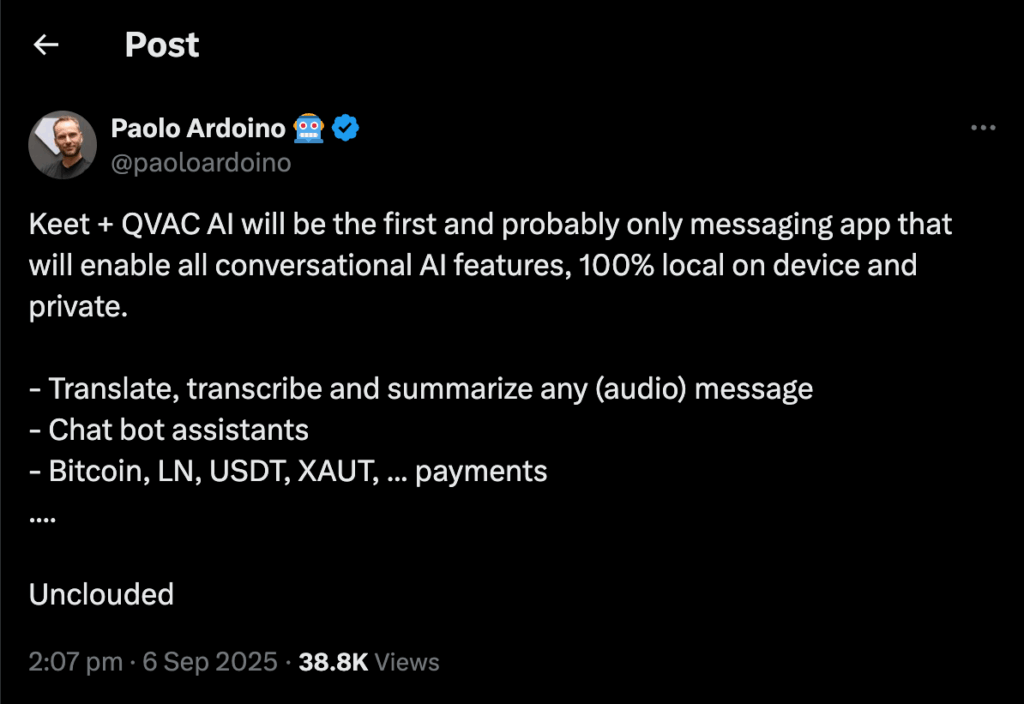
QVAC AI is expected to give Keet capabilities such as instant language translation and audio transcription. It will also support conversation summarization and chatbot functions. The messenger will also process digital asset transactions, including BTC, USDT, XAUT, and Lightning payments.
Ardonio’s comment outlines Tether’s focus on privacy at a time when most messaging services store and analyze user data on external servers. When combined, the two tools are expected to produce a communication service that merges AI utilities with secure payments. This ensures that data remains with users.
The Keet integration follows Tether’s broader strategy of applying QVAC AI across different products. Earlier this year, it planned to embed the technology into its Bitcoin Mining OS. The upgrade is intended to help operators track real-time performance and optimize output.
These moves build on several expansions that have taken Tether into fields like artificial intelligence, Bitcoin mining, digital education, and gold markets. Yet, it still dominates the stablecoin industry with a market cap of nearly $170 billion.

Fireblock launches stablecoin payment network
Fireblocks, a digital asset infrastructure company, has introduced a payment network connecting over 40 stablecoin providers across 100 countries. This was announced via a post on social media.
The network consolidates multiple payment rails, blockchain systems, and compliance frameworks through standardized interfaces. Through the new network, financial institutions can access stablecoin providers, including Alfred, Circle, Bridge, and Yellow Card, via unified APIs, reducing the need for separate integrations while maintaining regulatory compliance across jurisdictions.
It also has planned integrations for Circle Payments Network and WalletConnect. These connections provide access to over 2,400 participants, including banks, exchanges, and digital wallet providers.
Stablecoin transaction volumes have increased substantially, with annual throughput now matching the combined processing capacity of traditional payment networks Visa and Mastercard.
Despite this growth, institutional implementation remains complex due to fragmented provider landscapes and varying compliance requirements across markets.
Financial institutions usually manage separate relationships with multiple service providers, each requiring distinct API integrations and compliance protocols. The fragmented approach creates operational overhead and regulatory complexity, particularly for organizations operating across multiple jurisdictions with different digital asset regulations.
The Fireblocks network attempts to standardize these processes by providing uniform data formats, automated compliance screening, and consolidated settlement mechanisms across 60 fiat currencies. The platform includes built-in tools for sanctions screening, wallet verification, and Travel Rule compliance to address regulatory requirements.
Fireblocks has processed over $10 trillion in digital asset transactions across 120 blockchain networks. The company serves institutional clients, including banks, payment service providers, and fintech companies.
Ethereum ETF withdrawals total nearly $1 billion
On September 5, Ethereum-linked exchange-traded funds (ETFs) saw a wave of withdrawals, with investors pulling more than $444 million. The sell-off marked the second-largest outflow since the funds launched in July 2024.
BlackRock’s ETHA led the withdrawals, shedding $307.68 million (nearly 70% of the total value). Grayscale had over $80 million, Fidelity’s FETH shed $37.7 million, while 21Shares’ CETH posted $14.68 million in withdrawals.

As a result, the September 5 withdrawals extended a five-day run of capital exits that started on August 29. Over that period, Ethereum ETFs collectively lost more than $952 million, marking the nine funds’ largest weekly outflow since their launch.
Market analysts pointed out that the outflows are a mix of profit-taking and caution in response to heightened price swings across crypto markets.
CryptoQuant analyst Ja Maartutn said sellers in ETH futures outweighed buyers by $570 million, pushing net taker volume sharply toward the sell side. Historically, such heavy selling often emerges near local market tops, reinforcing the view that traders are hedging against further decline.
Ethereum co-founder Joseph Lubin recently reiterated that ETH’s potential extends far beyond current valuations. He predicted that the asset could multiply by 100 times and that Wall Street institutions would eventually integrate Ethereum into core operations, staking, and running validators to replace legacy systems.
According to him, JP Morgan’s early experimentation with Ethereum technology shows that large banks already have exposure to blockchain infrastructure. This background positions them to adapt more easily once decentralized rails become the industry standard.
DeFi Development Corp’s holdings surpass 2 million SOL
DeFi Development Corp has boosted its Solana (SOL) holdings beyond 2 million tokens worth over $400 million, becoming the second-largest corporate holder of the cryptocurrency.
In a recent press release, the firm announced that it acquired 196,141 SOL. The press release read,
“The newly acquired SOL will be held long-term and staked to a variety of validators, including DeFi Dev Corp’s own Solana validators to generate native yield”
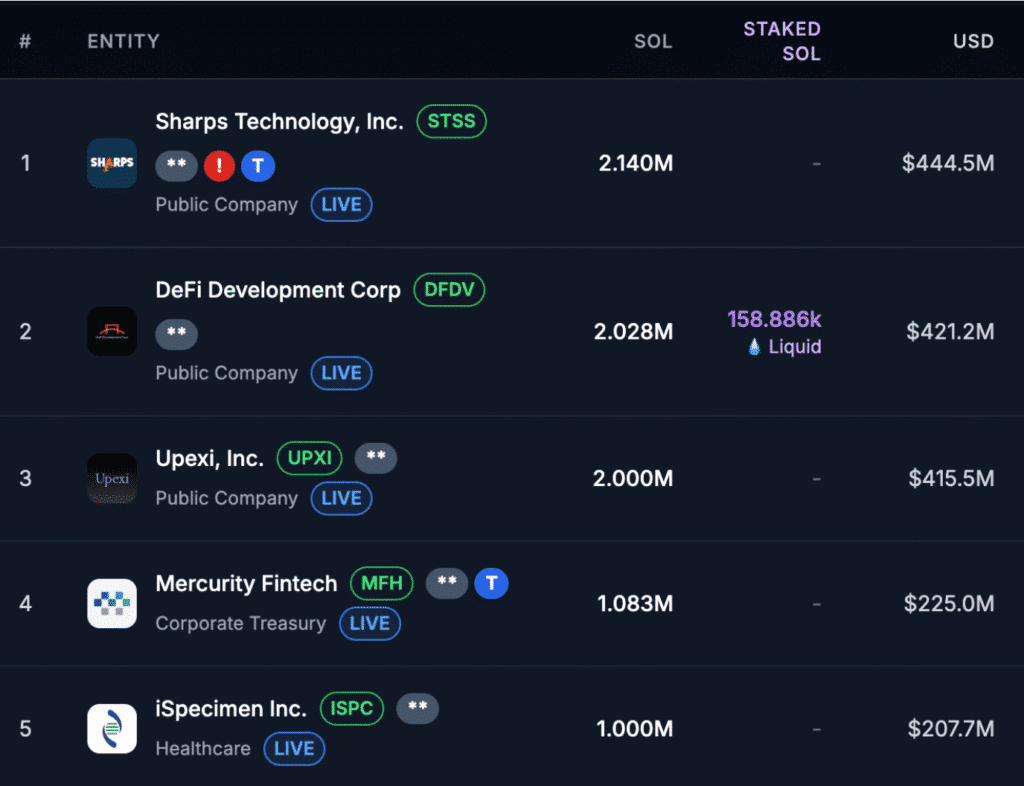
The average purchase price was $202.76 per coin. With this latest purchase, DeFi Development Corp now holds 2,027,817 SOL, exceeding Upexi’s holdings of 2,000,518 SOL.
The acquisition comes amid a broader price rally in Solana, which has seen its value climb by double digits over the past month. Similarly, it has also been helped by growing institutional interest in Solana.
According to Ray Youssef, CEO of Noones, the move reflects a broader shift, as treasuries and asset managers boost exposure to Solana’s strengthening liquidity and growing prospects for an ETF.
“Corporate treasuries and digital asset managers are also beginning to advance allocations, encouraged by Solana’s increasing structural liquidity depth and the prospect of an eventual ETF product.”
Beyond that, Solana’s on-chain network fundamentals are impressive.
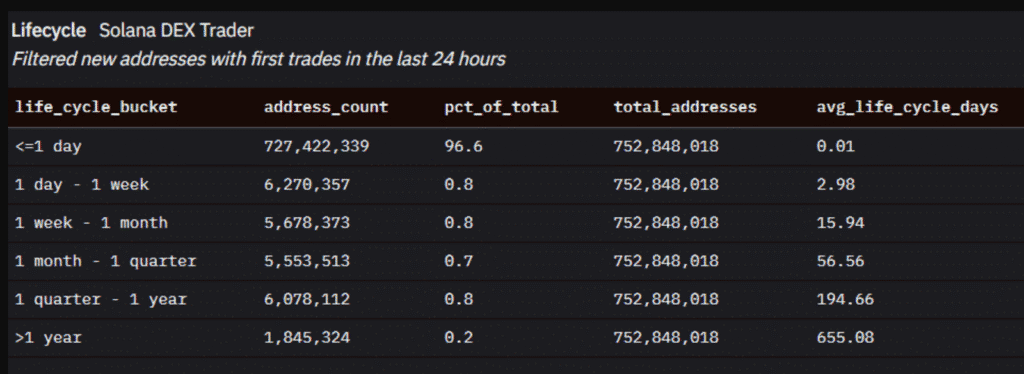
Solana has a high throughput, ultra-low fees, and sub-second transaction finality. It leads DEX activity with over 750 million transaction addresses and holds 25.36% of total trading volume, ahead of Ethereum’s 23.3%.
Is Pi Coin poised for a comeback?
Dr. Chengdiao Fan, co-founder of Pi Network, has been confirmed as a speaker at the upcoming Token2049 crypto conference. In addition to this, Pi Network will also serve as a Gold sponsor of the event.
Token2049 is one of the largest global conferences in the cryptocurrency and blockchain industry. The event brings together founders, executives, developers, investors, and regulators to discuss the state of the ecosystem, future innovations, and global trends.
This year’s edition is billed to be held in Singapore from October 1&2. The blog read,
“As the event approaches, further details regarding Dr. Fan’s session will be shared through Pi Network’s official channels. For now, confirmation of both sponsorship and founder participation marks an important step in Pi’s growing engagement with the wider blockchain ecosystem”
Dr. Fan’s participation provides a platform to present the Pi Network’s outlook on real-world use cases, community growth, and the broader path toward blockchain adoption. It also shows the network’s commitment to connecting with the wider Web3 space and the Pi community.
This development has raised optimism among the Pi Network community. Furthermore, it reignited speculation about a potential short-term price recovery for Pi Coin (PI) amid its ongoing decline.
Related: Explore Zypto App Pi ($PI) Wallet App for iOS and Android

Ripple’s trading volume pumps by 200%
Ripple’s native token XRP’s 24-hour trading volume has massively skyrocketed 200% on Tuesday, reaching a weekly high of $3.03. Its daily trading volume was $1.7 billion this week and has jumped above the $5 billion threshold.
The dramatic rise comes after the XRP call options expire in September, leading to investors booking profits and pulling out from the trade. The call options were mostly placed in June when its price was hovering at the $2.10 mark.
Options traders placed strike calls on XRP for $3, $3.5, and $4 for a contract expiring in September. According to the data from Derbit Amberdata, around 2 million contracts are set to expire before September 28.
Therefore, contract traders are changing hands as the day nears and booking profits, leading to its trading volume soaring 200%.
Furthermore, last week, two large cohorts of holders started to add coins. The first group held at least 1 billion XRP, and the second held between 10 million and 100 million XRP.
Since September 3, these groups grew their balances from 23.86 billion to 23.93 billion, and from 7.61 billion to 7.76 billion. At current prices, this added up to roughly $630 million in new holdings.
This buying was a clear push that helped XRP move above the $2.85 area, the level where most of the buying happened. That level had been stopping the XRP price from moving higher, and whale demand was the likely main reason the price rose again.
At press time, XRP was trading at around $3, rising by almost 10% within the past seven days. This comes amid an uptick in broader crypto activity, highlighted by the 1% rise in global crypto market capitalization over the same period.
The surge reflects renewed bullish sentiment, with both price action and derivatives data pointing to sustained momentum.
According to CryptoQuant, XRP’s Estimated Leverage Ratio (ELR) on Binance has climbed to a weekly high of 0.325, up 6% in the past seven days. The move signals rising investor confidence and a stronger risk appetite.
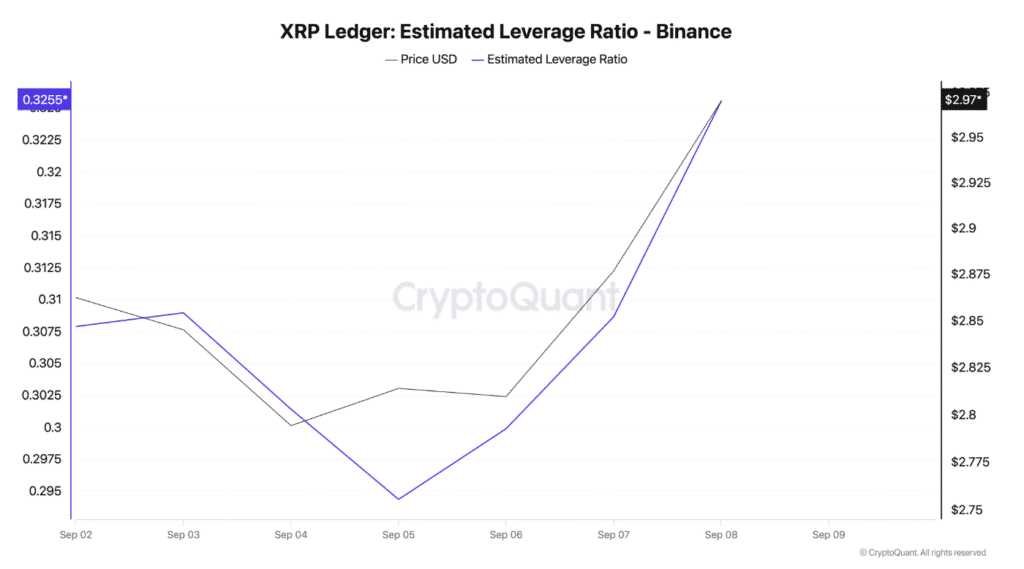
An asset’s ELR measures the average leverage its traders use to complete trades on a cryptocurrency exchange. It is calculated by dividing the asset’s open interest by the exchange’s reserve for that currency.
When it declines, it reflects a reduction in risk appetite among traders. It shows that investors are becoming more cautious about the token’s near-term outlook and steering clear of high-leverage positions that could magnify losses.
Conversely, a rising ELR indicates that traders are taking on larger leveraged positions, reflecting stronger conviction and a willingness to take on higher risk.
Related: Explore the best XRPL/Ripple (XRP) Wallet App for iOS and Android
Zypto Launches Obsidian Prepaid Global Mastercard®
Zypto has rolled out a brand-new single-load crypto card: the Obsidian Prepaid Global Mastercard®. Built for convenience and flexibility, the card comes with a powerful $10,000 transaction limit, making it ideal for travel, shopping, or high-value online purchases.
Fundable with 100+ cryptocurrencies and compatible with Apple Pay and Google Pay, Obsidian is accepted anywhere Mastercard® is supported.
Available now, exclusively at Zypto.com and in Zypto App.
Closing remark
Through all the multiple initiatives Tether has been getting involved in, it is positioning itself as a diversified technology firm rather than solely a stablecoin user.
Fireblocks’ payment network launch reflects industry efforts to develop a standardized infrastructure as stablecoin adoption expands to traditional financial institutions.
Ethereum ETF withdrawals show that Ethereum’s long-term narrative remains intact among its strongest advocates despite the short-term turbulence.
While the Token2049 event may spark short-term price moves, the lasting impact of Pi Network depends on its ability to deliver real progress beyond the conference.
For XRP, the whale purchase and other trend signals growing market confidence and the potential for continued upward momentum as leveraged traders back the token’s short-term rally.
And finally… Obsidian gives crypto holders a new way to spend, with a $10K limit.
FAQs
Which industries does Tether plan to invest in?
Tether is investing in gold-mining firms and AI.
What did Fireblocks launch?
Fireblocks, a digital asset infrastructure company, has introduced a payment network connecting over 40 stablecoin providers across 100 countries.
How did Ethereum ETF withdrawals total nearly $1 billion?
Ethereum ETFs collectively lost more than $952 million over a 5-day run of capital exits that started on August 29.
What move did DeFi Development Corp make?
DeFi Development Corp has boosted its Solana (SOL) holdings beyond 2 million tokens worth over $400 million.
What’s the latest with Pi Coin?
Dr. Chengdiao Fan, co-founder of Pi Network, has been confirmed as a speaker at the upcoming Token2049 crypto conference.