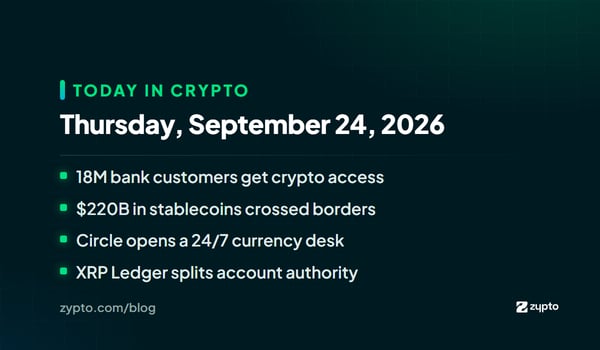
Six stories stood out today:
- Coinbase and Cardless launched a credit card that uses USDC holdings as collateral
- Over 200 crypto organizations pushed the Senate to schedule a CLARITY Act vote before the August recess
- The UK’s FCA proposed letting retail investment funds hold up to 10% in crypto ETNs
- Active tokenized real-world assets surged 600% in 18 months despite the broader market pullback
- A $30 million private key compromise drained Humanity Protocol, sending the token down 85%
- MetaMask released an Agent Wallet that lets AI bots execute DeFi trades within user-defined limits
The common thread: the infrastructure for everyday crypto ownership and participation is expanding rapidly, while the cost of weak key security remains as high as ever.
Coinbase and Cardless launch a credit card that runs on USDC collateral
Coinbase and Cardless have introduced a stablecoin-secured credit card. Applicants set aside a portion of their USDC holdings on Coinbase as collateral, continue earning yield on those assets, and pay a $49.99 annual fee for card access. The product targets people who hold crypto but cannot qualify for a conventional unsecured credit card, with Cardless co-founder Michael Spelfogel describing it as built for those “beginning their journeys.”
This is the practical version of a crypto-backed financial life becoming more normal. Yield on idle USDC while the card is in your wallet. A path to credit access that doesn’t require converting to cash first.
For people using Zypto App to hold stablecoins, the direction is clear: the range of things you can do without ever leaving the crypto ecosystem is widening. The Cash to USDC and USDC to Cash global service in Zypto App already covers that bridge at any participating MoneyGram location.
200+ crypto organizations are pressing the Senate to vote on the CLARITY Act
Four major industry groups, Stand With Crypto, the Digital Chamber, the Blockchain Association, and the Crypto Council for Innovation, jointly represent more than 200 companies in a letter urging Senate leadership to schedule a floor vote on the CLARITY Act before the August recess. The bill would divide regulatory oversight cleanly: the SEC handles crypto securities, the CFTC handles commodities. It has already cleared both the Banking and Agriculture Committees but stalled on the floor over disagreements on stablecoin yield restrictions and developer protections. Galaxy Digital puts the odds of passage this year at 60%.
The question is not whether the US needs a framework. It is whether Congress moves before or after the rest of the world builds one without it.
A clear regulatory structure matters most to everyday users, not institutions. Knowing which rules apply to which asset, and which agency enforces them, is what lets people participate without legal ambiguity overhead. That kind of clarity is what brings digital assets further into everyday financial life.
The UK’s FCA wants to let retail funds hold up to 10% in crypto ETNs
The Financial Conduct Authority opened a five-week consultation today proposing that UCITS funds and some retail-facing non-UCITS funds be permitted to allocate up to 10% of assets to crypto exchange-traded notes, provided the allocation aligns with the fund’s stated investment objectives. The cap reflects what the FCA calls a “conservative” position given the speculative characteristics of underlying assets. Unregulated and qualified investor schemes could go higher, but cannot market those products to retail consumers. The consultation closes July 13.
This follows the FCA’s August 2025 decision to lift its ban on retail trading of crypto ETNs, which itself brought the UK in line with European and North American norms. The 10% proposal extends that opening to fund vehicles that millions of ordinary investors use through pension wrappers and ISAs.
Incremental access through regulated fund structures is how most retail investors in the UK will first get crypto exposure. Regulatory permission is not the exciting part. The long-run direction it sets is.
Active tokenized real-world assets jumped 600% in 18 months
A Binance Research report published this week shows active tokenized real-world assets surged 589% between early 2025 and June 2026. Bonds and money market funds grew 83%, adding $6.5 billion. Tokenized stocks moved faster at 422%, with Ondo Global Markets alone exceeding $1 billion locked within eight months. Tokenized precious metals added $1.5 billion, led by gold. xStocks has now cleared more than $25 billion in cumulative trading volume. Major institutions including JPMorgan and Goldman Sachs are backing the underlying infrastructure.
Tokenized RWAs growing through a crypto pullback is the signal. The growth is not retail speculation driving a number up; it is institutional capital building settlement and ownership infrastructure that happens to run on blockchains.
Stocks, bonds, gold, and real estate accessible from the same self-custodial setup you use for Bitcoin is exactly the expanded participation that defines this space. Zypto App already covers 24,000+ assets across 20+ blockchains. As tokenized real-world assets land on those chains, real-world asset access through self-custodial wallets becomes the natural next layer.
A $30 million private key compromise just reminded everyone what is at stake
Humanity Protocol, a zkEVM blockchain project, suffered a security breach when private keys belonging to a member of the Humanity Foundation were compromised. The attacker moved at least $30 million in H tokens across decentralized exchanges. The token fell 85% within 12 hours, dropping from roughly $0.70 to $0.08. CEO Terence Kwok confirmed the incident in a public statement. CertiK data shows private key compromises were already the second-most costly attack vector in May 2026, accounting for $13.7 million in losses that month alone across multiple projects including Drift Protocol and Polymarket.
Private key security is not a solved problem. Repeating breaches across high-profile projects in 2026 suggests it is not even a declining one.
The Vault Key Card splits signing authority between your device and a physical card. A compromised phone cannot move funds without it. That design exists precisely because private key exposure is the most common and most costly category of crypto loss, and software alone cannot fully protect against it. Download Zypto App.
MetaMask launched a self-custodial wallet that AI agents can operate
MetaMask released Agent Wallet, an early-access product that lets AI agents execute transactions on decentralized finance platforms within boundaries set by the user. Users connect the wallet to supported AI frameworks including OpenAI Codex and Claude Code, define an allowlist of approved protocols, and the agent operates within those limits. Transactions flagged as potentially malicious require manual approval before proceeding. The system also offers up to $10,000 in loss protection on transactions its own security layer clears. Supported activity spans token swaps, perpetual futures, prediction markets, and liquidity provision across Ethereum-compatible networks and Hyperliquid.
Giving AI agents self-custodial access to DeFi is a real product now, not a whitepaper. The key constraint MetaMask is betting on: user-defined spending rules and protocol allowlists, not blanket agent authority.
The self-custody model is still doing the same job it always has. User-defined controls, transparent transaction history, no counterparty holding the keys. The mechanism that lets you trust an AI agent with your funds is the same one that lets you trust any setup: the private keys stay yours, and the boundaries stay your decision.