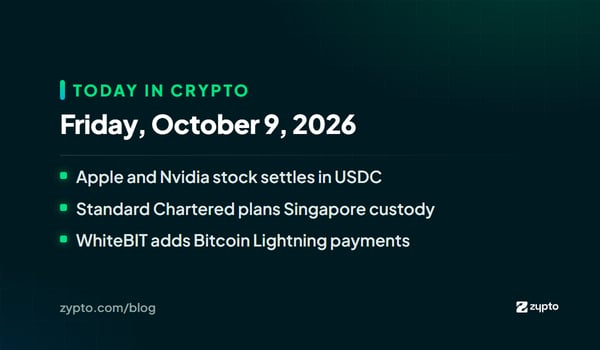
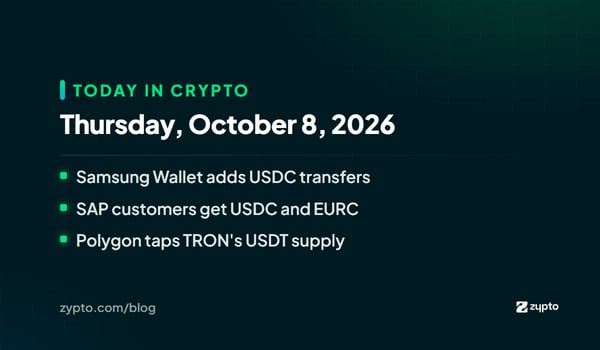
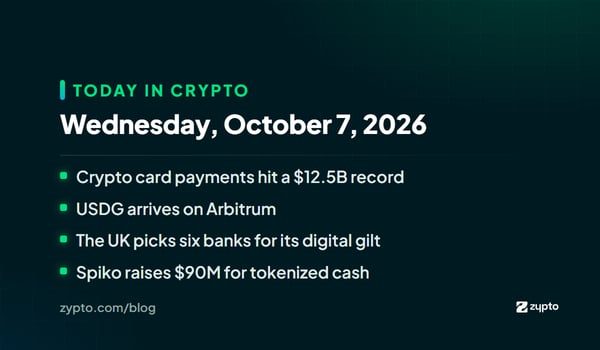
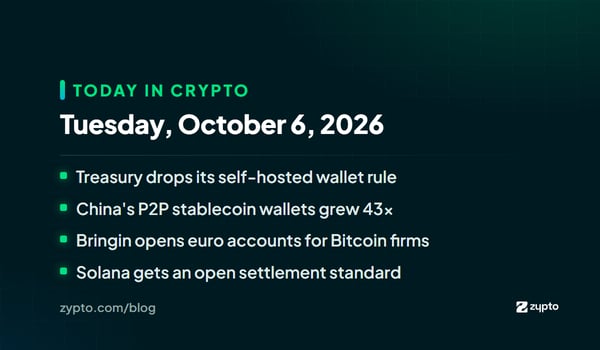
Six stories define the week so far:
- Mastercard will now settle transactions in stablecoins across six major blockchains, around the clock
- Stripe, Visa, and Mastercard are building a shared stablecoin platform, with Coinbase reportedly joining
- Congress holds its crypto tax hearing today, debating a bill that would remove reporting requirements on small transactions
- Bybit and Kraken are both offering tokenized SpaceX IPO access to retail crypto users
- Securitize cleared its final SEC hurdle on the path to an NYSE listing as tokenized RWAs hit $32 billion
- A Chinese court ruled that Bitcoin is legally property, even as the country bans trading
The common thread: the payment infrastructure for everyday crypto use is being built, standardized, and tested from multiple directions at once.
Mastercard will settle card transactions in stablecoins across six blockchains
Mastercard is enabling on-chain settlement alongside its existing fiat processes, supporting USDC, PYUSD, RLUSD, USDG, USDP, and SoFiUSD across Ethereum, Solana, Polygon, Base, Arbitrum, and XRPL. The move shifts settlement toward a 24/7 model: intraday, weekends, holidays, no banking-hours dependency.
Early participants include Cross River, Lead Bank, CBW Bank, ARQ, and Nuvei, initially across the U.S. and Latin America. “The next phase of stablecoin adoption is about real-world utility, especially in settlement, where timing and liquidity matter most,” said Raj Dhamodharan, Mastercard’s executive vice president of blockchain and digital assets.
Settlement infrastructure is not visible to cardholders, but it is what makes everything else work. When the rails settle in stablecoins on-chain, the cost and speed of moving money changes. Six blockchains and six stablecoins in one announcement is a meaningful commitment to breadth rather than a single-chain bet.
Stablecoin settlement moving on-chain means payments that work on weekends, on holidays, and through the night without clearing windows. The Zypto Premium VISA Card loads from Ethereum, Solana, Polygon, Base, and Arbitrum. Better settlement infrastructure on those chains means more reliable everyday spending for anyone already using crypto that way.
Stripe, Visa, and Mastercard are building shared stablecoin infrastructure
The three largest players in global payments are reportedly close to launching a joint stablecoin platform, with Coinbase said to be exploring participation. Each arrived here separately: Stripe acquired stablecoin infrastructure firm Bridge for $1.1 billion in 2024, Mastercard recently acquired BVNK, and Visa has processed $3.5 billion in stablecoin-settled card transactions.
A platform with all three names on it is a different kind of signal from individual integrations. It would shift stablecoin settlement from a feature each network runs independently to shared infrastructure reaching billions of cardholders.
The direction has been clear for some time. What is changing is the pace. Three competing payment networks building together rather than separately suggests the bet on stablecoin rails has become industry consensus rather than a differentiator.
Three of the largest payment networks in the world are now building stablecoin infrastructure together. For people who hold and use stablecoins, that kind of structural alignment makes digital assets more usable over time.
Congress holds its crypto tax hearing today, and the small-transaction exemption is the one to watch
The House Ways and Means Committee holds its crypto tax hearing today with a de minimis exemption on the table. If it passes, routine small transactions would carry no reporting obligation. The paperwork disappears, even though any underlying gain or loss still applies. Today’s hearing is the furthest this type of legislation has advanced in years.
Everyday crypto use and tax compliance have an uncomfortable relationship in the US right now. A de minimis exemption is a practical fix: routine small transactions would no longer require reporting. It is a meaningful step toward crypto that works in daily life.
Bybit and Kraken are both offering tokenized SpaceX IPO access to retail crypto users
Two of the largest crypto exchanges launched tokenized access to the SpaceX IPO within days of each other, both powered by xStocks. SpaceX is targeting a $1.75 trillion valuation and begins trading June 12. Kraken’s version issues SPCXx tokens, each backed 1:1 by underlying shares. Bybit’s IPO Express allows purchases at official IPO pricing. That kind of access has historically been limited to institutional investors and large brokerages.
Both platforms offer 24/7 trading on the tokens and DeFi composability. Kraken’s service is available across the European Economic Area and 110-plus international markets. The US, Canada, Australia, and the UK are excluded due to local regulatory requirements. Registration windows close June 11.
This is a structural shift in what a crypto platform can offer. The exchange ecosystem is extending from digital assets into tokenized real-world equity, settling in the same wallets and rails users already have. The line between a crypto app and a multi-asset financial platform is moving quickly.
The tokenized SpaceX IPO is one piece of a larger shift: the range of things people can participate in through their existing crypto setup is expanding. Zypto App was built around that kind of participation, combining self-custody with real-world spending, bill payments, and everyday financial tools in one connected place.
Real World Asset tokenization hits $32 billion as Securitize clears its final SEC hurdle for an NYSE listing
Securitize, the tokenization platform that manages $4 billion in assets for partners including BlackRock, Apollo, and BNY, received SEC approval for its merger with Cantor Equity Partners II. Shareholders vote June 29. If approved, the combined company lists on the New York Stock Exchange as SECZ.
The backdrop: tokenized real-world assets hit a record $32 billion in on-chain value in May, a 220% increase over 12 months. US Treasuries make up nearly half of that figure. Securitize reported $19.5 million in first-quarter 2026 revenue, up 39% year on year.
A tokenization platform going public on the NYSE signals that the infrastructure layer of real-world asset tokenization is becoming a mainstream financial industry. The largest asset managers in the world are already customers. The public market is now pricing that in.
Tokenized real-world assets are being built on Ethereum, Polygon, Arbitrum, Base, and Stellar. These are the same chains individuals hold assets on every day. The institutional infrastructure layer and the everyday participation layer are running on the same rails, and that opens up new possibilities for anyone already in this space.
A Chinese court ruled that Bitcoin is legally property, despite a national ban on trading it
A court in Qingdao, China sentenced a man to nearly 11 years in prison after he memorized 11 of 12 words in a victim’s wallet recovery phrase and used them to reconstruct full access and transfer 107 Bitcoin. Prosecutors argued successfully that Bitcoin meets the legal definition of property subject to theft under Chinese criminal law. The court agreed.
China maintains a ban on cryptocurrency trading and mining, but that restriction does not appear to have changed the legal status of digital assets when it comes to criminal property protections. The ruling creates a clear, if narrow, precedent: Chinese courts will treat unauthorized transfer of crypto from another person’s wallet as theft, prosecutable and punishable.
The security lesson is as important as the legal one. This case was not a technical exploit. It was a human one: the attacker was present during wallet setup and collected most of a seed phrase by memory. Self-custody security is not just about keeping private keys offline. It is about ensuring no one ever sees your seed phrase, under any circumstances.
The attack was not technical. Eleven words were memorized in the room where a wallet was set up. Self-custody security comes down to who has ever seen the recovery phrase. The Vault Key Card adds a physical signing layer so device access alone cannot authorize a transaction, but protecting the seed phrase is still where security starts and ends.