Tether Gold (XAUt) turns physical gold into a token you can hold and move on a blockchain. But how does that actually work under the hood, from the gold in the vault to the token in your wallet? This guide walks through the full mechanics, in plain language for newcomers and with the technical detail veterans want. If XAUt is completely new to you, start with our overview, What Is Tether Gold (XAUt)?.
The Short Version
Real gold goes into a secure vault. For each troy ounce deposited, one XAUt token is minted. You can then hold, send or swap that token like any other crypto asset, and its value tracks the gold price. When someone wants the physical metal back, they burn the tokens and the gold is released. Supply only ever grows or shrinks in step with the gold actually held.
The XAUt Lifecycle at a Glance
- Gold is allocated and vaulted
- XAUt is minted 1:1 against it
- You hold, send and swap it on-chain
- Tokens are burned to redeem physical gold, or simply sold on the market
Step 1: How XAUt Is Created (Minting)
New XAUt is minted only when an equivalent amount of physical gold is deposited into the reserve. Each token represents one fine troy ounce (about 31.1 grams) as an undivided ownership interest in specific London Good Delivery bars held in Swiss vaults.
Because issuance is tied to real deposits, the circulating supply expands and contracts with the gold actually held, rather than following a fixed schedule. There is no mining and no pre-set emission: a token exists because an ounce of gold does.
Step 2: How You Hold and Move XAUt
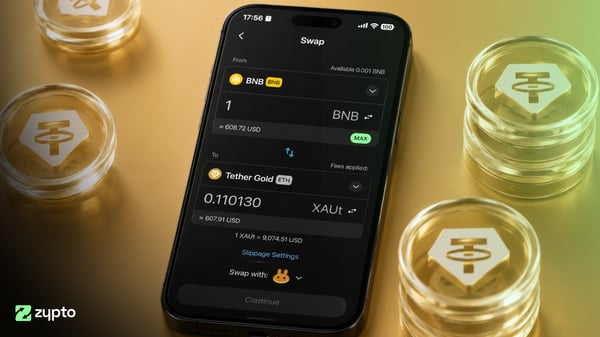
Once minted, XAUt behaves like any other token on its network, an ERC-20 token on Ethereum and a BEP-20 token on BNB Chain. You can hold it in a self-custodial wallet, send it to any compatible address, and swap it for other assets.
Tether’s system maps the tokens at your blockchain address to specific bars in the reserve, so your on-chain balance always corresponds to real, identifiable gold rather than a pooled promise.
Step 3: How the Price Works
XAUt is designed to track the spot price of gold, not a fixed dollar value. One XAUt aims to be worth roughly one ounce of gold at the current market rate, so its price rises and falls with the gold market.
This is the key difference from dollar stablecoins such as USDT, which target one dollar. You can follow the live Tether Gold price and watch it move with gold.
Step 4: How Redemption Works
Redemption is what ties the token firmly to the metal. Holders who want the physical gold submit a request through the primary market operated by TG Commodities, complete identity verification, and burn their tokens in exchange for bars.
Because gold is delivered as whole London Good Delivery bars, physical redemption generally requires around 430 XAUt (one full bar), collected in Switzerland. Most everyday users never redeem, though. They simply buy, hold and sell XAUt on the open market, which is far simpler and works in any amount, right down to a fraction of an ounce.
Same Gold, Multiple Blockchains
XAUt lives on more than one network, including Ethereum, BNB Chain and TRON. Tether has also extended it with an omnichain version called XAUt0, built on LayerZero’s Omnichain Fungible Token (OFT) standard.
XAUt0 lets holders move gold-backed tokens between blockchains without changing the underlying physical backing, and it can be converted back to standard XAUt to request physical delivery. The gold reserve is a single pool; the tokens are simply issued and moved across different chains.
In Zypto App, XAUt is supported on Ethereum and BNB Chain.
How to Check It’s Working Honestly
The mechanics only matter if the gold is really there. Two things let anyone verify it:
- Bar lookup: Tether provides an on-chain tool to check the serial number, weight and purity of the gold bar associated with a holding.
- Independent attestations: Tether publishes quarterly reserves reports for Tether Gold, reviewed by auditor BDO Italia, confirming at least one fine troy ounce backs every token in circulation. You can read them on Tether Gold’s reserves page.
We dig into this further in our guides Is Tether Gold Backed by Real Gold? and Who Stores the Gold Behind Tether Gold?.
What About Fees?
You do not pay an ongoing storage or custody fee to hold XAUt, unlike vaulting physical gold yourself. Standard blockchain network fees apply when you move it, and redeeming physical bars has its own costs and conditions.
Put Tether Gold to Work in Zypto App
Understanding the mechanics is one thing; using them is another. Because XAUt is just a token once minted, moving and managing it is simple in Zypto App. You can buy, manage, send, swap and protect Tether Gold across Ethereum and BNB Chain from one self-custodial wallet, and keep it in cold storage with the Vault Key Card.
New to gold-backed tokens? See how to buy Tether Gold, or start with our overview, What Is Tether Gold (XAUt)?.
Sources: Tether Gold official, Tether Gold reserves reports & attestations, Tether transparency.
Frequently Asked Questions
How is XAUt created?
XAUt is minted only when an equivalent amount of physical gold is deposited into the reserve, one token per fine troy ounce. Its supply grows and shrinks with the gold actually held.
How do I redeem XAUt for physical gold?
You submit a redemption request through TG Commodities, complete verification, and burn your tokens. Because gold ships as full bars, physical redemption generally needs around 430 XAUt and is collected in Switzerland. Most users instead just sell XAUt on the market.
Does XAUt work the same on Ethereum and BNB Chain?
Yes. It is the same gold-backed asset; only the network differs (an ERC-20 token on Ethereum, a BEP-20 token on BNB Chain). Zypto App supports XAUt on both.
Why does the XAUt price move?
Because XAUt tracks the spot price of gold rather than a fixed dollar value. When the gold market moves, XAUt moves with it. It is gold exposure, not a dollar stablecoin.
Prices, fees, features and availability mentioned in this article were correct at the time of publishing and may have changed since.