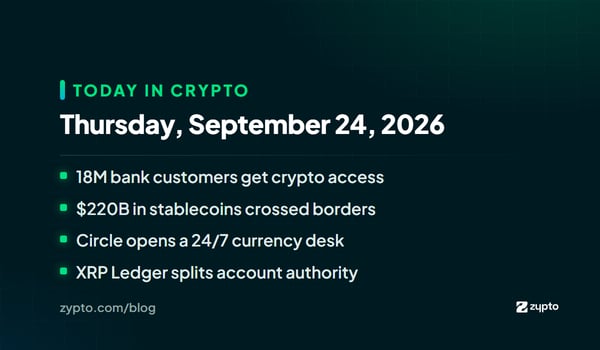
Cross-border money movement is the story under almost everything today. New rails for the dollar and the peso, payouts reaching 180 countries, and a country reopening its doors to crypto after a hard six months.
- A peso-backed stablecoin lands on the XRP Ledger to settle US-Mexico payments
- 180 countries: MassPay and Coinbase wire stablecoin payouts to businesses worldwide
- Hungary scraps the jail terms that pushed crypto trading underground for half a year
- Coinbase backs a payment card with stablecoins for people locked out of traditional credit
The thread is access. Three of these stories are about moving value across borders without the old overhead, and the fourth is about a country deciding its citizens should be allowed to participate at all.
Ripple and Bitso put a peso stablecoin on the XRP Ledger
 Source: Ripple
Ripple and Bitso expanded their long-running partnership to issue Bitso’s regulated Mexican-peso stablecoin, MXNB, on the XRP Ledger. MXNB joins RLUSD, Ripple’s dollar stablecoin, inside the XRPL Permissioned DEX, a layer built so verified counterparties can access onchain liquidity under a compliance framework. The pairing targets the US-Mexico corridor, where roughly $60 billion moves each year through remittances and business payments. “By bringing together RLUSD and MXNB on the XRPL Permissioned DEX, we’re helping create regulated, onchain liquidity infrastructure purpose-built for enterprise cross-border payments,” said Silvio Pegado, Ripple’s managing director for Latin America.
Zypto take: A peso stablecoin matters more than another dollar one in some ways. Most stablecoin infrastructure is dollar-denominated, which is useful but leaves the last leg of a payment, the conversion into what the recipient actually spends, sitting outside the chain. Putting the peso onchain alongside the dollar means both ends of a US-Mexico transfer can settle in stablecoins, with the currency swap happening as an onchain trade rather than through a chain of correspondent banks. That is the part of remittance that has always been slow and expensive, and it is finally being addressed at the protocol level. The XRP Ledger is one of the 20+ blockchains Zypto App supports, and the broader point holds regardless of which chain wins: value that can move and convert onchain is value people can actually use across a border. Holding stablecoins directly, on your own keys, is where that capability reaches an individual rather than just an institution.
Source: Ripple
MassPay and Coinbase wire stablecoin payouts to 180 countries
 Source: PR Newswire
MassPay and Coinbase announced a partnership to power cross-border business payouts with stablecoins, combining MassPay’s payout network across 180 countries with Coinbase’s custody and conversion infrastructure. Companies can fund disbursements in US dollars, convert to USDC through Coinbase, and pay recipients in USDC, other digital assets, or local fiat, all from one platform. Coinbase handles the wallet infrastructure and compliance; MassPay handles last-mile delivery. “Stablecoins have moved from experiment to infrastructure,” said MassPay CEO Ran Grushkowsky, describing a turnkey path to fund in dollars, move value onchain, and pay anyone in the world.
Zypto take: This is the quietly important version of stablecoin adoption: not a consumer launch, but the payout plumbing that businesses use to pay contractors, suppliers, and workers abroad. The old way involves prefunding accounts in dozens of currencies, idle capital sitting in foreign banks, and settlement measured in days. Routing the value through a dollar stablecoin and converting at the edge collapses most of that overhead. What stands out is how unremarkable it has become to describe USDC as infrastructure rather than a speculative asset. The same rails that let a company pay a freelancer in another country are the rails an individual can use to cash out value where they live, which is exactly what the USDC to Cash feature does, letting people cash in or cash out of USDC at participating MoneyGram locations.
Source: PR Newswire
Hungary scraps the jail terms that drove crypto underground
 Source: CryptoBriefing
Hungary will decriminalize crypto trading, reversing a framework that took full effect on December 27, 2025 and carried prison terms of up to eight years for service providers and up to five years for individuals making unauthorized transactions. Under the prior rules, every crypto transaction needed a compliance certificate from a licensed validator, and trading without one was a criminal act. Government spokeswoman Anita Kobol confirmed the reversal followed EU infringement proceedings, which argued the rules conflicted with the bloc’s MiCA framework. Platforms including Revolut had suspended Hungarian services rather than navigate the regime, and trading volumes fell sharply during the six-month window.
Zypto take: It is worth sitting with what actually happened here. For half a year, owning and moving a legal asset class in an EU member state could put an ordinary person at risk of prison. The rules did not stop crypto; they pushed activity offshore and out of view, while the people who stayed compliant simply lost access. That is the recurring lesson when a government tries to gate ownership: the technology routes around the restriction, and the main casualties are regular users who wanted to follow the law. This is also the clearest argument for self custody there is. When the rules can change overnight and intermediaries can be forced to pull out, holding your own keys means your access does not depend on any one company’s willingness or ability to operate in your country. Zypto App is built around exactly that, keeping your keys on your own device so ownership stays in the hands of the person rather than the platform.
Source: CryptoBriefing
Coinbase backs a payment card with stablecoins for the credit-locked-out
 Source: PYMNTS
Coinbase is launching a payment card, built with fintech Cardless, aimed at people who cannot qualify for a traditional unsecured card but hold digital assets. Applicants use their stablecoin holdings as collateral to secure the credit line, and the product extends a partnership that began with a Coinbase-branded card last year. “People apply from all different parts of the credit spectrum,” said Cardless co-founder Michael Spelfogel. “There are some people that want to use this method because they believe in cryptocurrency, but they’re just beginning their journeys and accumulating wealth.”
Zypto take: The interesting move here is using crypto holdings as collateral rather than asking someone to sell. Traditional credit access depends heavily on a history most people build slowly and some never get the chance to build at all. Letting digital assets back a credit line turns a holding into something useful without forcing the holder to give it up, which is a genuinely practical form of participation. The wider pattern is consistent across today’s stories: digital assets keep finding their way into the everyday financial tools people already understand. Zypto already connects crypto to real-world spending through the Zypto Premium VISA Cards, which a user loads with crypto in advance and then uses for real-world spending wherever Visa is accepted. You can see the full range on the crypto cards page. Download Zypto App.
Source: PYMNTS
Key Takeaways
- Cross-border payments are where stablecoins are proving themselves fastest. A peso onchain and dollar payouts to 180 countries are two sides of the same shift: the slow, costly middle of an international payment is being removed, one currency and one corridor at a time.
- Stablecoins are now described as infrastructure by the people building on them, not as a speculative bet. When a payout network and a regulated exchange treat USDC as plumbing, the conversation has moved from whether to how.
- Hungary is a reminder that access can be taken away as well as granted. Ownership you hold yourself, on your own keys, is the version that does not depend on a single company’s permission to operate where you live.
- Digital assets keep merging into familiar tools. A card backed by stablecoins, a payout funded in dollars and delivered onchain: the wins are practical and unglamorous, which is exactly why they last.
- The corridors being wired this week for businesses and institutions are the same ones individuals will travel next. The interesting question for the rest of 2026 is how quickly the peso-on-XRPL kind of infrastructure reaches the person actually sending money home.